
Table of Contents
You’ve watched the argument play out in a comment section a hundred times. Someone insists an actor is 5’7″. Someone else produces a premiere photo as proof he’s six foot. Nobody changes their mind, and the whole thing dies down until the next red carpet.
Celebrity height is one of the few genuinely checkable facts about fame, and yet it’s also one of the most fought over. The reason is simple: the people with the biggest incentive to inflate the number are usually the ones who get to publish it. So instead of trusting a fan wiki or a studio bio, here’s a method you can run yourself in about ten minutes. It won’t hand you a laser-accurate figure, but it will get you within an inch most of the time, and it will tell you when a listed height is outright fiction.
Before you measure anything, check who published the number
Every height claim has a source, and not all sources are equal. A draft combine measurement or a passport detail quoted in a court filing is worth ten times a press kit. For actors and musicians, the official figure usually traces back to an agency profile filtered through the industry’s long-running fixation on celebrity height. That doesn’t make it a lie. It does make it marketing, so treat it as a hypothesis rather than a fact.
- High confidence: sports combine data, military or medical records, documents entered into evidence, measurements taken for competitive sport weighting.
- Medium confidence: costume-fitting figures leaked by crew, consistent recollections from long-term co-stars, verified stage measurements.
- Low confidence: agency profiles, database listings, anything phrased as “reports suggest” or “believed to be”.
Step 1: Find a baseline you actually trust
To measure anyone from a photograph you need something of known size in the frame. You have two practical options, and the best estimates use both.

Pair them with a verified co-star
Pick someone whose height is documented by measurement rather than publicity. Retired athletes are ideal: a 6’9″ basketball player making a cameo next to an actor is a walking ruler. Nineties supermodels work almost as well, because their measurements were logged constantly from the start of their careers and rarely inflated — Cindy Crawford has been listed at 5’9″ since she was a teenager, which makes her a stable reference point in photos going back three decades.
Use fixed objects as your ruler
Look for standardised fixtures: podium heights, car door frames, architectural handrails, the uniform barriers used at press events. A handrail is typically 34 to 38 inches off the ground. If an actor’s shoulder sits level with one, you have a soft measurement before you’ve even identified their co-star.
Step 2: Subtract the footwear, because this is where most guesses collapse
Footwear is the single biggest source of error in amateur height estimating. People add two inches in their heads and call it a discrepancy.
- Men’s dress shoes with a stacked heel: 1 to 1.5 inches.
- Height-increasing shoes or elevator insoles: 2 to 3 inches, occasionally more.
- Cowboy boots: 1.5 to 2 inches.
- Chunky platform sneakers: up to 2 inches.
- Women’s stiletto heels: 3 to 4 inches.
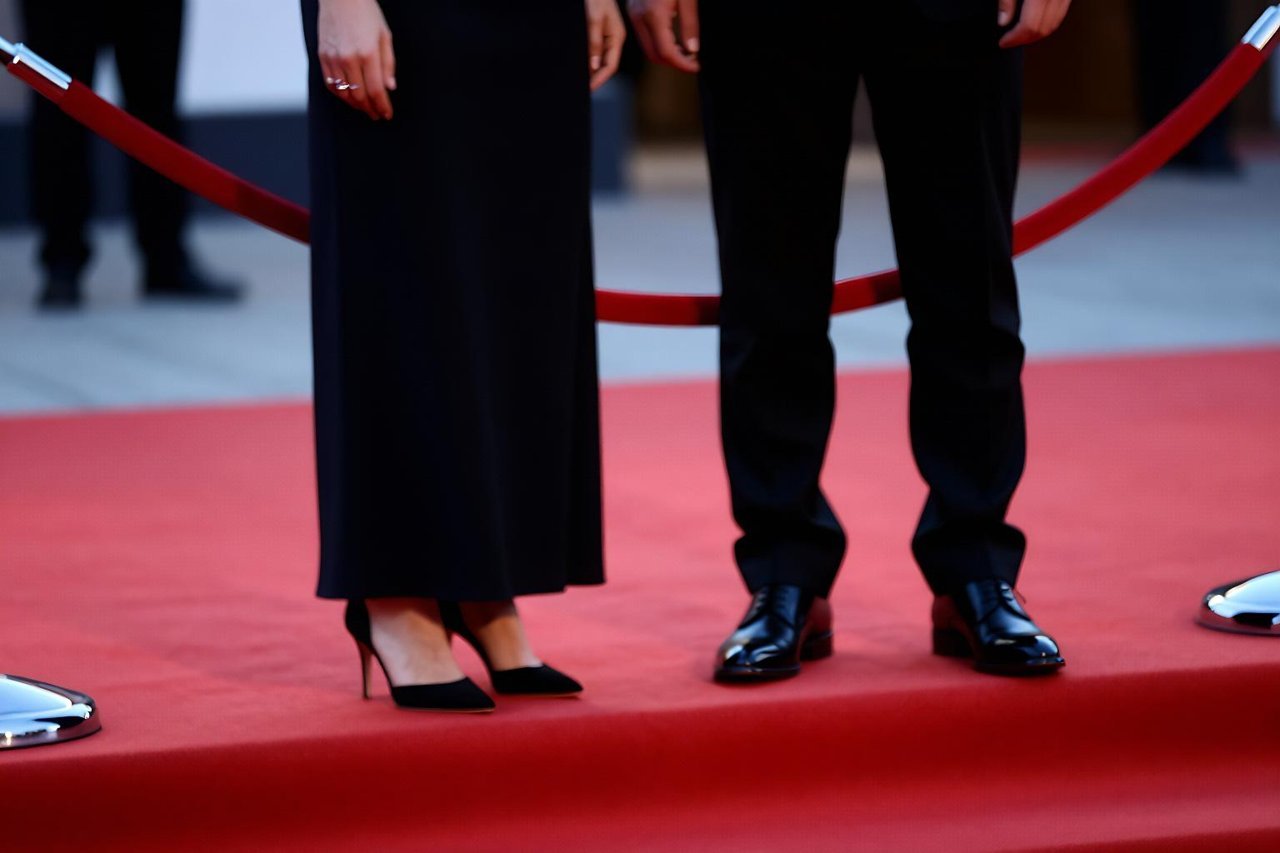
- Block heels on a red carpet: routinely 4 inches.
That gap explains why two people can look identical in height in one photo and four inches apart in the next. It’s also why red-carpet styling is never neutral: stylists build looks around a client’s proportions, and a heel choice can quietly rewrite the story a photograph tells.
Step 3: Correct for the camera and the ground
Three variables bend a photo before anyone has even stood still.
Lens and camera height
A wide lens shooting upward from chest height stretches whoever is closest to it. A long lens fired from 30 feet away flattens everything and is far more honest. Press photographers at arrivals are often working close and low, which is why premiere photos are the least reliable and red-carpet-wide shots from the back of the pen are the most reliable.
Standing surface
Check the feet. Premieres happen on steps, in gardens on slopes, on sand, on kerbs. A two-inch height difference is meaningless if one person is half a step higher than the other, and group shots at events are full of exactly that.
Posture and the hour of the day
Spines compress. Most people measure 1 to 2 centimetres shorter at 11pm than they did at 9am. An actor photographed after a twelve-hour press day is genuinely shorter than the same actor photographed on a morning show, and neither reading is wrong.
Step 4: Track the number across a decade, not a night
One photo proves nothing. A pattern proves a lot. Pull images of the same person from 2008, 2014 and 2024, ideally with the same co-star each time, and watch the relative gap between them.
There’s also a directional rule worth remembering: most people lose roughly 1 centimetre of height per decade after 40, mostly through disc compression. So if someone’s listed height has crept upward by an inch and a half while they’ve aged twenty years, something other than biology is at work. Real measurements drift downward. Publicity numbers drift up.
A worked example
Say an actor is listed at 6’4″. You find a premiere photo where he’s standing beside a co-star whose height is well documented at 5’10”, and she’s in 3-inch heels. On the night, she’s 6’1″. He’s in standard dress shoes adding about an inch, so his on-the-night height is his barefoot height plus one. Their heads are level, flat carpet, no steps.
Run it: her 6’1″, minus her nonexistent heel contribution for the comparison, puts the pair level. Subtract his one inch of shoe and you get 6’0″ barefoot. That’s four inches off the listing. Allow half an inch for posture, half an inch for a slight slope, and you’re still looking at a realistic window of 6’0″ to 6’1″, generously 6’2″.
Now repeat the exercise at three separate events across eight years. If the arithmetic keeps landing in the same window, you’ve got a defensible estimate. If it lands all over the place, your baseline co-star is probably the unreliable part of the equation.
Why the maths is worth doing at all
Height isn’t trivia in the entertainment business. Casting breakdowns have historically specified minimum heights for romantic leads, and a 5’9″ actor who books those roles will often be publicly listed at 6’0″ because the gap between what the industry casts and what it admits to casting is uncomfortable. Sports have the flip side: jockeys, boxers and gymnasts have all had reasons to round in either direction.
This is also why height claims so rarely get corrected. The celebrity news cycle has no incentive to run a correction on a number that flatters a subject, and the Hollywood publicity machine has always treated height as packaging rather than data. Nobody is lying to you directly. They’re just not rushing to fix it.
Build your own estimate: the checklist
Run through this in order and you’ll usually end up within an inch of the truth:
- Identify the source of the official number and downgrade it if it came from a publicist.
- Find at least one co-star or athlete with an independently measured height.
- Check every pair of shoes in the frame and subtract accordingly.
- Confirm both people are on the same surface and the same step.
- Prefer long-lens shots from a distance over close wide-angle shots.
- Cross-reference at least three events spread over several years.
- Apply the ageing rule: real heights fall after 40, listed heights don’t.
Keep the margin of error in mind at the end. The honest answer to most celebrity height questions isn’t a single number — it’s a range of about an inch and a half, and anyone who claims precision beyond that is selling you something. What this method gives you isn’t certainty. It’s a way to tell a small exaggeration apart from a four-inch edit, which is the part that actually matters.


