
Table of Contents
You don’t need a cabin in the woods, a burner phone or a month off work. A digital detox is far less dramatic than the marketing around it suggests, and a good deal more useful once you understand what you’re actually trying to change.
This is a primer for people who’ve heard the phrase, half-considered trying it, and aren’t sure where the edges are. No guilt, no smugness. Just the fundamentals, in the order they’ll help you most.
What a digital detox actually is
Strip away the branding and a digital detox is a planned, temporary reduction in how much you use the devices and platforms that eat your attention. Temporary matters. Planned matters. The point isn’t to prove you can survive without your phone; it’s to interrupt habits that have gone invisible so you can see them clearly, then decide what’s worth keeping.
People usually picture one version of this, the 30-day silent retreat, but the practical range is much wider. A weekend without social apps counts. So does deleting email from your phone for a week, or moving Netflix off your home screen so it stops being the first thing your thumb finds.

It’s about attention, not moral purity
There’s a tendency to turn unplugging into a personality test, where the people who do it are virtuous and everyone else is a dopamine addict. That framing is unhelpful, and it’s a big reason most attempts quietly collapse. You aren’t purifying yourself. You’re running an experiment on your own attention and collecting data.
Why the fundamentals beat the length of your break
Beginners fixate on duration. Twenty-four hours or thirty days? Honestly, duration is the least interesting variable. What changes your experience is friction, cue removal and replacement.
Attention is cue-driven. You don’t check Instagram because you decided to; you check it because your thumb found the icon while the kettle was boiling. Take the cue away and the behaviour has nothing to attach to. That’s why moving an app off your home screen often works better than a willpower pledge you make on a Sunday night.
Replacement matters just as much. If you remove the thing you do in every spare 30 seconds, those 30 seconds don’t vanish. They get filled with something, and if you haven’t chosen what, the phone quietly wins by default.
The four levers behind every credible detox plan
- Friction. Log out, delete the app, switch the screen to greyscale, leave the phone in another room. Every extra step is one more chance to wake up before you tap.
- Cues. Notifications off, home screen cleared, phone out of the bedroom. You’re removing the prompt, not the option.
- Time boundaries. A phone-free first hour of the day, a no-devices dinner, a hard stop at 9pm.
- Replacement. A paperback, a walk, a guitar, a notebook. Something that sits closer to hand than the phone does.
Once you can see those four levers, you can build your own version instead of borrowing someone else’s 30-day rulebook and hoping it fits your life.
Start with one hour, not one month
Here’s a first experiment that costs you almost nothing. Pick one hour tomorrow, leave the phone charging in a different room, and go for a walk or make dinner without it. Count how many times your hand goes for a pocket that’s empty.
Most people hit somewhere between five and fifteen reaches in a single hour. That number isn’t a failure, it’s a baseline. Write it down. Next week, run the same hour again and compare.
Cold turkey or slow taper?
Both approaches work, and which one suits you depends on how heavy your use is and how badly you cope with feeling deprived. There’s a proper comparison in cold turkey versus a slow taper for digital detox, and the short rule of thumb goes like this: if you’re above roughly five hours of daily screen time, a taper tends to stick, because a hard stop shocks your routine so violently that you bounce straight back. If you’re at two hours and mostly irritated with yourself, a clean break for a few days is easier and far more clarifying.
What the first 48 hours feel like
Restless. Slightly boring in a way that’s almost physically uncomfortable. You’ll reach for the phone during ad breaks, in queues, in the forty seconds the microwave takes to finish. Some people get a phantom buzz against their thigh for a day or two.
That’s the withdrawal of a habit, not evidence you’re doing it wrong. The discomfort peaks early and fades faster than expected. Day two is usually easier than day one, and by day four most people describe themselves as noticeably calmer.
Beginner mistakes worth skipping entirely
The most common one is treating the whole thing as an endurance test you either pass or fail. Miss a day and it feels pointless, so you abandon the rest. The second is detoxing everything at once, phone and laptop and social media and email and streaming, then lasting about 36 hours before the loss of your normal routine overwhelms you.
There’s a longer catalogue in this piece on why unplugging attempts keep falling apart if you want the pre-mortem before you start. The short version: small, specific and repeated beats big, vague and abandoned.
Borrow a structure if you need one
Free-form unplugging is hard for beginners because there’s nothing to push against and no obvious finish line. A defined structure lowers the decision load: a start date, an end date, one rule per day. A seven-day digital detox challenge works well as a first attempt, because a week is long enough to notice a shift and short enough that your brain doesn’t panic at the idea.
The easiest win is the two hours before bed
If you only change one thing, change this one. Scrolling in bed is the highest-leverage habit to interrupt, because it costs you the following day rather than just the current evening. Bright screens, gripping content and the “one more thing” loop all push sleep later, and the debt compounds.
There’s more on the mechanics in how screen time before bed affects sleep. The practical version: charge the phone outside the bedroom, buy a £10 alarm clock, and give yourself a thirty-minute buffer where the last thing you do is deliberately dull. A paperback chapter. A shower. Laying out tomorrow’s clothes.
Your environment does half the work
Habits are physical before they’re psychological. A phone on the kitchen counter gets used in the kitchen. A tablet on the coffee table gets picked up before the remote.
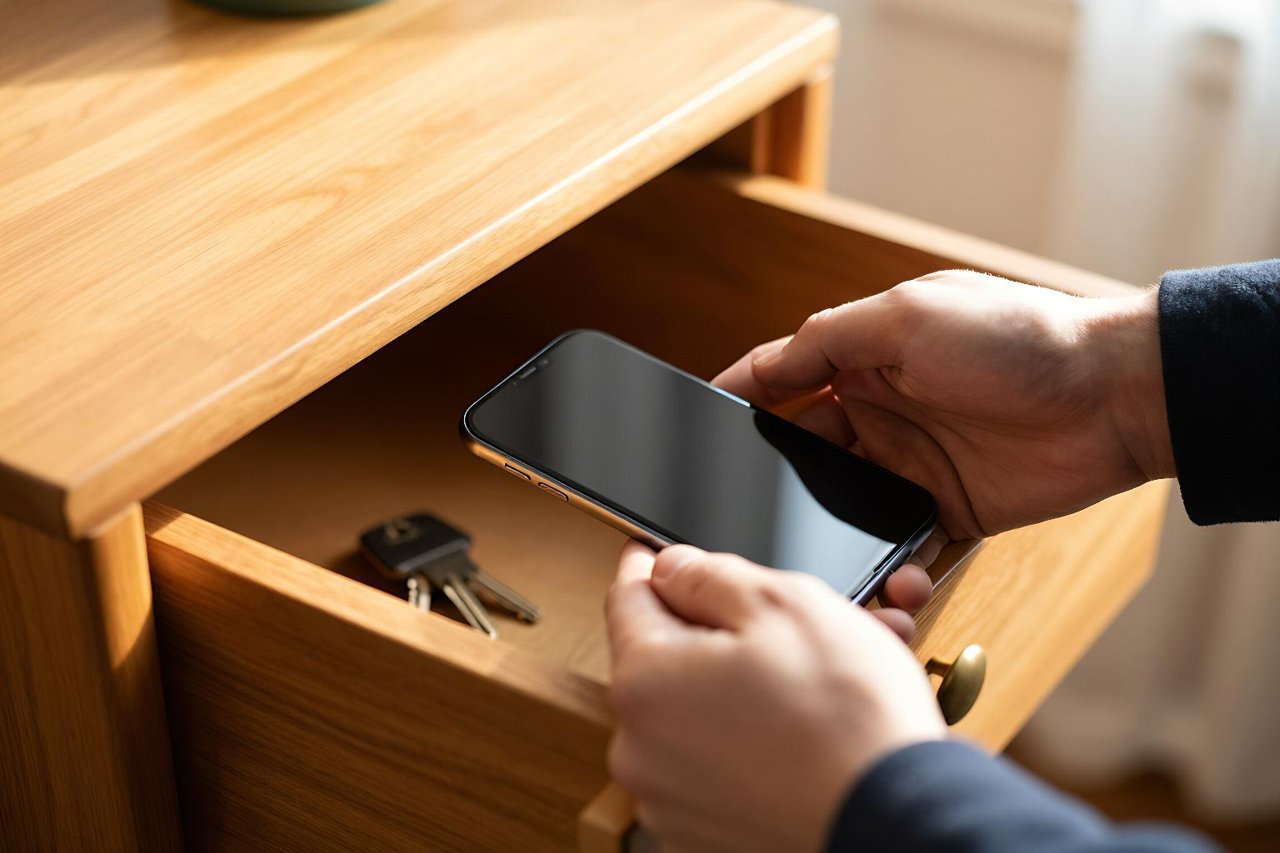
Treat the setup as part of the detox: one charging station in one room, a clock in the bedroom so your phone isn’t your alarm, and the TV remote stored in a drawer. If you want to go further, this guide to decluttering and resetting your home room by room pairs well with a screen-time reset, since both are really about removing things that quietly generate decisions.
How to tell whether it worked
Don’t measure success by how virtuous you feel on day three. Use numbers you can compare, ideally two weeks before and two weeks after.
- Daily pickups, straight from your phone’s built-in screen time report
- Total screen time on the same day of the week each time
- Minutes between waking up and the first phone check
- Evenings the phone stayed out of the bedroom
Some numbers will barely budge, and that’s fine. A drop from 92 pickups a day to 61 is a real change even if your total hours stay flat, because the interruptions were the thing fragmenting your focus.
The day after your detox ends
The break itself is the easy part. Re-entry is where the gains get kept or thrown away, and the usual mistake is reinstalling everything at once because you’ve “earned it.”
Walk back in slowly. Reintroduce one platform per week and pay attention to what it actually gives you. If an app makes you feel worse within three days of returning, that’s an answer, and it’s more trustworthy than any intention you set beforehand. Keep the parts that earn their place, leave the rest out, and you’ll end up with something more valuable than a clean month: a routine you can actually live in.


