
[ad_1]

In this second installment of his bespoke journey over the past 37 years, the author of Gentleman tells us how he gave up on Savile Row, but sampled tailors in Germany, Austria, the Czech Republic, Ukraine, Poland, Spain and Italy.
By Bernhard Roetzel.
In Part 1 of this article I wrote about my first experiences with bespoke tailoring, and my formative years on Savile Row. From 2003 on my enthusiasm for Savile Row and English tailoring dwindled, however, for a couple of reasons.
One of them was that I got to know Italy better. I started experimenting with several makers of top quality RTW and MTM and was very happy with the suits I got there. My favourites were Belvest and d’Avenza.
The other was that Tobias Tailors closed in 2003, and I hardly visited England after that because I did no more England-related books. John Coggin also stopped doing trunk shows in Frankfurt because the shoe shop he used closed down.
I didn’t order anything from a tailor for many years because I didn’t need anything, but also because my great first love for bespoke died when Tobias Tailors closed. I still love bespoke tailoring, but never again as much as I did in the first years with them.

In Europe, I felt torn between the different worlds of tailoring that I discovered. I was often tempted to order something when I liked the craftsman and the atmosphere, but I always stopped myself at the last moment because I didn’t feel like starting all over again with a new tailor.
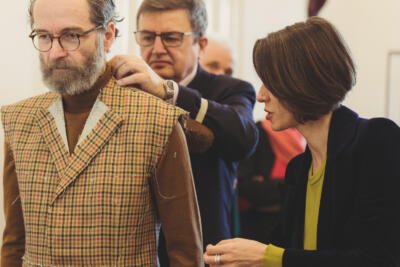
In 2005, for example, I visited Kathrin Emmer (above) in Berlin while I was there for the Congress of the World Federation of Master Tailors. Kathrin showed me her workroom and I liked her work. She had trained in Munich and worked for Volkmar Arnulf, the most renowned German bespoke tailor of the old generation.
I moved to Berlin in 2007 and visited Kathrin a couple of times for a chat over a cup of coffee. In 2011 I was finally ready to order a jacket, but the fabric that I had picked wasn’t available anymore (a worsted Alsport). A little later I came back because I now wanted a suit. It was a double-breasted made from a grey flannel with a little houndstooth pattern.

I had a very precise I idea of what I wanted: a 1930s-inspired cut with pleated trousers, wider in the leg than I had worn before, no vents and a bit more V-shaped. I showed Kathrin a couple of photos and at the first fitting I saw how well she had understood me and how well she had constructed the pattern.
There were no sleeves in the coat at that stage. At the next fitting there was hardly anything to correct. I think the sleeves were a bit too long but she could alter that from the shoulder, as the buttonholes were open already.
A little later I had another double-breasted suit made based on the first one. I asked her to replicate the first one, just with the coat a little closer to the body. I picked a light-grey wool with mohair in a medium weight for spring and summer. The fabric was very nice but it turned out to be too heavy – but that was my fault.

At the fitting of the second suit I was pleasantly surprised that Kathrin really had managed to replicate the fit of the first suit – an issue I had found in the past. It fitted a bit closer to the body but the look was very much the same. She explained that she always measures the finished suit and writes the measures in her book.
After the first two double-breasted suits Kathrin made two more single-breasted ones for me. One was in dark blue with a faint overcheck and one was a mid-grey glen check. The latter was supposed to be more Italian and I gave her an Italian RTW suit as a reference.
She did well but still I learnt the lesson that it is no good to ask tailors to emulate a style from another country. The problem is, even if the suits fits well (as the one from Kathrin does) it will lack identity.
This is why I also advise readers to get a suit from a tailor who lives or was trained in the country you want (like James Whitfield who is English and trained at Anderson & Sheppard, but lives and works in Berlin).

In 2016 I made the acquaintance of the Viennese tailor Michel Possanner (above). Several friends had recommended him whenever I had asked for tailors other than the usual suspects. He invited me to speak at an event in his shop and I seized the opportunity to order a blazer.
We decided on a blue fabric from Minnis. We agreed on a double-breasted with a classic button configuration. The first fitting took place a couple of weeks afterwards and the fit was already very good.
Michel unpicked the shoulder sleeve and pinned it following the contour of my figure. At the second fitting I cannot remember any issues and the blazer was finished afterwards without any need for another fitting.

Michel makes a very soft coat with natural shoulders. He trained at Knize and makes a similar silhouette with a fairly low notch. The length of the coat is very classic, similar to the English taste and the chest pocket is lower than most tailors nowadays (which suits my taste).
According to Michel his tailoring is softer than Knize’s but it does incorporate things he has learned there. For instance the cuffs of the sleeves are made with a bit of linen inside to give them more shape.
Later I ordered a pair of cavalry twills and again Michel did an excellent job. Michel sticks to his own style – he will not deliver anything that he feels is not elegant or flattering. He does have a very good taste and sense of style, something that many tailors lack.

Two years later I met Zdenek Hartl from Prague (above). He had trained at one of Prague’s most renowned houses in the 1960s, which had been established in the golden pre-war age of tailoring. After 1989 he opened his own business. Since the late 1990s he has been coming to Vienna for trunkshows at the cloth merchant Jungmann & Neffe.
Mr Hartl has a huge number of customers in Vienna because of the value he offers. He charges much less than the local houses, which might explain why many of them look down their noses at him. I think that he is excellent not least because of the huge experience he has gained over decades of making for rather demanding customers.
Many customers show him old Knize suits they had made in the past, or found in second hand stores, and ask him to replicate them. Others use him in addition to other tailors. I met one Brit who lives in London and Vienna; he said he is an Anderson & Sheppard customer but has double-breasted suits made in their style by Mr Hartl while he is in Vienna.

I was hesitant to try Mr Hartl because of the distance to Vienna but he invited me to come to Prague for a fitting. Prague is five hours by train for Berlin so I agreed (as opposed to nine hours to Vienna).
I had a very precise idea of the suit I wanted and I sketched it on a piece of paper after I was measured in the fitting room at Jungmann & Neffe. I picked a heavy British houndstooth tweed from their shelves.
I travelled to Prague and met Mr Hartl in his shop in Verdunska street. Most Viennese customers have never been there and I had heard a couple of strange stories about a dingy workroom somewhere in Prague.
What I found was a typical tailor’s shop in a quiet residential area. Very tidy and nice, just like any other tailor’s shop in Europe. The workroom is in the back of the building in a small structure in the backyard: also very light and tidy with about six fully employed tailors working there.

My fitting was waiting for me on a dress dummy and it looked promising. I wasn’t disappointed when I first tried on the trousers and then the jacket. Both were spot on.
Mr Hartl suggested that he proceed straightaway to the finished suit. Despite being rather euphoric after the fitting I tried to utter my doubts in the most polite way possible.
Mr Hartl has such an air of friendly authority that I felt like a schoolboy asking an old teacher if he was sure about what he said.
As an answer he led to the wall and pointed to a photograph that showed Arnold Schwarzenegger with Mr Hartl at the fitting of a sports jacket. In his broken English Mr Hartl said that he did one fitting for this customer too because Arnold Schwarzenegger didn’t stay long enough in Prague for another. This convinced me, so I agreed.

We met a couple of weeks later in Dresden, halfway between Berlin and Prague. We did the fitting in the lobby of a hotel. I was handed the suit in a bag and I put it on in the bathroom. Even before seeing myself in the mirror above the wash basin, I felt that the suit was perfect.
In the lobby I found a bigger mirror and it confirmed my impression. The suit fitted very well after only one fitting and it looked exactly as I had envisioned it before. The heavy tweed probably helped, but I have seen other suits on me made from heavy cloth which clearly showed issues.
After that first successful suit I ordered four more outfits and all were very good. At the subsequent meetings I noticed that Mr Hartl starts at zero every time. He doesn’t seem to use the previous patterns or measurements. I have seen a video of him striking the pattern on the fabric directly without using a paper pattern as a stencil.
So for every new piece since the first one we have done two fittings, even for the trousers. The quality of the making has always been excellent. The two fittings were always necessary because I had changed my weight between ordering and fitting.
In general Mr Hartl seems to prefer a slightly shorter coat and narrower lapels, if the customer doesn’t ask for something else.

The first English bespoke suit I ordered since 2003 was made by James Whitfield in Berlin (above). He came to Berlin in 2012. He was hired by a German shop called Purwin & Radczun. They couldn’t find a cutter that met their expectations in Germany so they hired James.
I saw the suits he made there and I always liked the idea of a genuine Savile Row tailor working in Berlin. I never got to try James until he started his own business after leaving Purwin & Radczun.
James makes a suit with a long coat, pronounced shoulders and a high waist. As he cannot rely on outworkers like his colleagues in London, he has trained a tailor who works for him fulltime.
I had found a piece of jacketing in the Scabal warehouse and asked James to make a sportcoat for me. The length was a bit short because I had shared it with a friend but James managed to cut the jacket from it.

James did two fittings and the resulting jacket was very good. When the jacket was made I was very thin; when I put the weight on again later James had to let the jacket out at the side seams to the max. The inlay was smaller than usual because the original length of cloth was a bit short.
I learned from that experience that I’d rather order fabric from a tailor. It is a risk to buy cut lengths unless you know exactly how much is needed. Tailors usually want more of a patterned cloth, for example, so do take care to buy enough.
I have stopped ordering at trunk shows of visiting tailors. It is usually too complicated and time-consuming to meet for the fittings. Pitti Uomo is a popular meeting place for fittings but I find it is stressful for both sides. Usually the fittings take place in a rush, sometimes the tailors cannot concentrate fully or they lose the notes they take.

In the last seven years I have tried a couple of promising young tailors from Middle Europe, including Tim Fain from Kiev (above) and Dawid Kukliński from Gdansk. Tim used to come to Berlin regularly before the war in Ukraine started and he made two very good suits for me.
Dawid visits Berlin and Leipzig regularly. He has made a sports jacket for me from linen by Maison Hellard and a suit made of grey covert fabric by Holland & Sherry. Outside Kathrin Emmer I’ve also tried other German tailors, for example Detlev Diehm and Markus Schnurr (below, first and second respectively).


I met both Detlev and Markus a long time ago when I had had suits made by Tobias Tailors. Detlev was then the creative director and designer of the Bavarian maker of handmade suits Regent, often called the ‘German Brioni’. He trained as a tailor initially before he studied design. He went back to his roots a couple of years ago.
Markus trained as a costume tailor, which is not uncommon in Germany. He worked for Dietl in Munich, the most renowned post-war tailor in Germany, and then started his own business in provincial southern Germany, where he offers very good handwork and cutting.

Among the southern European tailors, I have tried Joaquín Fernández Prats (above). I met him at Pitti Uomo. He was still working for the shirtmaker Mariano Langa in Madrid and his boss invited me to Madrid. I was enchanted by the atmosphere of the old-fashioned shop and I got measured by Joaquín. I came back to Madrid for fittings twice.
Joaquín cuts a very distinctive Spanish style, with a collar and lapel shape which is more French than Italian. I’ve always admired the style of elegant Spanish gentleman and the suits made by tailors from their country, so I was interested to try this.
At the first fitting the suit still showed traces of my style but at the second fitting more of Langa’s and Joaquín’s house style emerged. The finished suit was 100% Spanish, with the exception of the trousers. They were cut very wide in the leg with forward pleats, but even then they had a Spanish accent because I followed Joaquín’s suggestions of a wide waistband and belt that fastens at the side.

The only longer-lasting relationship I’ve had with a tailor sprung from a chance encounter. I met Massimo Pasinato in Milan at an event in the VBC showroom in 2018. Francesco Barberis Canonico made the introduction and the next morning Massimo took my measurements for a three-piece suit. I had chosen a medium weight dark-grey high-twist fabric from VBC.
We met for two fittings in Germany. The first was well cut and I didn’t detect anything to improve at first sight. Massimo then took off the collar and unpicked the shoulder seam. He lifted the left front part just a little bit in order to smoothen out the front.
The second took place a couple of weeks later. I don’t remember how it went, probably because everything was fine. The standard of workmanship was excellent. I wore that suit at Pitti at the cocktail hosted by VBC at Liverano’s shop. When I ran into Anda Rowland she complimented me on the suit. Even if I detected a degree of polite flattery the reaction felt honest.
I wanted to order more from Massimo and sent him another suit length but Covid stopped all progress. We met a couple of times after the pandemic but he never found the time to take new measurements.
Finally, it happened in September 2025 in Vienna when we met at a trunkshow. We did the first fitting in Milano a month later.
The fabric is a light-grey Prince of Wales with a red overcheck from Draper’s. Massimo somehow managed to give the suit an English air. We had agreed on slanted pockets with flaps and a ticket pocket, trousers with forward pleats and side-adjusters and buttons for braces.

Writing this piece and its predecessor has brought back many memories of bespoke and caused me to think about the mistakes I have made. The world was very different when I ordered my first suits because there were no smart phones, no social media, no Instagram.
The internet has taken away a lot of the magic of bespoke, but it gives the novice a lot of information. Unfortunately, information cannot replace knowledge or experience. So everybody just has to order his first suit from a tailor, make right or wrong decisions and then learn from the results.
Ideally, the tailor will be skilled and experienced and based not too far away. This will help with correcting the mistakes. The customer should also know exactly what he wants but leave the tailor enough freedom. Otherwise he might choke the enthusiasm.
Always remember, a tailor is not a magician. Don’t expect too much; there is no perfect suit. Communication is the most important: find out what you want and let the tailor know it. It is your suit so you must like it and feel good wearing it. Finally, if you find a tailor who makes this suit, stick with him!

Which tailor would I use today? Well, the tailors above are all ones I would use again because I was happy with the result. But how many times do we like a meal in restaurant and yet never return?
The tailors that I have been most happy with judging by the number of repeat orders are Zdenek Hartl from Prague, Kathrin Emmer from Potsdam, Massimo Pasinato from Vicenza and Dawid Kukliński (below) from Gdansk.
Mr Hartl offers the best value for money, this is an important factor. But he is also extremely skilled and I like his style. And he is a very nice person even though verbal exchange is limited.
Kathrin Emmer is closest to my home of all, it’s only about a 90 minutes drive to see her. She is the one that gives the smallest amount of input regarding style but she is extremely versed at cutting and she can exacly replicate the suits she makes.
Massimo Pasinato has recently reached another level in his cutting, at least in my observation. His handwork was always excellent, but he seems more mature and relaxed now. He is very reliable and consistent which I find very important.
Dawid Kukliński makes a very nice suit, very middle European in the sense of a quiet and subdued elegance. He admires Savile Row style more than most younger tailors from Middle Europe but he doesn’t try to copy it. His prices are attractive and he comes to Berlin on a regular basis.
If I had to choose one of them as my only tailor it would probably be Mr Hartl.

Part 1 of Bernhard’s journey, talking about using an English and German bespoke tailor in the 1980s and 1990s, can be found here. For more on Bernhard’s writing, especially on shops and tailors to visit in central Europe, see his writing more generally here.
[ad_2]
Source link


