
[ad_1]
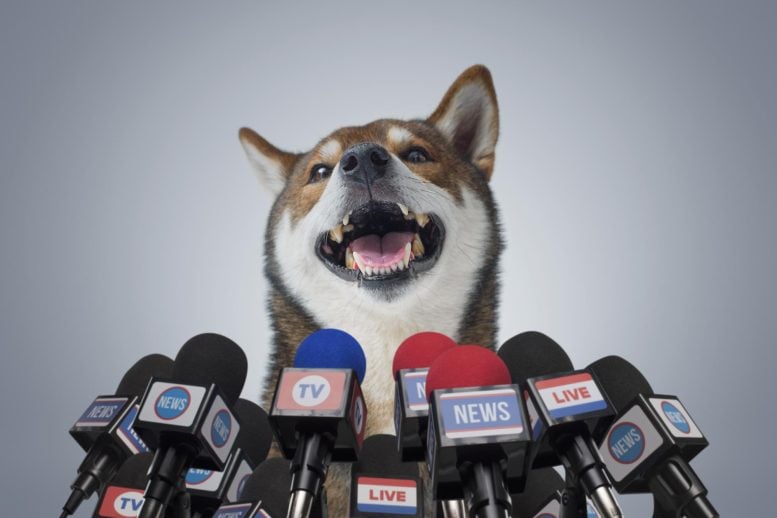
A new scientific review explores a long-standing question: could dogs ever learn to talk? While the idea of dogs speaking in full sentences belongs to science fiction, researchers are examining the biological limits and technological tools that could expand how dogs communicate.
For hundreds of years, people have been fascinated by the idea of a “talking dog”, imagining a loyal companion that could speak like a human, a theme that has appeared repeatedly in folklore, books, and films.
Today, scientists are taking a closer look at whether this concept could ever be possible and what it might reveal about the nature of dogs and our relationship with them.
Testing the limits of canine speech
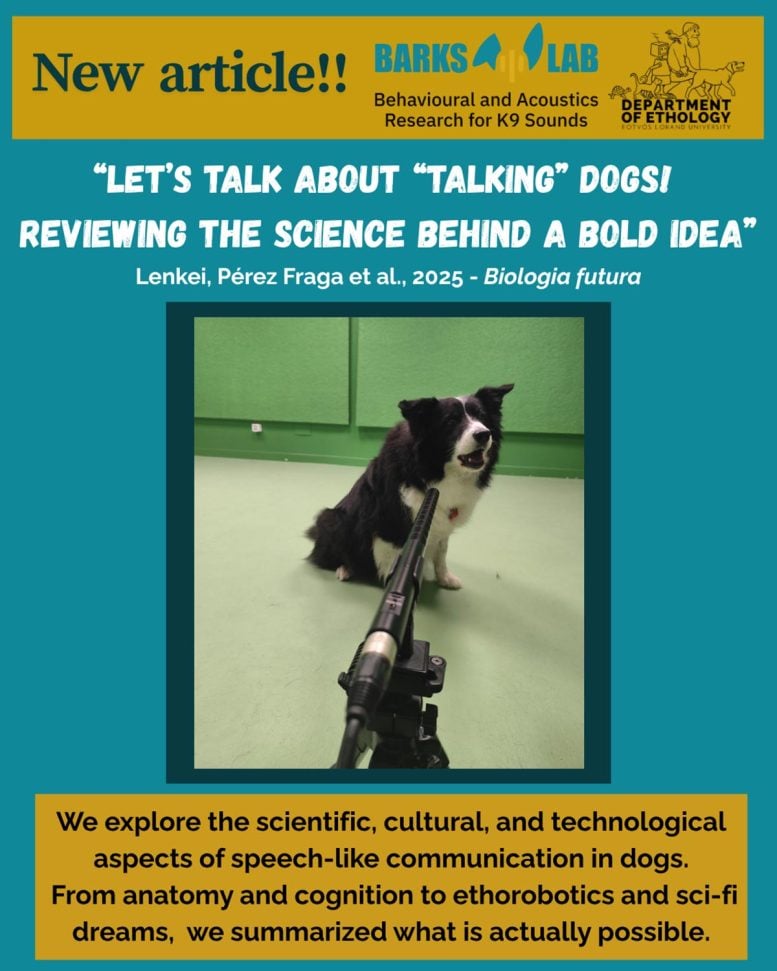
In a new review, researchers from the BARKS Lab at the Department of Ethology, Eötvös Loránd University (Hungary) examine the anatomical, cognitive, and evolutionary factors that shape how dogs communicate with humans and consider whether any of these traits could support spoken language.
At first glance, the question may seem trivial or even humorous, but from an evolutionary biology standpoint, it is meaningful. If dogs truly had the capacity for speech while living so closely alongside humans, such an ability would likely provide a strong advantage and would be expected to spread widely over time.
“The real question is: are dogs really on the road to verbalization? Which skills are necessary for speech production and comprehension abilities that the dog might possess, and which skills do dogs lack?” asked Dr. Rita Lenkei, one of the lead authors. “We aimed to clarify what is known, what is overstated, and what remains to be explored through serious scientific inquiry.”
The researchers also emphasize that the long-standing dream of a talking dog may never move beyond imagination. Alongside the biological hurdles, they point to ethical concerns about whether humans should attempt to make dogs speak in human-like ways.
“Instead, we suggest that the focus should be on better understanding the unique ways dogs already communicate, both vocally and non-verbally, and what this tells us about language, empathy, and cooperation across species,” added Dr. Paula Pérez Fraga, the other lead author of the review.
Dogs as models for language science
One of the review’s main contributions is its relevance to research in language evolution. “Because we cannot experimentally recreate the conditions under which human speech emerged, comparative models are essential. Studying how domestication shaped dogs’ communicative skills may help illuminate the early cognitive and neural steps toward speech-readiness in our own species,” said Dr. Tamás Faragó, leader of the research group.
The findings have implications not just for the evolution of the human language, but also for ethorobotics — a new field at the intersection of animal behavior and robotics. Insights into dog-human communication could help design robots that better interact with both people and animals.
In the end, dogs may not need words to be great communicators. As this review explains, understanding each other doesn’t always require speech, sometimes it just takes “listening” in the right way.
Reference: “Let’s talk about “talking” dogs! Reviewing the science behind a bold idea” by Rita Lenkei, Paula Pérez Fraga, László Róbert Zsiros, Balázs Szigeti and Tamás Faragó, 29 July 2025, Biologia Futura.
DOI: 10.1007/s42977-025-00276-0
Never miss a breakthrough: Join the SciTechDaily newsletter.
Follow us on Google and Google News.
[ad_2]
Source link


