
[ad_1]

Josh Walters is a friend and a menswear designer. I was chatting to him recently about his wedding outfit, and thought both the design and the craft involved were rather inspiring.
Josh went to great lengths to source the most authentic makers for every part of the outfit, and even tailored parts of it himself. The overall design was also interesting because of tensions inherent in ideas of Scottish traditional dress, and Josh’s feeling that as a designer, he had to impose a little style of his own.
Here is what he made, and why.


So Josh, why did you decide to get married in Scottish dress, do you have any Scottish ancestry?
Way back I do, but more importantly my wife is Scottish and we were always going to get married where her mum was born, on the Isle of Bute. It’s a place which is very special for both of us and it was going to be a Scottish wedding.
Did the specific location have any affect on your outfit?
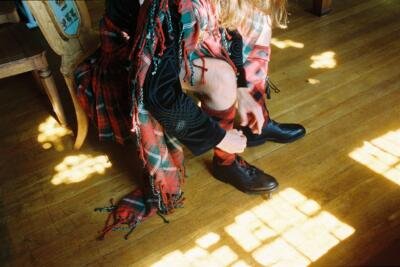
Yes the tartan is from there – the Duke of Rothsay. Interestingly it’s one of the few that still isn’t linked to a clan, just to the area.
That’s how they were originally right, just local weaves and designs, then they got taken up by families or clans more recently?
Yes correct. It was also nice that this was the tartan King Charles wore before he was King. He had the hereditary title of the Duke of Rothsay and when he was Prince Charles he often wore the ‘ancient muted’ version of this. I opted for the brighter, modern version.
How did your wife’s family feel about what you were going to wear?
They loved it – I’m certainly not the first husband of a Scottish woman to adopt her family tartan. But I still felt a bit of imposter syndrome I have to say, and a bit of pressure being a designer. I knew everyone was interested in what I’d end up wearing.


How straightforward are the decisions around jacket style, kilt etc?
Well a lot of the modern, ready-to-wear versions are a bit gross to be honest. They’re often hybrids of different periods and styles, made for a foreign audience. Sometimes that’s down to historically inaccurate films or TV dramas.
One obvious problem is that jackets will merge English lapel shapes that the ruling gentry might have worn, with things the Scots wore when they were actively rebelling against the English.
The authentic Scottish designs often had more in common with French or Russian jackets, because there were close international relations. So mine has a lot in common with a Russian hussar’s jacket for example. Modern jackets also have a tendency to add extraneous detail, like excessive embroidery on the arms or back, because it looks more impressive.
The other one you often see is a Jacobite shirt, the one with leather ties across the front, worn with clothes a Jacobite would never have worn. But it’s just what people like – you see those in tourist shops all over Edinburgh.
How do you tell what was accurate?
There are lots of good resources, the National Library of Scotland has a lot. The best books are mostly from the 19th century when George IV visited Scotland (the first monarch to do so for 200 years) and then Queen Victoria. She commissioned the book The Highlanders of Scotland, which recorded a lot of the dress at the time. [Both images above from that book.]
So what did you end up wearing?
I had a lot of advice from the guys at Kinloch Anderson, but that started with the kilt.
The kilt is meant to be worn very high, even above your natural waist right up on the bottom of the ribs. There’s also a choice as to how it’s pleated, in a box pleat or not. A box pleat uses far more material but tends to only be worn by a couple of military units like the Black Watch.
I also like the kilt as a piece of fashion – given how I dress, I wanted to be able to wear it again in the future. Like the articles you write about wedding clothing – I wanted to be able to wear it outside of just other weddings and formal events. It’s a strong look, but I think I’d wear it with a plain sock and a sweater.
I opted for machine finishing on the kilt but the knife pleats were check matched. It has bridle-leather buckles and the fly plaid (across my chest) is finished with purled knotted fringes. This is the traditional, hand finishing that would have suited the material in the past as it would have been a much looser weave.
And I guess everyone asked you what you were wearing under the kilt?
Yes every auntie asked that! And of course I was full Scottish, nothing underneath. Actually it was uncharacteristically hot that day, 32 degrees, so I was grateful for it.


So how did the kilt then influence the jacket?
Mostly in terms of the length. Because the kilt is worn high, there’s a question of how long you want the jacket to be, how much you want it to overlap the kilt.
This seems to be something a lot of rented formalwear struggles with. Guys want to wear their trousers on the hips, so if you get something like morning dress the waistcoat will be very long in order to cover the top of the trousers.
Exactly, and that ruins the look – it’s the high trouser and short waistcoat that anchor the outfit, then the coat can cut away from it. Same with white tie.
With my jacket here, I went with the shortest design I could because it flattered me – I don’t have the biggest shoulders, but this makes the most of my slim waist. It was also an area where I thought I’d go for something a little more exaggerated, a little sexier.
The problem with a lot of those ready-to-wear outfits is that they just make guys look dumpy. The waist is too low and it’s doesn’t give them much of a figure. But this can look really sexy if you want it to.
The disadvantage of custom is that it’s more expensive of course.
Absolutely, the whole outfit can quickly run into thousands of pounds, but you want to look special right? These photos are going to be on your wall for ever.


How did you commission the kilt with Kinloch Anderson?
I visited them in Edinburgh, but they also do fittings regularly at the Caledonian Club in London. You should go see them in Edinburgh some time by the way Simon, they have a little museum and you can see all the workshops out of the back window. As a royal warrant company they make it all on site.
But you didn’t make the jacket with them?
No, I tried on so many different styles, so many fits and lengths, but in the end I decided to make it myself. I knew where to get the velvet, I knew where to get all the trimmings. So I pulled some all-nighters and got it done. The thing that took the most time was the embroidery.
That was in silk Russia braid, while the jacket itself is Brisbane Moss silk. Historically men would have worn barathea for eveningwear and special occasions, or a shetland or subtle tweed in earthy colours. I was cognisant of how black velvet absorbs the light on a sunny day and in flash photography, so thought this silk would be better. I think it worked. The jacket can be worn closed in a double-breasted fashion, but it’s intended to be worn open.

How about the shoes and socks?
The shoe is a ghillie brogue in a style that would traditionally be worn by a piper, kind of heavy because they’d be marching at the front of the miliary band. I commissioned them bespoke from Tricker’s, who I’d used in the past. They were based on a shoe we found in their archives, and adapted onto their Bourton Brogue.
We did use a Vibram ‘Vi-Lite’ sole for the shoe, so it’s not as heavy as it looks. I wanted them to look rugged but also wanted to enjoy the Ceilidh [Scottish event, with singing and dancing].
The kilt sock – or rather diced hose – was also taken from what a piper would have worn. There are lots of different rules here, like whether you match the sock to the tartan or to the jacket. But as you often write about on Permanent Style, you just need to take those traditions and understand them, rather than necessarily copy them.
Then there’s the garter flash, which echoes the tartan and just sticks out of the sock.

It looks like some of the accessories might have been the most fun?
Yes I actually went slightly overboard on those. The knife for example – the ‘sgian dubh’ – is beautiful, and bloody lethal. The blade is damascus steel and the handle made from walnut, ebonised walnut and brass. The sheath is made from the same bridle leather as the trimmings of the sporran. That cost £900…
Tell me about the sporran – can you actually use it for anything?
It’s from Margaret Morrison sporrans. The main body is black goat’s hair with three tassels in white goat hair, typical of 18th century regimental models. The internal bag and belt are bridle leather, and inside the sporran there’s an elasticated pouch for a phone and an integrated card holder, so yes you can! The sporran cantle is a replica of one in the Museum of Scotland, cast in brass.
Lastly there’s the brooch, which is a vintage one from Wright and Teague. They’re a great company, the husband and wife founded the brand in the 1980s and produce handmade jewellery inspired by organic forms and Anglo-Celtic historical influences. My wife and I both have silver rings from them.

There’s so much going on here. Was part of the attraction – even unconsciously – that there were so many elements to get into?
Yes, probably. I considered a suit (which would have been in mohair) or morning dress, but this was both exciting and interesting in terms of the craft involved.
To be honest one factor that almost made me go for a suit was the fact my wife designs the soft accessories at Dunhill, and I wanted to wear a tie from her. But in the end that didn’t make sense.
The shirt was from Dunhill though, a prototype I designed while I was there. It’s a band collar in voile cotton from Alumo. I needed something lightweight and breathable, and I’ve always been a fan of skinny, unstructured band-collar shirts like this.
Dare I ask how much everything cost?
I think it was just under £3,000, which isn’t bad given all the different elements involved, and how much a guy will often spend to have his suit made to measure or bespoke.
Plus your own labour in making the jacket?
Well yes, plus that. If you had the jacket made it would be closer to £3,500. You could also have a much simpler MTM kilt and jacket outfit for £1,500-£2,000 that would still be lovely. I might even get an alternative jacket or hose at some point for future events – the kilt is fine but together with the jacket and hose it has a lot of ‘main character’ energy.
Thanks Josh, clearly a wonderful day and it’s been a great way to highlight some traditional Scottish crafts here on PS.
My pleasure Simon.

Outfit details and prices:
- Kinloch Anderson bespoke hand-finished kilt and garter flashes, £810
- Kinloch Anderson bespoke fly plaid with purled fringe, £405
- Margaret Morrison bespoke sporran with goat hair, brass cantle and bridle leather trims
- Margaret Morrison ‘sgian dubh’ in blackwood, brass and damascus blade, together £923
-
Tricker’s bespoke ghillie shoe (through a friend, but full price £550)
- Wright and Teague vintage brooch, £60
- Jacket, made by Josh himself
- Shirt, old Dunhill sample designed by Josh
Josh Walters is a menswear designer and founder of the brand 3Man; he previously worked as a designer for Dunhill. Now a Design and Creative consultant, he is currently the Design Director of Baracuta.

[ad_2]
Source link


