
[ad_1]

A bold checked jacket is not the most versatile thing to own. Quite aside from how many other things it goes with, its boldness means that it will likely outshine them all, and stick in the memory of anyone you meet. It’s not something you can wear regularly without becoming the guy in that jacket.
But, when you already have a navy blazer, a grey herringbone, a soft brown cashmere and perhaps a couple more, more unusual designs can be fun. And tweed is a good place to start, because it’s easier to dress down.
I’ve had my share of unusual jackets, including a bold Huntsman check, a pink Orazio cord, a purple Liverano and a grassy tweed from The Anthology.
Of them all, I’d say the tweeds were the most successful – from a fabric point of view. I don’t have the Huntsman anymore, as the style wasn’t for me, but the grassy green is still worn fairly often and with jeans more than anything else.
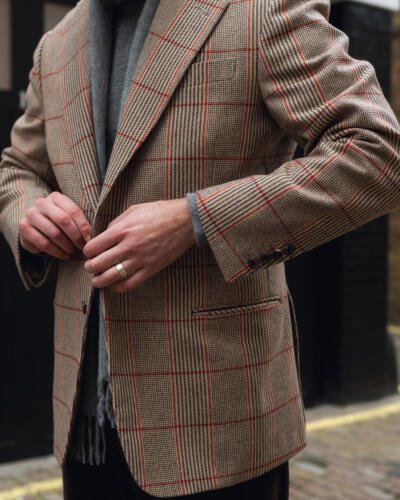
It was with this in mind that I chose this Russell check for a second jacket with the Korean tailor Tranquil House.

I asked the archivist at Johnston’s during our recent visit about Russell checks (or plaids, for our American cousins). Despite having research on all Scottish estate tweeds, they had no relevant information. There is a Russell clan in Scotland but apparently no record of an estate tweed, and the clan tartan seems unrelated.
There is a chance the name comes from the prominent red or orange lines – russell means red-coloured – in the design, but that was purely speculation.
Russell checks do also vary a little in colour, while the thing that unites them is the lack of a horizontal set of stripes to match the vertical ones. In the better-known glen check, that band of stripes you can see bracketed by orange lines above would be matched by one running across the material, and the characteristic houndstooth pattern would be created where the two overlap.
Without that, the Russell check is subtly unusual, and it is sometimes referred to as ‘glen stripes’ for that distinctive aspect. Although of course the thing that makes it bold is the brightness and contrast of the colours: just like a glen check, you could render this pattern in much darker, low-contrast colours and it would barely be more than texture.


Interestingly, the Russell check has become slightly fashionable in the tailoring world in recent years – a small but nonetheless consistent thread through the preferences of influential people we know.
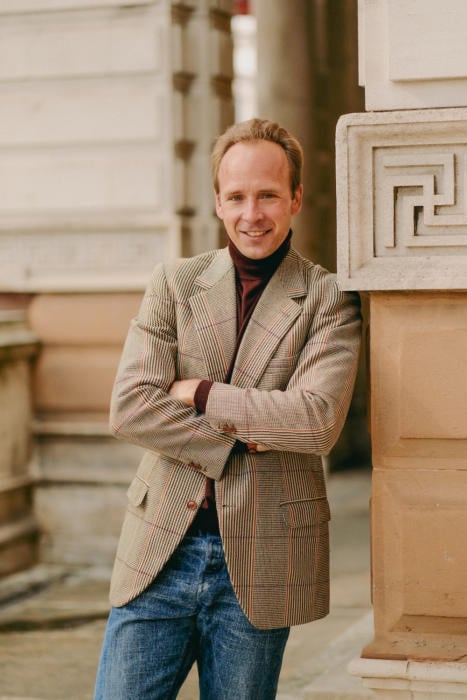
The lovely Chase Winfrey at J Mueser has had one for a while, and it fits in very much with his old Barbour and shirt-and-tie (first image above). The tailor Fred Nieddu mentioned to us first a few years ago that it was one of his favourite checks – he associated it with rather drunk and dishevelled old Englishmen. Peter Zottolo had one made by Fred two years ago, in cashmere. And Oliver and Carl of Rubato opted to include it in their first range of tailoring last year (second image above).
It’s also been popular among more traditional dressers for a long time – evident from its inclusion in the range at Cordings, reader Andrew’s one from Caraceni, and the fact our contributor Bernhard Roetzel had one made back in the late nineties when he was first commissioning tailoring on Savile Row. (Andrew and Bernhard shown below.)

I’ve been enjoying wearing mine as this unusual, slightly more exciting choice – and really as a piece of outerwear, given its weight.
I was expecting to like it with blue jeans, and it does work well there – with the collar up, a blue oxford or denim shirt underneath, and brown suede boots. Leaning into the vibe of a country gent who’s grudgingly adopted jeans.
But the jacket also works rather nicely with brown cords, like the ones pictured below. In retrospect the cords could be a touch lighter, and a shoe in a lighter brown still would stop the bottom half being too dark (it’s funny how much better you see outfits sometimes when they’re photographed). But brown overall is a good partner.
It’s then fairly easy to use neutrals everywhere else – greys and whites in this case. The scarf is helpful as it replaces a collar on the knit, making it more flattering around the neck. (And a jacket of this weight would be disposed of as soon as I got inside, so the scarf comes off at the same time.)

That weight is 560g (18oz), which is heavy for a jacket but standard for traditional shooting tweeds such as this – those intended for rough outdoor pursuits, and ‘thornproof’ as a result. It’s 32247 from the Hartwist bunch at Porter & Harding. (Another popular one, worn by the likes of Andrew above for example, is 2404 from the Alsport bunch at Huddersfield Fine Worsteds, which is 20oz.)
As a jacket to wear indoors and ideally not notice as you type away at your desk, it’s terrible. But as something to wear as a coat substitute, and perhaps for those that usually take off their jacket indoors anyway, it’s nice. Also good for standing outside of pubs.
For more on shooting tweeds, see the PS guide to tweed bunches. These are good options for tweed suits, should that be something you’re looking for, because the density of the weave means they hold their shape, retaining a crease in the trousers for example. Rather different to the sponginess of most Harris tweeds.

As to the cut and fit, Kim at Tranquil House has certainly improved on the first jacket he made me, which had a few issues. But he also pushed the proportions quite a bit to try and fix those, making the shoulders much wider.
The fit and make is OK now, and if I were a Korean resident wanting an English-style suit then it would be good value for money. But I can’t recommend Kim without some caveats for anyone else.
It’s also a shame that the collar is not hand-padded, both for the shape it would help create around the neck, and for the slightly messy machine stitching on the underside of the collar.

Clothes shown:

[ad_2]
Source link


