
[ad_1]
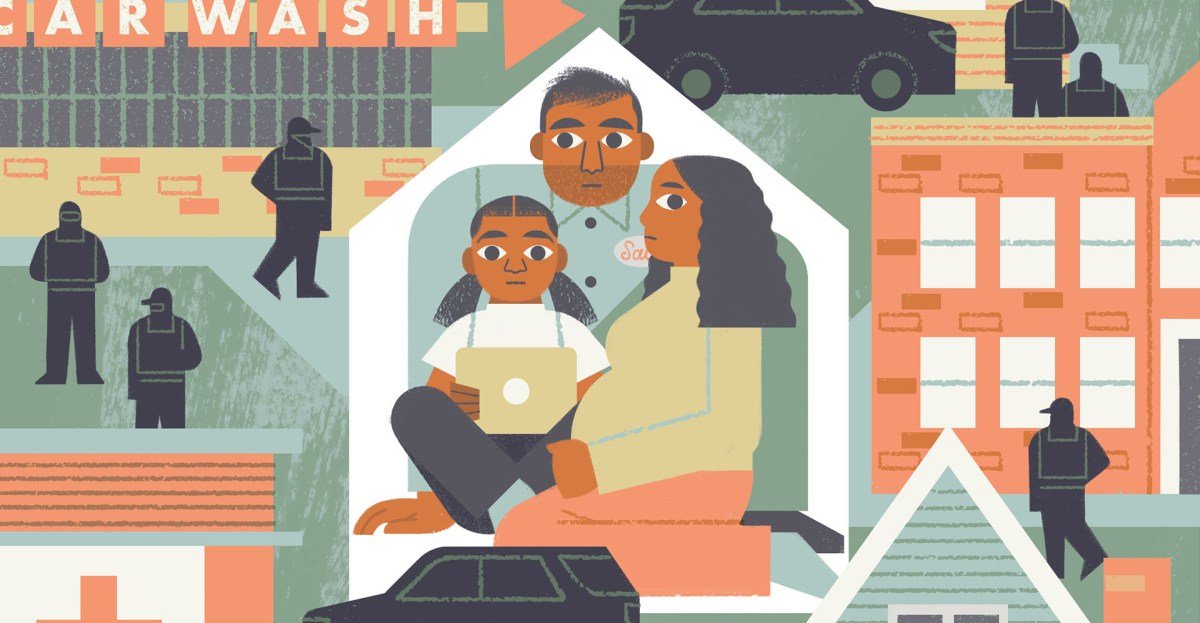
Entire families sheltering in their homes, afraid to go outside. Children getting their lessons on iPad screens. Pregnant women skipping doctors’ appointments and considering home birth. A pervasive sense of confusion and terror — a feeling that “nothing is safe.”
These may sound like scenes from 2020, when the COVID-19 pandemic shuttered schools and workplaces and sent families indoors, fearful of contracting a deadly disease. They’re also stories I heard in the last week, talking to doctors, educators, and advocates around the country about the impact of ICE on immigrant communities.
In Los Angeles, car wash workers are sheltering in place, driven from their jobs by round after round of immigration raids. “Family members, they’re just asking them: stay home,” said Flor Melendrez, executive director of the CLEAN Carwash Worker Center, a nonprofit workers’ rights organization. “It’s not safe out there.”
In Minneapolis, a sense of “eerie calm” pervades Dr. Bryan Fate’s pediatric waiting room, as families skip their kids’ checkups for fear of being picked up by ICE. When kids do come in, they’re sicker.
“We’ve certainly seen infections that fester and get worse at home,” Fate, who practices at Children’s Minnesota health system, told me. Parents are “balancing the health of their child and the safety of their family, and that’s a terrible decision they have to make.”
These stories echo in cities across America as the country enters a kind of second pandemic, one in which the pain is even more unequally distributed, but, arguably, no less dire.
The same essential workers who were on the front lines of COVID are in the heartbreaking position of watching history repeat itself — except, this time, the wound is self-inflicted.
The return of “shelter in place”
At first, they thought it would be just a few weeks.
But now, car wash workers in Los Angeles have been living in fear for nearly a year, Melendrez told me. At least 100 car washes in the Los Angeles area have been raided by immigration authorities in the last few months, some of them more than five times, Melendrez told me.
“You could only imagine the level of trauma,” Melendrez said. “It’s like living a kidnapping scene.”
Some workers are also keeping their children home from school, fearful of being stopped by immigration authorities during pickup or dropoff, Melendrez said. It’s a theme that’s emerged around the country as ICE officials conduct high-profile raids near schools or bus stops. Liam Ramos, a 5-year-old Minnesota preschooler, was taken into custody along with his father when they were returning from school. He ended up spending almost two weeks in immigration detention in Texas.
Now, districts in Minnesota and beyond are offering remote learning, just as they did in 2020 and 2021. At some schools in St. Paul, Minnesota, fully 50 percent of families chose virtual learning when the district began offering it in late January, said Valora Unowsky, senior executive academic officer with the district. Districts in Los Angeles and Charlotte, North Carolina, have also offered remote learning.
“It’s impossible not to compare this to the pandemic,” Unowsky said of remote learning in her district. But “during the pandemic, everybody was in the same situation.” Now, it’s the students in the district who were already more vulnerable before the current ICE surge began — lower-income, more likely to be learning English as a second language — who are more likely to be learning on iPads rather than in classrooms with their friends.
Children’s Minnesota and other hospitals and clinics around the country also offer virtual appointments for patients who are afraid to go to the doctor in person. But “there are just visits where you really need to be able to get vital signs and do an exam and see the kid in front of you,” Fate said.
Much like in the pandemic, children with disabilities and chronic conditions have been especially affected, as they rely on regular appointments with multiple specialists, which their families no longer feel safe keeping. “That can affect everything from breathing to getting feeds for your feeding tube, to getting a new wheelchair,” Fate said. “Even just simply picking up medicine at the pharmacy is a risk for some families.”
Doctors around the country have also seen pregnant patients skip prenatal visits, and more patients are requesting home births, even if they have conditions that make that option unsafe. When people do come to the hospital to have a baby, what should be a joyous experience is now tinged with fear, Fate said. “This new life is going to need medical care that you’re really terrified to have to go seek,” he added.
That ever-present fear kept coming up in my interviews for this story, perhaps the clearest echo of the pandemic: the sense of being surrounded by a threat that cannot be fully predicted or understood. During the early years of the pandemic, “there was so much in the news, so much in different media outlets that it made it very blurry to understand what was real and what was not, what was proven and what was not,” Melendrez said. Now, as masked ICE officers surge in and out of cities and immigration officials spread apparent misinformation about their plans, that feeling of confusion has returned.
“We go back to the same thing of living in fear,” Melendrez said.
The long-term toll of isolation
Doctors, teachers, and others who were on the front lines during COVID-19 know that fear and isolation take their toll. Indeed, the country is still struggling to heal from the learning losses and psychological suffering brought on by the pandemic — only for a significant fraction of the population to face them yet again.
Fate is already seeing more symptoms of anxiety in his young patients, from skin picking, to hair pulling, to bed-wetting. Among neurodivergent kids, who are losing access to crucial therapies they get through school, he’s seeing the “loss of these hard-earned milestones that are impacted by trauma.”
We learned from the pandemic “how important it is to go to school, how important it is to have structure and routine and see faces and be with people,” Fate said. “To see those similar themes emerge again, without a virus causing it, but the external act of the government — it’s just a feeling of helplessness.”
The one bright spot, however, is that a return of pandemic conditions has also meant a revival of the networks that sprang up during the pandemic to support the most vulnerable. In the early months of COVID, the Chicago food pantry Nourishing Hope distributed groceries to hungry families out of Wrigley Field, CEO Mitzi Baum told me.
Now, the group has expanded its home delivery services with a focus on families affected by ICE. Nourishing Hope also offers mental health services that are available remotely.
In St. Paul, school counselors are doing extra outreach to kids learning remotely, and the district is also delivering shelf-stable food boxes to sheltering families to help replace the meals kids would ordinarily get at school, Unowsky said — a service many districts also offered during the pandemic. Parent-teacher organizations have reached out to help families, as well.
Earlier this month, White House Border Czar Tom Homan announced a drawdown of immigration forces in Minnesota. But advocates on the ground fear a continued presence, and immigrant communities around the country are still bracing themselves, wondering if they’ll be next. It’s another reminder of 2020 and 2021, when Americans anxiously checked infection rates in their areas, waiting for the next surge.
News of a drawdown notwithstanding, many communities are still struggling. A lot of what families in St. Paul need are “things that really nobody can provide,” Unowsky said. “We’re just looking forward to when we can bring our kids back.”
[ad_2]
Source link


