
[ad_1]

By Robbie Collin.
It’s a formative stage in every man’s sartorial journey: when the height of good taste means trying to dress like a spy from a film. There’s James Bond of course – and goodness knows there’s enough advice out there for anyone hankering after an ivory dinner jacket and/or a blue terrycloth playsuit.
Then there’s the tattier, more thoughtful strain of secret agent, such as Michael Caine’s Harry Palmer in the UK; or in the US, Joe Turner – the CIA analyst in Three Days of the Condor played by Robert Redford.
These outfits read as espionage via academia, with a crumpled dash that feels almost accidental. If you’ve a grey herringbone blazer at home – and, this being Permanent Style, I’ll wager you do – then you’ll know what I mean.

There is, however, another group of cinematic spies whose sense of style – and what it can bring to our civilian wardrobes – is, I think, hugely under-recognised. Then again, that’s the whole point.
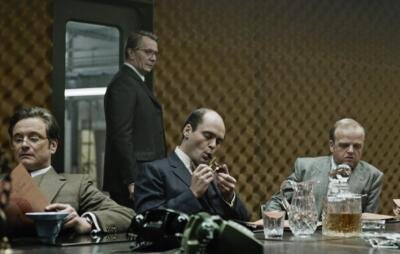
I’m talking about the Secret Intelligence Service officers in Tomas Alfredson’s Tinker Tailor Soldier Spy: that ravishingly dingy 2011 adaptation of of John Le Carré’s seminal espionage novel. From Gary Oldman’s George Smiley to the Guess Who? board of potential double agents he finds arrayed before him, these men have cultivated a look which, to the average audience member, barely qualifies as a look at all.
Isn’t it just rooms of men in suits? Well, yes and no. Because in these men’s rooms – in their world – the tiniest details of tailoring and accessorising come freighted with meaning.
We often talk about dress codes, but the term has rarely felt as apt.


The film’s costume designer was Jaqueline Durran, the two-time Oscar winner also responsible for the peacocky splendour of Joe Wright’s Anna Karenina and Margot Robbie’s cellophane negligee in Wuthering Heights. It’s fair to say that Tinker Tailor Soldier Spy unspools in a subtler register than these, though the reverberations between its characters’ outer layers and inner states is just as strong.
As Smiley, Oldman wears a three-piece charcoal suit (made by Timothy Everest in an empathically un-swinging midcentury style), a white shirt with a dark tie, and a reversible mac (below) that Durran had seen in a 1960s photograph of the author Graham Greene.
None of this chimes too obviously with the early 1970s setting, and nor is it meant to. The suits, like the men who inhabit them, are doing their jobs with a couple of decades’ mileage on the clock.


Durran has spoken in interviews about curating a look in which everything could have been sourced from within half a mile of Piccadilly Circus: Savile Row, Jermyn Street, Burlington Arcade. But not recently.
The style is redolent of the civil service, as well as the private members’ clubs of Mayfair and St James’s. It’s overwhelmingly grey – perfect for men whose work takes place in what are, in a number of senses, grey areas.
But on film that greyness doubles as a canvas for the display of near-subliminal psychological tells. Just as Oldman’s Smiley scrutinises his colleagues, often from behind the character’s signature thick-framed spectacles, the menswear-conscious viewer will find himself combing every rig for deviations from the template, and wondering what they might mean.


What’s the significance of the swelled edge on John Hurt’s jacket – or the peaked lapels on Toby Jones’s? What should we read into the slight flare to Benedict Cumberbatch’s trousers? And why is Colin Firth wearing desert boots instead of oxfords, derbies or brogues? (Those last two shown above.)
Wonderfully, all of these details do reflect aspects of their wearers’ characters: in what must be one of the most niche menswear moments in cinema in the last 20 years, a certain figure’s moral turpitude is foreshadowed by him wearing a slightly jaunty pair of socks.
The costumes are very specific, central to the plot. And inevitably they invite us to consider what aspects of our own tailoring reveal about our characters.


The significance of the outfits is further demonstrated by the contrast with SIS’s more working-class ‘scalp-hunter’ division, which includes Mark Strong’s Jim Prideaux and Tom Hardy’s Ricki Tarr (both above).
Their comfortable, durable gear befits men on the move. Prideaux dresses like a substitute teacher, and actually ends up working as one for a spell. Hardy’s clothes are more movie-like: a custom Belstaff shearling coat, a Barracuda G9 and a chambray work shirt, with cords in olive or powder blue.
Durran has said Hardy’s costumes were influenced by 1960s photographs of Steve McQueen – again, the dates don’t neatly align, and that’s the idea.

The clothes of Tinker Tailor Soldier Spy are old, scuffed and fraying but, God willing, still fit for purpose, like the national order their wearers (or, at least, most of them) are trying stoically to shore up.
The lesson to us on the outside is simple: subtlety in dress can speak volumes. No matter what you wear, clothes contain clues about both your personality and your intentions. Above all, choose your socks with care.
Robbie is the chief film critic for The Telegraph, a PS reader and menswear enthusiast.


[ad_2]
Source link


