
[ad_1]
Key Points
- The United States Army conducted a 1,300-mile long-range aviation operation during the Talon Reach exercise in Korea, integrating multiple helicopter units in a coordinated attack and air assault mission.
- The exercise validated the brigade’s ability to sustain combat aviation operations over extended distances using forward refueling sites, unmanned systems, and synchronized multi-battalion operations.
The United States Army demonstrated a long-range aviation combat operation exceeding 1,300 miles during the Talon Reach exercise on March 12, 2026, conducting a coordinated attack and air assault mission across the Korean Peninsula.
According to the Army, the large-scale operation involved AH-64 Apache attack helicopters, UH-60 Black Hawk utility helicopters, and CH-47 Chinook heavy-lift aircraft, supported by sustainment and command elements. The mission integrated multiple battalions executing simultaneous operations, including attack missions, air assault maneuvers, and medical evacuation flights.
“Very few units will employ all of their helicopters across more than 1,300 miles while integrating every battalion to support both brigade and division operations,” said Col. Jason S. Raub, commander of the 2nd Combat Aviation Brigade.
– ADVERTISEMENT – CONTINUE READING BELOW –
He added, “If we are capable of this, it signals that every other combat aviation brigade is capable of this as well. I would think twice before testing America’s resolve and the capability of the U.S. Army.”
The exercise followed a structured progression of training over the past 20 months, aimed at improving readiness for complex, multi-domain operations. “For the past 20 months we have progressed from a crawl, walk, run approach to improve our proficiency, capability and capacity in support of our operational plans,” Raub said.

“I wanted to transition from a virtual fight to a realistic fight to test and validate our mission essential tasks. All operations were executed simultaneously — the attack battalion conducted its attack mission, MEDEVAC performed lift and medical evacuation operations, and our assault battalion conducted an air assault across the peninsula. This tested our systems and stressed our command nodes.”
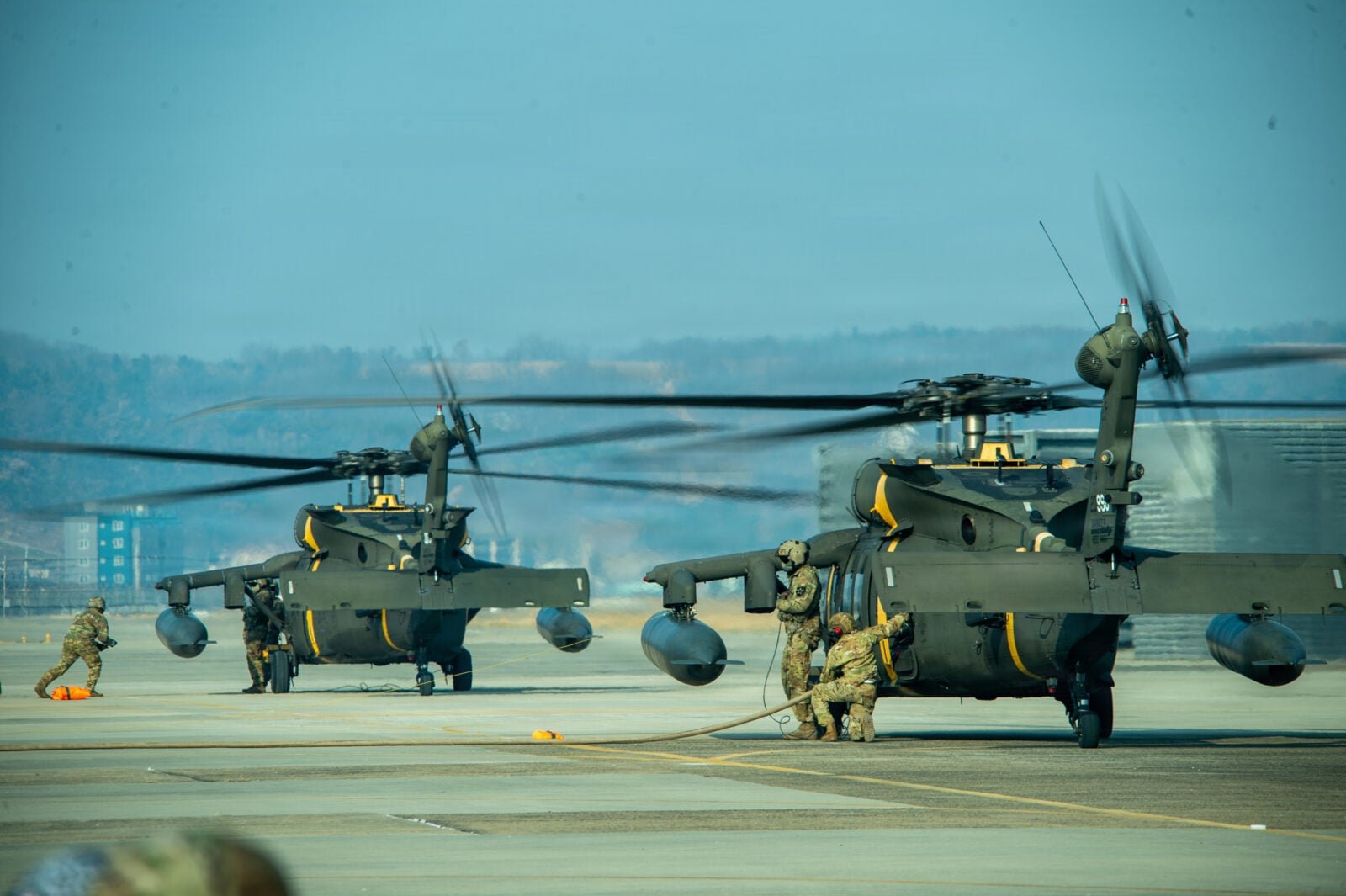
From a technical standpoint, long-range aviation operations require sustained logistics support, command and control integration, and the ability to refuel and rearm aircraft in dispersed locations. During Talon Reach, Forward Arming and Refueling Points (FARPs) were established across the peninsula to enable continuous operations.
The brigade deployed seven FARP sites to support the mission, allowing helicopters to refuel quickly and maintain operational tempo. “A Forward Arming and Refueling Point extends the operational reach of a battalion,” said 2nd Lt. Nicholas Meadows, who oversaw one of the sites.
“Our teams can rapidly establish refueling operations in austere locations, allowing aviation crews to sustain missions across extended distances. These operations require a tremendous amount of coordination and teamwork.”
The exercise also integrated small unmanned aircraft systems (sUAS) to support reconnaissance and targeting. According to Raub, “We used our drone company throughout the entirety of our missions performing reconnaissance for the division and later supporting the long-range maritime interdiction we completed at the end of our flight.”
Apache crews from the 4th Battalion, 2nd Aviation Regiment executed the culminating phase, conducting a precision strike following long-range movement. “Operation Talon Reach was a long-range mission of more than 1,100 miles that culminated in an attack and seizure of an island,” said Lt. Col. William Carrion.
“This mission confirmed that 4-2 Attack Battalion is ready to execute anywhere, anytime. We can extend combat power and mass forces wherever they are needed.”
The operation emphasized synchronization between manned and unmanned systems, with Apache helicopters integrating targeting data from drones to enhance battlefield awareness and strike coordination.
Exercises such as Talon Reach are conducted within the framework of the U.S.–Republic of Korea alliance and are intended to demonstrate readiness and interoperability between combined forces.
The ability to conduct long-range aviation operations is increasingly relevant in regions where forces may need to operate across dispersed locations while maintaining combat effectiveness.
[ad_2]
Source link


