
Table of Contents
[ad_1]
In a beauty landscape increasingly defined by discernment rather than excess, the modern complexion is less about layering and more about intention. The new codes of luxury, especially in fashion-adjacent beauty circles, are written in botanicals that perform as well as they photograph. Think less decorative florals, more functional flora. Within this shift, arnica oil has emerged not as a trend piece, but as a quietly authoritative ingredient: subtle, storied, and surprisingly potent.
For decades, arnica lived in the margins of beauty, tucked into pharmacies and athlete kits, synonymous with bruises and recovery. But in the current era of performance-driven skincare, its narrative has been recontextualized. Now, it’s less about treating injury and more about preempting stress – environmental, inflammatory, and cellular. Arnica, in other words, has moved from first aid to first principle.
The Rise Of Performance Botanicals
The appeal of plant-based skincare is no longer rooted in nostalgia or the romance of “natural beauty.” Today’s formulations are expected to deliver measurable outcomes, often rivaling lab-synthesized actives. This is where botanicals like arnica thrive: complex, bioactive, and layered in function.
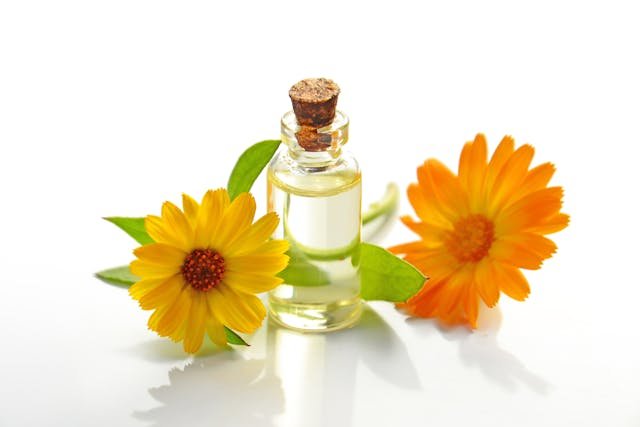
Extracted from Arnica montana, a yellow alpine flower that thrives in harsh, mountainous climates, arnica oil is typically created through infusion (its blossoms steeped in carrier oils to draw out active compounds). The result is not just a fragrant oil, but a concentrated botanical system designed to soothe, restore, and recalibrate the skin.
At the heart of its efficacy lies helenalin, a compound known for its ability to modulate inflammatory pathways. By interfering with key inflammatory signals, arnica addresses one of the most pervasive (and often invisible) drivers of skin aging: chronic, low-grade inflammation.
Inflammation: The New Beauty Battleground
If the last decade was defined by exfoliation and resurfacing, the next belongs to calming and repair. Inflammation, once discussed primarily in medical contexts, has become a central concept in skincare, linked to everything from premature aging to uneven tone and compromised barrier function.
Arnica’s anti-inflammatory properties are not theoretical. Traditionally used to reduce swelling, bruising, and discomfort, it has long been valued for its ability to visibly calm the skin. In a beauty context, this translates to a reduction in redness, a more even complexion, and an overall sense of equilibrium.
But what makes arnica particularly compelling is its relevance to “inflammaging,” a term increasingly invoked in both dermatology and luxury skincare. Chronic inflammation accelerates collagen breakdown and dulls the skin’s natural luminosity, effects that no highlighter can convincingly mask. By targeting this underlying process, arnica operates not as a cosmetic fix, but as a corrective strategy.
Brightening, Reimagined
In the lexicon of beauty, “brightening” has often been shorthand for exfoliation or pigment suppression. Arnica offers a more nuanced interpretation.
Rather than stripping the skin or aggressively targeting melanin, it works by improving circulation and reducing the appearance of discoloration—particularly the kind associated with stress, fatigue, or minor trauma. This is why arnica has historically been used to fade bruising; it supports the skin’s natural recovery process, helping to restore clarity and tone.
In modern formulations, this translates to a kind of lived-in radiance: skin that looks less inflamed, more rested, and subtly lit from within. It’s the difference between engineered glow and authentic vitality.
For a deeper dive into its mechanisms and applications, the science-backed overview of arnica oil benefits offers a compelling entry point into why this alpine ingredient is gaining traction among formulators and editors alike.
Texture, Touch, And The Sensory Experience
Luxury skincare is as much about experience as it is about efficacy, and arnica oil delivers on both fronts. Typically infused into lightweight carrier oils like sunflower or grapeseed, it absorbs with a certain ease—never overly occlusive, never fleeting.
On the skin, it feels purposeful. There’s a quiet slip, a softening effect that lends itself to massage and ritual. In an era where facial massage has become both a wellness practice and a sculptural technique, arnica’s ability to reduce puffiness and tension adds another layer to its appeal.
It’s not hard to imagine it backstage at fashion week: pressed into cheekbones before makeup, or used post-show to calm skin that has endured hours of product, heat, and handling.
The Aesthetic Of Restraint
What makes arnica oil particularly resonant right now is its alignment with a broader aesthetic shift, one that values restraint over excess, and authenticity over artifice.
This is the era of “skin first.” Makeup, when worn, is sheer and intentional. Skincare is expected to do the heavy lifting, creating a canvas that doesn’t require correction. Arnica fits seamlessly into this philosophy. It doesn’t promise transformation overnight; instead, it supports the skin’s own processes, enhancing what is already there.
There is also a certain intellectual appeal. Arnica is not the most obvious ingredient. It requires a level of curiosity, a willingness to look beyond the usual suspects like vitamin C or hyaluronic acid. For a fashion-forward audience, this sense of discovery is part of the allure.
A Note On Use And Modern Formulation
As with many potent botanicals, arnica demands respect. In its raw form, it can be irritating and is not meant for ingestion; in skincare, it is carefully diluted and formulated for topical use. This is where the sophistication of modern beauty comes into play: the art of harnessing nature without compromising safety or elegance.
Today’s formulations often pair arnica with complementary ingredients – think barrier-supporting lipids, calming extracts, and subtle antioxidants – creating blends that are both effective and sensorially refined.
From Apothecary To It-Girl Staple
Perhaps the most interesting aspect of arnica’s ascent is how seamlessly it bridges worlds. It carries the credibility of traditional medicine, the intrigue of alpine sourcing, and the polish of contemporary formulation. It feels at once grounded and elevated, a rare combination in an industry often driven by extremes.
In many ways, arnica oil embodies the current mood of beauty: intelligent, understated, and quietly transformative. It doesn’t announce itself with bold claims or viral packaging. Instead, it earns its place through performance, through the subtle but undeniable improvement in how the skin looks and feels over time.
And in a moment where true luxury is defined not by excess, but by efficacy and intention, that may be the most fashionable quality of all.
[ad_2]
Source link


