
Table of Contents
The Lesson I Learned in a Cornfield
Your dog is fast. Faster than you. And when he spots a squirrel or a deer, all your calls to come back are just background noise. I learned this the hard way after my own labrador vanished into a cornfield outside Ames, Iowa. Four hours of searching, a handful of prayers, and one very tired panic-attack later, she sauntered out from the treeline, tail wagging. That’s when I bought a GPRS tracker for dogs.
That little device changed everything. Not just for emergencies, but for the daily worry that lives in the back of every dog owner’s mind. If you’ve ever felt that gut-drop when your dog’s collar isn’t in your hand, you already know why this technology matters.
What Exactly Is a GPRS Tracker for Dogs?
Let’s clear up the alphabet soup. GPRS stands for General Packet Radio Service—it’s an older but reliable data network that your phone uses to send and receive small chunks of information. A GPRS tracker for dogs combines a GPS receiver (to find your dog’s location via satellites) with a cellular transmitter (to send that location to your smartphone using a SIM card and GPRS data).
So think of it this way: GPS finds your dog, GPRS tells you about it. Almost every modern dog tracker on the market is technically a GPS/GPRS device. Even ones marketed as simply “GPS trackers” rely on mobile networks to get the coordinates to your app.

But Isn’t GPRS Obsolete?
You might hear that GPRS is old technology, and in some ways it is. However, it’s still widely supported by carriers because it’s efficient for low-volume data transmission—exactly what a tracker needs. Newer trackers use LTE or even 5G for faster updates, but a solid GPRS tracker remains a dependable, budget-friendly choice. The principle is the same: your dog’s position is constantly calculated and relayed to a map on your phone.
How Does a Dog GPS Tracker Work?
Here’s the simple version. There are three pieces to the puzzle:
- GPS satellites: They ping your dog’s tracker to pinpoint its exact coordinates.
- Cellular network (GPRS/3G/4G): The tracker sends those coordinates over mobile data to the company’s servers.
- Your phone’s app: The servers beam the location to your screen, usually within two to three seconds.
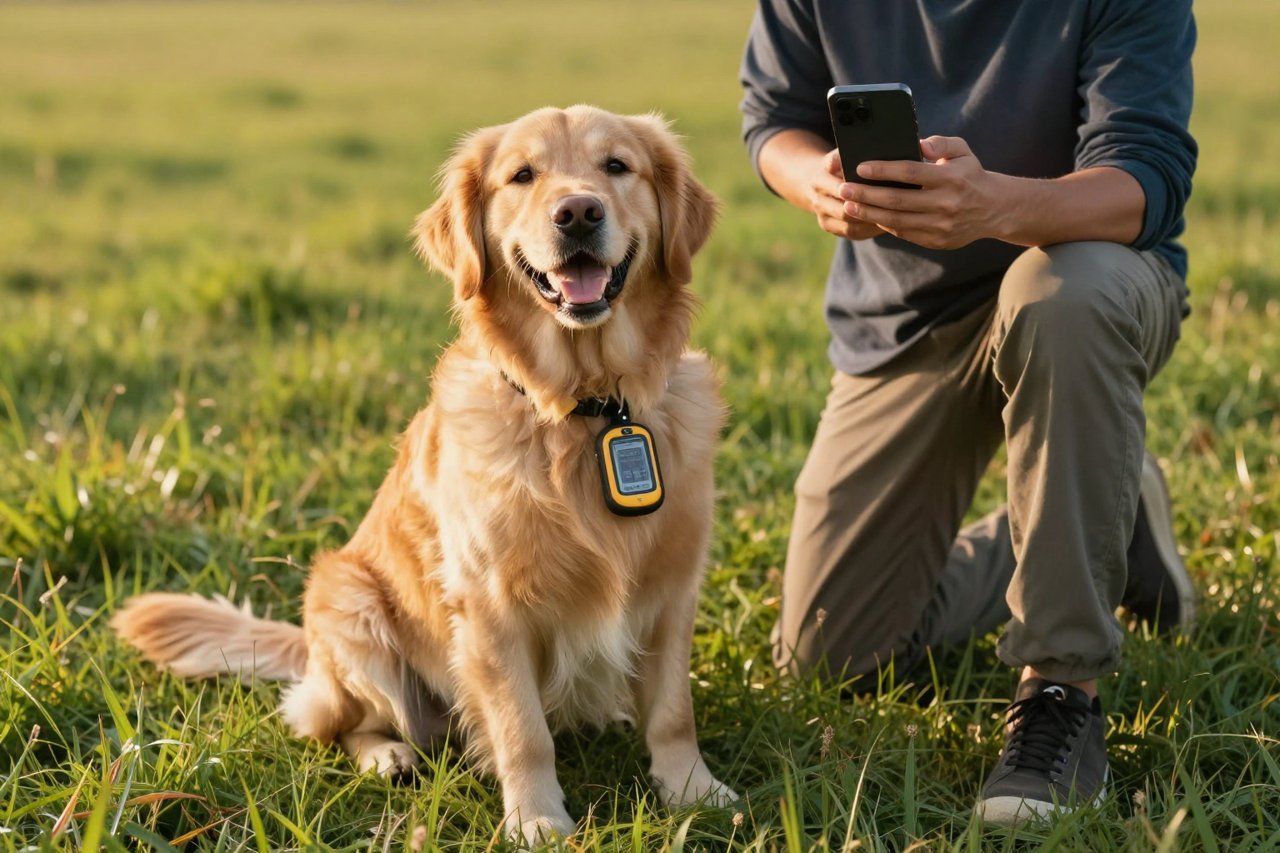
Most trackers let you choose how often the GPS pings. If your dog’s out of sight, you can switch to live tracking, which updates every one or two seconds. That’s like watching a tiny dot move in real time through a field or a maze of streets. In contrast, standard tracking might only update every minute or even every five minutes, depending on battery-saving settings. When every second counts, those fast updates are the difference between catching up to your dog at the neighbor’s backyard or losing the trail entirely.
Key Features to Look For in a Dog Tracker
Not all trackers are created equal. Some are flimsy toys with plastic clips. Others are professional-grade devices that can survive being chewed, slammed, and dunked in a creek. Before you click “buy,” here’s what actually matters:
- Real-time tracking mode (updates under 3 seconds)
- Battery life: 24–72 hours with live tracking on, ideally longer on standard mode
- Waterproofing: IP67 or IP68 rating, so a lake swim won’t kill it
- Weight: Less than 3.5 ounces is ideal for a 20+ pound dog
- Geofencing alerts: Get a text when your pup leaves a safe zone you drew on the map
- Subscriptions or no monthly fee: Know your long-term cost before you commit
- Coverage area: Does it work in rural areas? Check the carrier’s network maps
Battery Life and Size Trade-Offs
Here’s the thing about battery life: it’s the biggest compromise in the industry. A tiny collar attachment will last 12 hours on live mode. A bigger device might last three days. Think about your day-to-day reality. If you’re hiking for eight hours with your dog off-leash, you want a battery that won’t die mid-slog. But if your dog is a 9-pound Chihuahua, you can’t slap a brick the size of a matchbox on her collar. Look for a tracker that offers a power-saving mode that sends location every 5–10 minutes while active, so the battery stretches for a week between charges.
Real-World Uses Beyond Finding a Lost Dog
Yes, the main purpose is to find your dog when they’ve bolted. But let me tell you, a GPRS tracker for dogs earns its keep in plenty of other scenarios too.
The Escape Artist
Some dogs are Houdini. They dig under fences, slip through gates, and squeeze out of playpen setups. Instead of waiting for the next escape to panic, you can get a geofencing alert the moment their collar leaves your yard. That’s the difference between a quick dash around the block and a full-blown missing-pet poster situation.
The Hunting Companion
If you hunt with your dog, you know the struggle of tracking a pointer that’s locked onto a scent 800 yards away. A tracker with a long-range signal (some work up to 9 miles) lets you follow the action without walking in circles. Some even have a built-in flashlight or bark detector—handy details.
The Senior Dog
Older dogs can get confused. A dog with cognitive dysfunction might wander out of an open door and stand blankly on the curb. Real-time location makes it easy to find them even when they don’t respond to their name. One of my neighbors uses a tracker for her blind border collie, and she told me it gave her “a few more good years” of letting the dog wander the backyard freely.
Setting Up Your Dog’s Tracker Like a Pro
Buying the tracker is only half the battle. The setup is where most people trip up. Start by fully charging the device and downloading the companion app. Follow the instructions to pair it via Bluetooth. Be sure to allow the app to access your location and notifications. Then attach the tracker securely to your dog’s collar—make sure the buckle is tight enough that it won’t slide off, but loose enough that it doesn’t rub.
Once it’s on, create a geofence around your house. Test it by walking out of the gate and seeing if the alert fires. Then go for a walk and switch to live tracking. Watch the dot on your phone and confirm it matches your path. If there’s a lag of more than five seconds, restart the app or move to a spot with better cell coverage.
The Charging Routine That Saves You
There’s no worse feeling than grabbing a tracker that’s dead when you’re already running out the door. Set a recurring reminder to charge it at the same time you charge your phone. Some people swear by charging the tracker with their toothbrush in the morning, or every Sunday night. Whatever works. Just make it a habit.
Beyond the Panic: Everyday Perks
Once you get used to having real-time location, you’ll start to appreciate the quieter benefits. You can check if your dog is napping in the sunny spot in the yard without actually interrupting that perfect sunbeam face. You can let your kids walk the dog and secretly confirm they’re still on the block. If you leave your pup in the backyard while you’re at work, you can glance at the app to see if they’re pacing back and forth (which might mean they’re bored or anxious).
The GPRS tracker for dogs in your Amazon cart isn’t just an emergency gadget. It’s a tiny window into your dog’s world—a world that mostly revolves around sniffing things you’ll never identify and chasing sounds you’ll never hear. And when your dog is an escape artist with a mind of their own, that window of certainty is a beautiful thing to hold.


