
Table of Contents
Your body manufactures collagen every single day. It’s the protein that keeps skin from sagging, gives tendons their spring, and pads the cartilage between your knees. Production peaks in your twenties and then declines by roughly one percent a year, which is why a 45-year-old has noticeably less of it than a 20-year-old doing the same workout.
That explains why so many people end up staring at a shelf of powders and capsules with no idea which one to buy. Should it be 5 grams or 20? Marine or bovine? Does it go in coffee? This is a from-scratch guide for anyone who has never taken collagen before and wants the fundamentals straight before spending $30 a month on it.
What Collagen Actually Is
Collagen is a protein, which means it’s a chain of amino acids folded into a shape. Three of those amino acids matter most here: glycine, proline, and hydroxyproline. They twist into a triple helix, a rope-like structure that gives collagen its tensile strength. Vitamin C is required for that twisting step, which is why a severe vitamin C deficiency shows up as bleeding gums and skin that won’t heal.
There are at least 28 types of collagen in the human body, but a handful dominate:

- Type I: roughly 90% of the collagen you have. Skin, bone, tendon, teeth.
- Type II: cartilage, the cushioning in your joints.
- Type III: skin and blood vessels, usually found alongside type I.
When a tub says “types I and III” it’s aimed at skin, hair, and nails. “Type II” means joints. That one distinction clears up most of the confusion on the shelf.
Why Swallowing Collagen Doesn’t Just Get Digested Away
The obvious objection: isn’t collagen just protein? Don’t you digest it? You largely do. Stomach acid and enzymes chop protein into individual amino acids, and at that point your body has no idea whether they came from a steak or a scoop of powder.
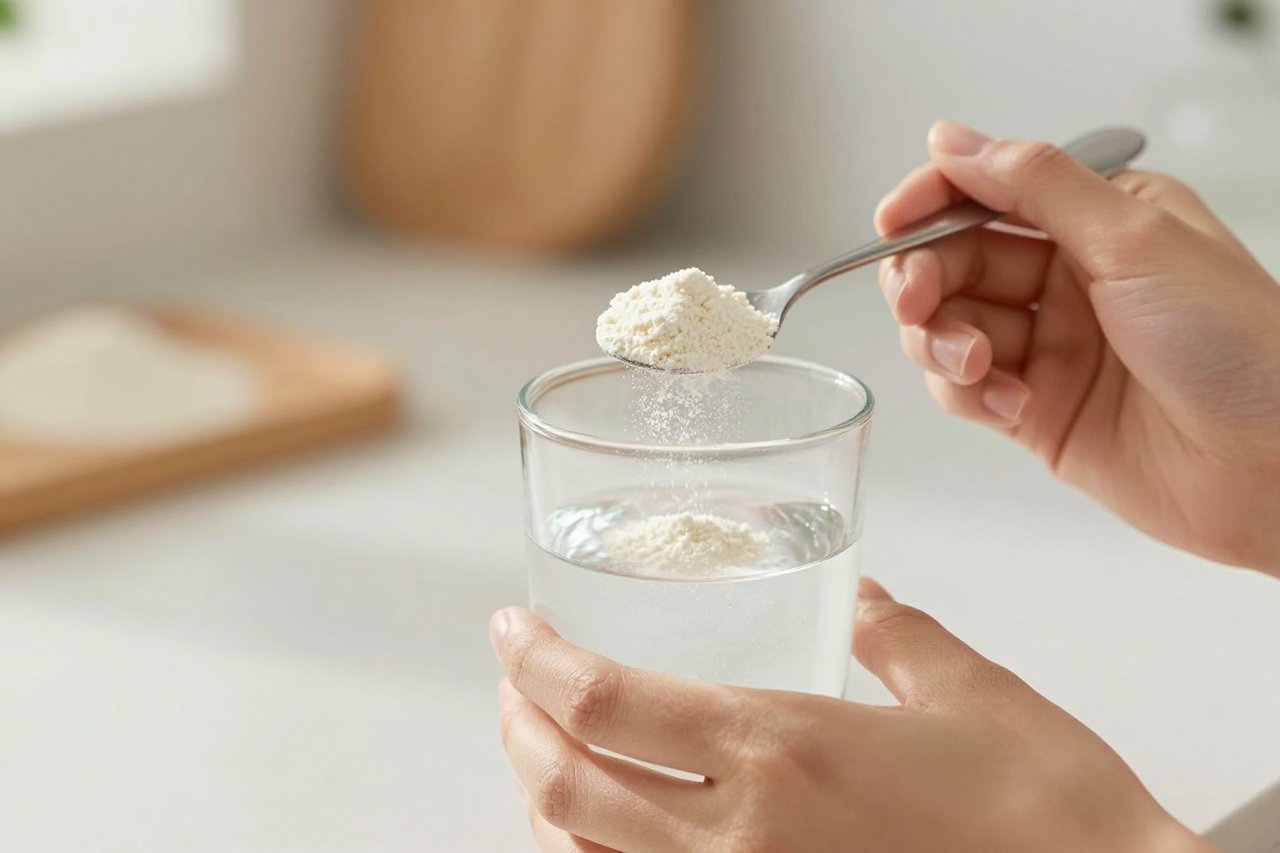
The twist is that hydrolysed collagen never gets fully chopped. Hydrolysis breaks the long protein into short chains called peptides, typically two to ten amino acids long. Those fragments survive digestion, show up in the bloodstream within about an hour, and seem to act as signals rather than bricks. They appear to nudge fibroblasts, the cells that build collagen, into producing more. That signalling theory is the leading explanation, not a settled fact, and honest researchers say so.
Decoding the Words on the Label
Hydrolysed collagen / collagen peptides
Same thing, different marketing. The protein has been pre-broken so it dissolves in cold water and absorbs quickly. This is what most clinical trials use.
Undenatured or “native” type II (UC-II)
Not hydrolysed. Taken in tiny doses, usually 40 mg, and studied for joint comfort through a different mechanism, something closer to immune tolerance. Don’t expect it to help your skin.
Gelatin
Collagen that’s been cooked but not hydrolysed. It sets into a jelly when it cools, which is lovely for gummies and useless in cold coffee. Nutritionally similar, less convenient.
“Collagen booster”
Read the ingredients. Plenty of products with that phrase contain no collagen at all, just vitamin C, zinc, and a few amino acids.
If the differences between these forms are already blurring together, there’s a comparison of how collagen types, sources, and forms stack up that goes deeper into each category.
Where It Comes From
- Bovine: hide and bone from cattle. Cheapest, most studied, types I and III.
- Marine: fish skin and scales. Smaller peptides, often marketed as better absorbed, though head-to-head evidence is thin. Tastes faintly of the sea.
- Porcine: pig skin. Common in Europe and Asia, less so in the US.
- Eggshell membrane: contains types I, V, and X, mostly sold for joints.
Vegan collagen does not exist. Collagen is by definition an animal protein. What you’re buying in those tubs is a blend of the amino acids collagen is built from, plus vitamin C, and there’s very little research testing whether it does anything.
What the Research Actually Supports
Modest effects, mostly. A pooled analysis of randomised trials on skin found small improvements in elasticity and hydration after eight to twelve weeks, with wrinkle depth reductions measured in fractions of a millimetre. Real, but nowhere near a facelift. Joint studies show similar-sized drops in pain scores for people with knee osteoarthritis. Hair and nail evidence is thinner, mostly small trials on brittle nails.
The effects are subtle enough that lifestyle factors still do more heavy lifting. Sunscreen, sleep, and not smoking will beat a powder every time. If facial ageing is your main concern, it’s worth understanding what collagen can and can’t do for skin, joints, and hair before you set expectations.
Powder or Cream?
Topical collagen is a different product entirely. The molecule is far too large to penetrate skin, so a collagen cream sits on the surface and moisturises rather than replacing anything. That’s still worth having, and collagen creams earn their place in a routine when they’re formulated well. But a jar will not raise your skin’s collagen content, and no cream does what a prescription retinoid does. If wrinkles are the target, it’s also worth sidestepping the common mistakes that sabotage wrinkle creams you already own before adding another product to the shelf.
Dose, Timing, and Vitamin C
Most studies land between 2.5 g and 10 g per day. Above 10 g, results don’t improve and you’re paying for expensive urine. A 40 mg dose of UC-II is a completely different protocol, aimed at joints.
Timing matters less than consistency. Some research suggests taking it 30 to 60 minutes before exercise, when collagen synthesis is already ramping up, and pairing it with vitamin C helps the body use the amino acids. Practically, taking it whenever you’ll actually remember beats optimising for a window you’ll forget. Give it eight to twelve weeks before deciding.
Five Label Red Flags
- “Proprietary blend” with no individual amounts. You can’t tell whether you’re getting 5 g of collagen or 500 mg.
- Collagen listed last. Ingredients are ordered by weight, so if sugar or flavour comes first, collagen is a garnish.
- Under 2 g per serving. Below the range used in most trials.
- No type or molecular weight stated. A serious brand tells you both.
- Grandiose timelines. “Visibly younger skin in 7 days” isn’t a claim anyone can support.
Price is a poor proxy for quality here, and there’s a useful breakdown of the buying mistakes that waste money on collagen if you’d rather not overpay for the same peptide.
How to Tell Whether It’s Working
Pick one thing to measure and change nothing else. Photograph your face in the same light at the same time of day, or note how your knees feel on stairs. Then wait.
Weeks one and two: nothing happens, and that’s normal. Weeks four to six: nails grow faster and chip less, which is the earliest sign most people notice. Weeks eight to twelve: skin feels springier, fine lines look slightly softer, joints ache a little less after exercise. If nothing has changed by week twelve, either the dose is too low, the product is weak, or you’re one of the people it simply doesn’t do much for. Stop taking it and put the money somewhere it works. A single tub bought at full price is a cheap experiment; a year-long subscription to something you never evaluated is not.


