
Table of Contents
In 1975, if you wanted to know something, you found a book. If you wanted to reach someone across the country, you paid by the minute and hoped they were home. And if you wanted to type a letter, you either owned a machine heavier than a bicycle or you borrowed one from an office.
Half a century separates that world from this one. It’s a single lifetime, and the distance between the two is startling. Here’s how technology has changed in the last 50 years, and what that change actually looked like from the inside.
The computer moved out of the basement
A hobbyist in 1975 could order an Altair 8800 for $397. It arrived as a box of parts with no keyboard, no screen, and 256 bytes of memory. You entered programs by flicking switches on the front panel. Two years later the Apple II and Commodore PET arrived with real displays, and by 1981 IBM had legitimised the whole category with the PC.
The leap in raw capability is genuinely hard to picture. A mid-range smartphone now carries around 8 GB of RAM, roughly 30 million times the working memory of that Altair. In 1984, only about 8 percent of American households owned a computer. By 2000 it was just over half. Today it’s close to 90 percent, and most of those machines fit in a pocket.

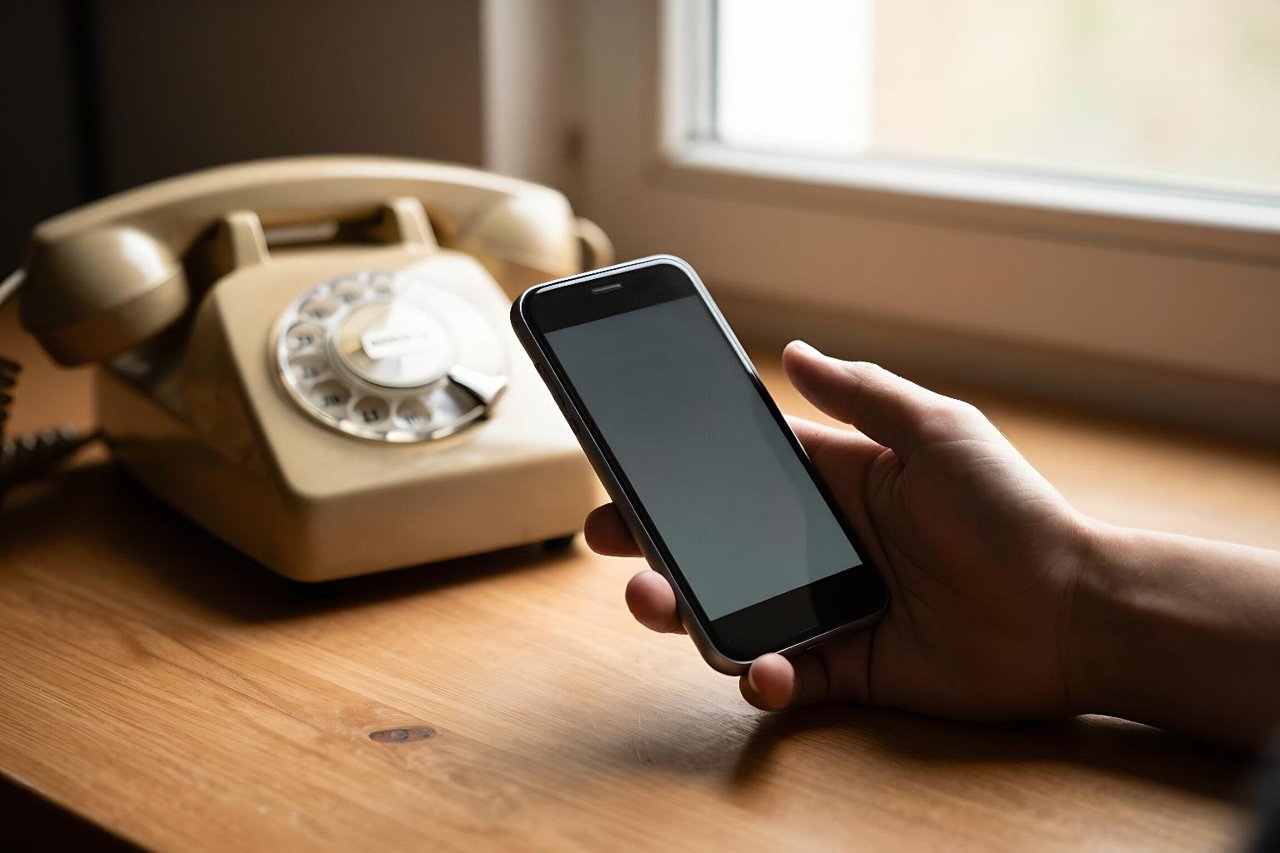
The phone stopped being attached to a wall
Motorola engineer Marty Cooper made the first handheld mobile call in April 1973, standing on a New York pavement. The phone that eventually reached shops, the DynaTAC 8000X, went on sale in 1983 for $3,995. It gave you 30 minutes of talk time and needed about 10 hours to recharge.
Long-distance calls in the 1970s were billed like a utility, with cheaper rates after 11pm and a queue of quarters at every payphone. Then came text messaging, then the iPhone in 2007, then the quiet assumption that a video call to another continent should be free. Children born this decade will find the idea of a long-distance charge as odd as a party line.
Storage went from shelves to someone else’s servers
In 1975, a business that needed serious storage bought an IBM 3350 disk drive: 317 megabytes, about 600 pounds, six figures. Home users had cassette tapes, then 5.25-inch floppies holding 360 KB. The 3.5-inch disk that became a schoolbag staple held 1.44 MB, which felt enormous at the time.
A 128 GB microSD card now costs less than a takeaway meal and weighs a gram. Much of what we saved has also moved off physical media entirely, which is why cloud-based data storage has become the default for everything from family photo albums to payroll records. The filing cabinet became a folder tree, and the folder tree became a login.
Medicine learned to see inside us
The CT scanner reached hospitals in the early 1970s, and the first full-body MRI scan of a human followed in July 1977, taking nearly five hours to produce an image a modern machine would capture in minutes. Surgery changed alongside it: gallbladders that once meant a week in bed and a long scar now come out through four small holes as day surgery.
Sequencing a human genome cost about $2.7 billion and took 13 years when the first draft was finished in 2003. Today it costs roughly $1,000 and takes a day or two, which is why genetic testing now sits in ordinary oncology clinics rather than locked research labs.
Space went from flags to geology
NASA’s Viking landers touched down on Mars in 1976 with computers holding around 18,000 words of memory between them. They sent back the first pictures from the surface and answered a simple question: what does the place look like? The rovers working today carry more processing power than the landers’ entire support systems and drill into rocks to read their chemistry.
That shift from visiting to analysing is the real story. When a Martian rock turned up containing a mineral nobody expected, the news was reported by instruments designed to identify exactly that kind of surprise.
The machines we love to be afraid of
Anxiety about clever machines is not new. HAL 9000 unnerved audiences in 1968. The Terminator arrived in 1984, and by the time Terminator 2: Judgment Day was released in 1991, the idea of a computer deciding we were the problem had become a blockbuster formula. As the film’s 35th anniversary prompts a second look at the franchise, the same worry has simply moved from silver-screen robots to chatbots answering customer emails.
What’s changed is proximity. In 1991 a killer AI lived in a fictional future. In 2025 it lives in a browser tab, and the argument about it happens in the same device that turns on your kitchen lights.
Some things barely moved at all
Not every prediction landed. The paperless office never quite arrived, and most of us print more than we expected. A transatlantic flight in 1975 took about seven hours from London to New York; a 2025 flight takes roughly the same, since the Concorde was retired in 2003 and jet speeds have barely budged since.
Batteries improved steadily rather than dramatically, and the electric car that seemed imminent in the 1970s took five more decades to become ordinary. Progress is uneven. It clusters in the places where a single breakthrough unlocks a thousand cheap applications.
The bill for all that speed
Every upgrade had a cost that wasn’t on the invoice. The world now generates more than 60 million tonnes of electronic waste each year, and only a fraction of it is properly recycled. Plastic production climbed from around 2 million tonnes in 1950 to more than 400 million tonnes a year, which is why plastic bag bans are now measurably keeping trash off shorelines.
The pattern repeats: a material solves a problem, becomes universal, and then the cleanup takes decades. Cheap microchips and cheap polymers arrived through the same door.
Where the next fifty years are already pointing
The uncomfortable lesson of the last half century is that the biggest changes were rarely the ones on the magazine covers. Nobody in 1975 predicted that the telephone would eat the camera, the map, the wallet and the record shop. They were too busy being impressed by the pocket calculator.
If you want a sense of where the next decade is heading, look at what’s cheap and getting cheaper rather than what’s loud. Analysts tracking the technology trends shaping 2025 keep circling the same few: machine learning that runs on ordinary hardware, cloud infrastructure that scales by the hour, and sensors embedded in things that never used to think. The tools are becoming invisible, which is usually the sign that they’ve won.


