
Table of Contents
Travel long enough and you start to notice the ratio. The famous sites come with timed tickets, audio guides and a queue that snakes past the gift shop. Then, twenty minutes off the main road, there is a ruin with no fence, no sign, and a goat picking through what used to be a temple doorway. Nobody is there but you.
Forgotten monuments around the world are rarely lost in the cinematic sense. Most were outgrown, quarried for building stone, swallowed by vegetation, or simply out-marketed by a more photogenic neighbour. UNESCO’s World Heritage list protects a little over 1,200 places. Archaeologists have recorded millions of sites. The gap between those two numbers is where the interesting things live, and it is the same gap explored in the most mysterious lost civilizations and what they leave behind.
Why a monument gets forgotten
Silt, salt and jungle do a lot of the work. Kilwa’s mosques are being eaten by the sea. Frost is splitting the stone heads on Mount Nemrut. But neglect is rarely the whole story. A monument survives on attention, and attention follows a story someone can sell: a battlefield people recognise, a king with a decent legend, a view that photographs well from a car park. Lose that, and a site can sit in the middle of a village for eight centuries while everyone walks past it.
Two kinds of obscurity in Southeast Asia
Bujang Valley, Malaysia: busy before Angkor existed
Drive ninety minutes north of Penang into the rice plains and oil-palm country of Kedah and you are in what Malaysian archaeologists argue is the oldest civilisation in Southeast Asia. The Bujang Valley has produced more than 90 candi, the brick shrines of a Hindu-Buddhist polity that traded with India and China, along with iron-smelting furnaces dated to the early centuries CE. That is roughly a thousand years before Angkor was founded.

It is not a ruin field in the conventional sense. Shrines sit behind village houses. Several structures were dismantled in the 1970s and 1980s to make way for development, still a sore subject locally. The archaeological museum at Merbok explains what you are looking at, but the landscape itself asks something of you: imagination, and a willingness to drive between scattered fragments.
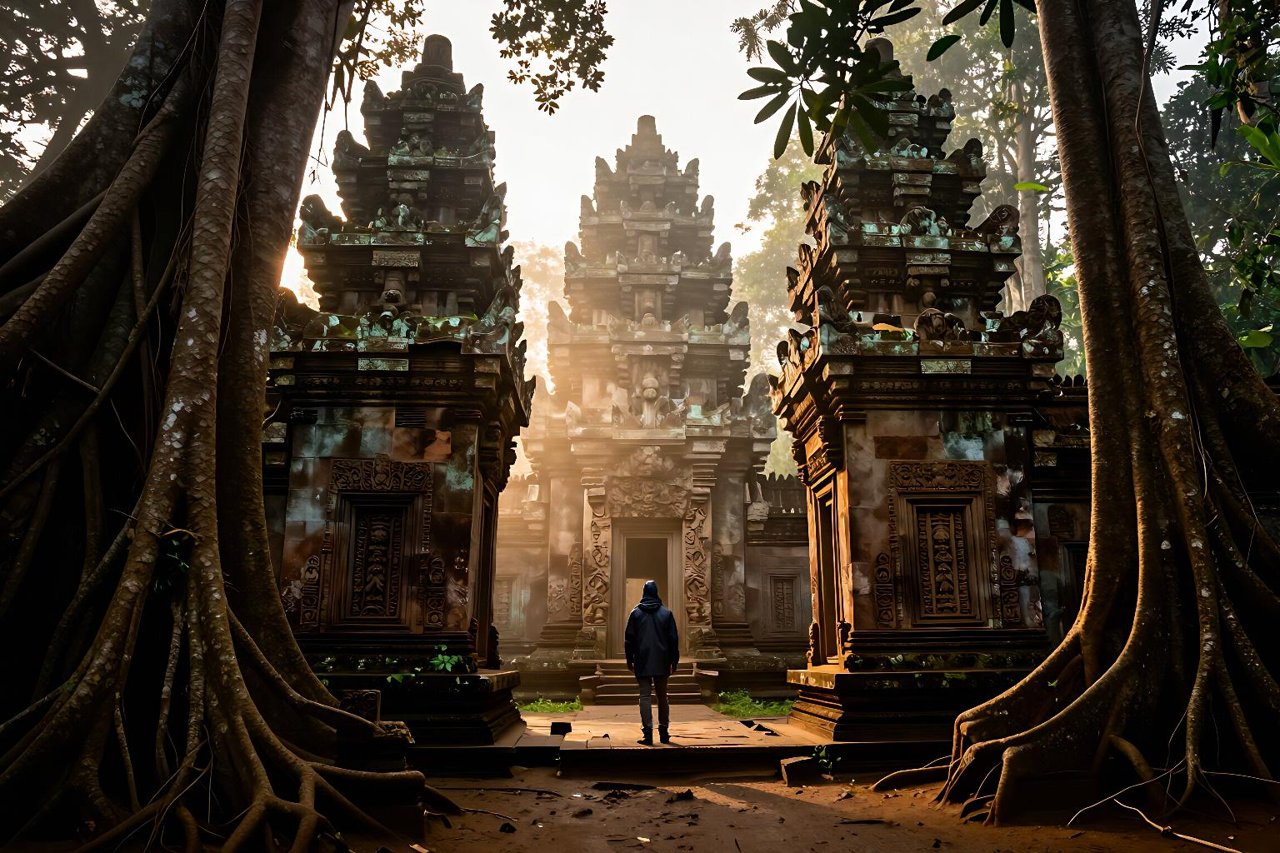
Banteay Chhmar, Cambodia: thirty towers the jungle kept
Jayavarman VII built Banteay Chhmar in the late 12th century, and it was not a modest project. A walled complex of more than thirty towers, galleries of bas-reliefs showing naval battles, and a famous multi-armed Avalokiteshvara. It sits near the Thai border, which is part of why so few people go. The Khmer Rouge held the area for years, landmines were cleared through the 2000s, and the access road was, for a long time, a genuine adventure.
What has changed is how much we can see. Airborne laser scanning and satellite survey have revealed whole city grids hidden under jungle canopy across the region, settlement patterns that ground survey missed for a century. The Banteay Chhmar moat was always visible; the scale of what surrounded it is only now coming into focus, as this account of how lasers, drones and droughts are rewriting the human story sets out.
It is also one of the better models for community tourism in Cambodia. Local families run homestays, guide visitors by bicycle, and cook for them, which means your entry fee stays in a village of a few thousand people rather than vanishing into a capital city.
Ani, the city on the wrong side of a border
On a windswept plateau above the Akhurian River, where Turkey meets Armenia, stand the red basalt bones of a city that may have held 100,000 people. Ani was the capital of a medieval Armenian kingdom, and travellers prone to exaggeration called it the City of 1,001 Churches. The cathedral, begun in 989, still has its pointed arches. The Church of the Redeemer was sliced open from dome to foundation by a lightning strike in 1319.
The Mongols sacked Ani in 1236. An earthquake finished the job. By the 17th century it was empty. Today it faces Armenia across a ravine that nobody crosses, and visitors approach from Kars on the Turkish side, walking an empty ridge past fading frescoes. It is one of the great sights of the region, and on a weekday in October you may have the cathedral entirely to yourself.
Kilwa Kisiwani and the coral-stone coast
Off the southern coast of Tanzania, reachable by boat from Kilwa Masoko, is an island the medieval world considered a serious destination. Ibn Battuta visited in 1331 and described Kilwa as one of the most beautiful cities he had seen. Its Great Mosque, built from coral rag and lime mortar, has domes and barrel vaults that were engineering marvels in 14th-century East Africa, funded by a gold trade that ran inland to Great Zimbabwe.
The ruins are now losing ground to the sea. Salt attacks the mortar, wave action undercuts the foundations, and conservation has depended on a handful of international projects. You can stand in a mosque six centuries old and hear the Indian Ocean working at the wall behind you. Fewer than a few thousand people visit in a year.
The permanent runners-up
Aphrodisias, Turkey
The stadium here seated around 30,000 and runs to nearly 270 metres, making it one of the best preserved ancient stadiums anywhere in the Mediterranean. The city was a sculptor’s town, famous across the Roman world for carving marble, and its reliefs fill a museum on site. Ephesus, two hours away, takes the crowds. Aphrodisias takes the people who read the guidebook properly.
Kuélap, Peru
The Chachapoya built this fortress city on a ridge at around 3,000 metres, with walls up to 20 metres high and more than 400 buildings, starting centuries before Machu Picchu. It was abandoned in the 16th century and only properly documented in the 19th. A cable car opened in 2017, cutting a long, steep walk, though visitor numbers remain a fraction of the Inca trail’s.
Aihole, India
More than 120 temples scattered across a village in Karnataka, most of them 6th to 8th century, and many historians call it the cradle of Indian temple architecture. Hampi and Badami collect the tour buses. Aihole gets farmers, school groups and the occasional architectural historian with a tripod.
Memorials whose country no longer exists
Between the 1960s and 1980s, Yugoslavia built hundreds of monumental concrete memorials to its World War II dead. Tjentište’s Valley of Heroes. Petrova Gora, a stainless-steel fist against the sky. Designers like Bogdan Bogdanović treated them as sculpture as much as commemoration. Then Yugoslavia dissolved, and the monuments lost the state that maintained them. Plaques were prised off, some were vandalised, and many now stand in fields with no interpretation at all. Their afterlife is one thread in this guide to Sarajevo and the country’s passage from war to wonder.
Something similar happened on the Normandy coast, where thousands of Atlantic Wall bunkers still sit in fields, gardens and cliff faces. Some are farm sheds. Some are sliding into the sea. A few are museums. You can drive past a dozen of them on the way between the better-known sites, which is exactly what a well-planned D-Day beaches itinerary allows time for.
The monument you walk past on the way to the famous one
Mehrauli, in south Delhi, is the best argument that obscurity has nothing to do with quality. A 200-acre archaeological park next door to the Qutub Minar holds more than a hundred monuments: the tomb of Balban, the Jamali Kamali mosque, the stepwell of Rajon ki Baoli, and dozens of anonymous domes and graves in between. Millions of people photograph the Qutub each year. The park next door is often empty apart from boys playing cricket. Four teenagers from Noida built an app that walks you through Delhi’s history, partly because the signage at places like this is so thin.
How to visit without loving a place to death
- Check access first. Many of these sites sit on private or military land, or open only when a caretaker is around. A phone call the day before saves a wasted afternoon.
- Use the local guide. At Banteay Chhmar, Kilwa and Ani, guiding is often the only direct income the monument generates for the people living beside it.
- Stay off the masonry. Lime mortar and root-damaged stone do not recover from a hundred pairs of trainers a week.
- Pay the entry fee even when nobody asks. A padlocked gate and a plastic chair are sometimes the entire conservation budget.
- Ask before photographing homes. In Bujang Valley, Mehrauli and parts of Ani, the monument is somebody’s neighbourhood, not a set.
The goat will still be there when you leave. What matters is whether the gate is still open in twenty years, and whether the money you spend on the way in reaches the village rather than a coach company two hundred kilometres away. Forgotten monuments around the world do not need rescuing by outsiders. They need enough visitors to justify keeping the roof on, and few enough to keep the place worth visiting.


