
Table of Contents
You’re standing in a grocery store aisle holding a bunch of leafy green herbs, and the recipe in your hand calls for coriander. Or maybe you’re scrolling a British food blog that insists on “fresh coriander” when you know full well you’re looking at cilantro. Both moments cause the same small panic: did I buy the right thing?
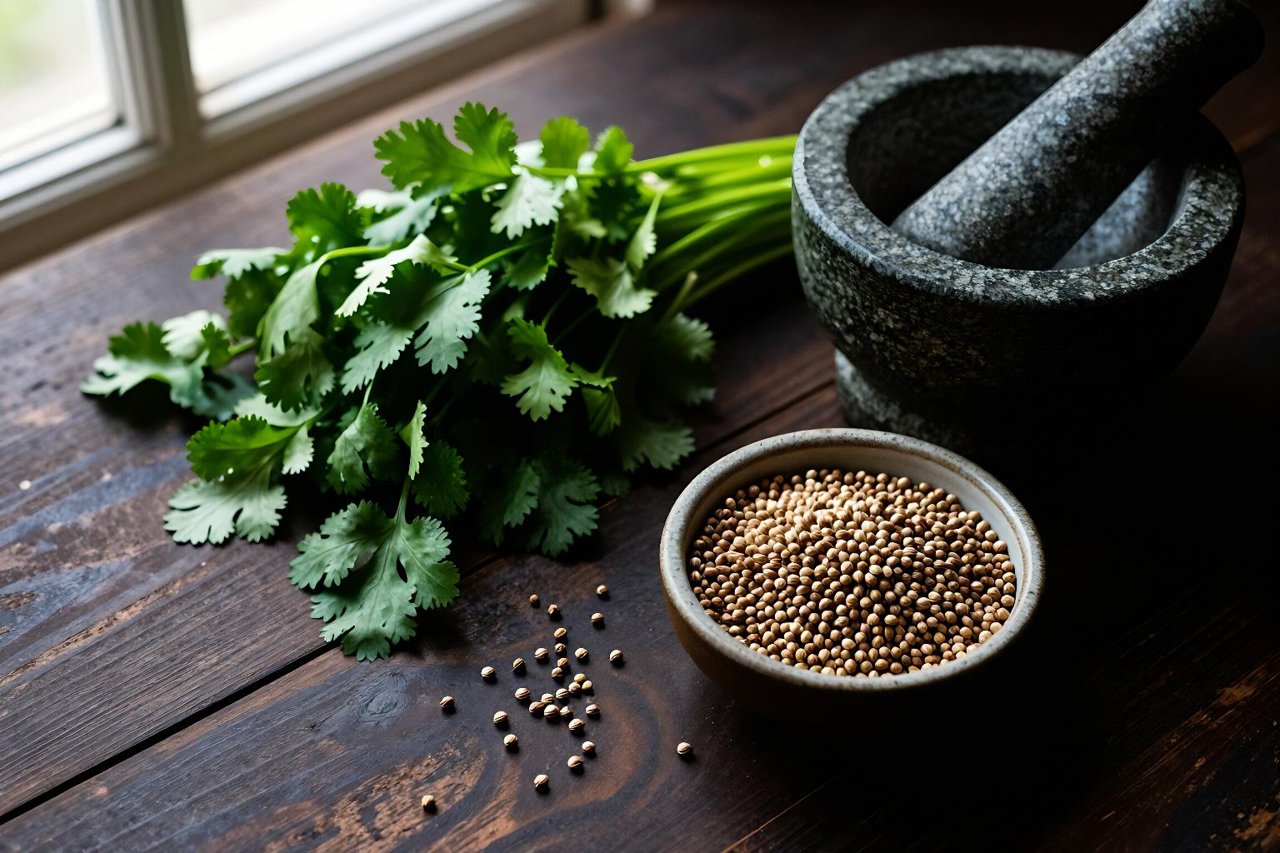
Here’s the short answer. Cilantro and coriander are the same plant, Coriandrum sativum, an annual herb in the parsley family. The confusion isn’t botanical, it’s linguistic. What you call the plant depends entirely on where you learned to cook.
The naming divide, explained in one paragraph
In the United States and Canada, “cilantro” means the fresh leaves and stems, while “coriander” means the dried seeds. In the United Kingdom, Australia, Ireland, India and most of the Commonwealth, “coriander” covers the whole plant, leaves included. So a British recipe asking for chopped coriander wants what an American recipe would call cilantro. Nobody is wrong. The words just travelled different routes: “cilantro” comes from Spanish cilantro, itself from Latin coriandrum, while “coriander” arrived through Old French coriandre.
One more wrinkle worth knowing. In parts of India, “dhania” refers to both the seed and the leaf, and the two are treated as separate ingredients in the same dish. A dhaba curry might use ground dhania in the gravy and a fistful of fresh dhania on top. Same word, two jobs.

What the leaves actually taste like
Fresh cilantro is bright, green and slightly citrusy, with a peppery finish. The stems carry more flavour than the leaves, which is why Thai and Vietnamese cooks blitz whole bunches, stems and roots included, into curry pastes and marinades. If a recipe tells you to pick the leaves and discard the stems, you’re throwing away the best part.
The soap gene
Roughly 4 to 14 percent of people describe cilantro as tasting like soap or dish detergent, and it’s not fussiness. A cluster of olfactory receptor genes, most famously OR6A2, makes some people unusually sensitive to the aldehydes in the leaf. Those same compounds show up in soap manufacturing and in the scent glands of stink bugs, which explains the comparison. Interestingly, the effect fades for many people with repeated exposure, and crushing or cooking the leaves reduces it. Coriander seeds contain far lower levels of those aldehydes, so people who hate the leaf often love the seed.
What coriander seeds bring to the table
Dried coriander seed is a completely different experience: warm, nutty, floral, with a lemon-peel edge. It’s a backbone spice in Indian garam masala, Ethiopian berbere, Moroccan ras el hanout and German sausage blends. Ground coriander is one of the few spices that works equally well in a lamb tagine and a carrot cake.
Toast before you grind
Whole seeds are far more aromatic than pre-ground powder, which loses its punch within about three months. Toast them in a dry pan over medium heat for 60 to 90 seconds, shaking often, until they smell like orange peel and toasted bread. Let them cool completely before grinding, or they’ll steam and clump. A spice grinder or a mortar and pestle both work; the mortar gives you a coarser, more rustic texture that’s lovely on roasted vegetables.
Buying and storing each one
- Fresh cilantro: Look for upright, unwilted stems and deep green leaves with no yellowing. Trim the ends, stand the bunch in a glass with an inch of water, cover loosely with a plastic bag and refrigerate. It keeps about a week.
- Freezing leaves: Cilantro turns mushy when frozen whole, but chopped and packed into ice cube trays with a splash of water or oil, it drops straight into soups and curries.
- Coriander seeds: Buy whole, store in an airtight jar away from the stove, and they’ll hold for two to three years. Smell them before use; if the aroma is flat, the oils are gone.
- Ground coriander: Buy in small quantities, date the jar, and replace every six months if you cook with it regularly.
Can you substitute one for the other?
Usually not, and it’s worth understanding why. Swapping ground coriander seed for fresh cilantro leaves is like swapping coffee beans for a cup of tea. The seed is a warm background note; the leaf is a raw, bright finish. There is no ratio that fixes that.
Where substitutions do work: if a recipe wants fresh cilantro and you have parsley, flat-leaf parsley gets you 70 percent of the way there, especially in a salad or a chimichurri. If you’re out of ground coriander seed, ground cumin plus a pinch of ground fennel or caraway is a reasonable stand-in for spice blends. Cilantro haters can often use culantro (Eryngium foetidum), a different plant with a similar but more intense flavour that lacks the soapy aldehydes, and it’s a staple in Puerto Rican and Trinidadian cooking.
How different cuisines treat the two parts
Mexican cooking leans hard on the leaf: pico de gallo, salsa verde, tacos, and a whole genre of agua fresca. Coriander seed barely appears. Indian cooking uses both enthusiastically, blooming whole seeds in hot ghee at the start of a dish and finishing with fresh leaves. Thai kitchens use the root, which is the most intensely flavoured part of the plant, pounded into green curry paste with garlic and white pepper. Scandinavian bakers grind coriander seed into rye bread and aquavit. Vietnamese and Cambodian cooks scatter raw leaves over noodles and summer rolls as a salad green, not a garnish.
The one rule that solves the confusion
When you’re reading a recipe, ignore the word and look at the form. If it says “chopped,” “a handful,” “fresh” or “to garnish,” you need the green stuff. If it says “ground,” “crushed,” “toasted” or gives a measurement in teaspoons, you need the seeds. That single check works for any recipe from any country, and it’ll save you from dumping a tablespoon of ground spice into a salsa that wanted a fistful of herbs.
Keep a bunch of cilantro in the fridge and a jar of whole coriander seed in the cupboard, and you’ve covered both halves of the plant. They’re not rivals and they’re not duplicates. They’re two ingredients that happen to share a Latin name, and knowing which one a recipe means is the whole game.


