
Table of Contents
A bunch of parsley costs about a dollar and usually dies in the crisper drawer within a week. That is a waste, because the herb does far more than decorate a plate. It carries more vitamin K per bite than almost any leafy green, it holds its own in dishes that call for it by the bowlful, and it comes in forms most cooks never touch, including a root vegetable that tastes like a cross between carrot and celeriac.
Here is what to look for, what the numbers actually mean, and how to get through a whole bunch before it turns yellow.
The Three Parsleys Worth Knowing
Curly parsley
Tight ruffled leaves, mild grassy flavour with a faint soapy edge that some people genuinely dislike. Its real advantage is structure. Curly parsley holds its shape when chopped and does not collapse under dressing, which is why it survives as the default diner garnish and works well in potato salad, egg sandwiches, and anything that needs a bit of green crunch. It is also cheaper and hardier than the flat-leaf sort, and it grows well in partial shade.
Flat-leaf (Italian) parsley
Bigger, darker, flatter leaves and roughly twice the concentration of the volatile oils that give parsley its flavour. When a recipe just says parsley, this is what is meant. It is the herb in tabbouleh, chimichurri, gremolata, and persillade. Chopped fine, it almost dissolves into a sauce. Left coarse, it stays bright and separate. A useful trick: salt the chopped leaves lightly and let them sit for five minutes before dressing them, which takes the raw, slightly metallic edge off.

Root parsley (Hamburg parsley)
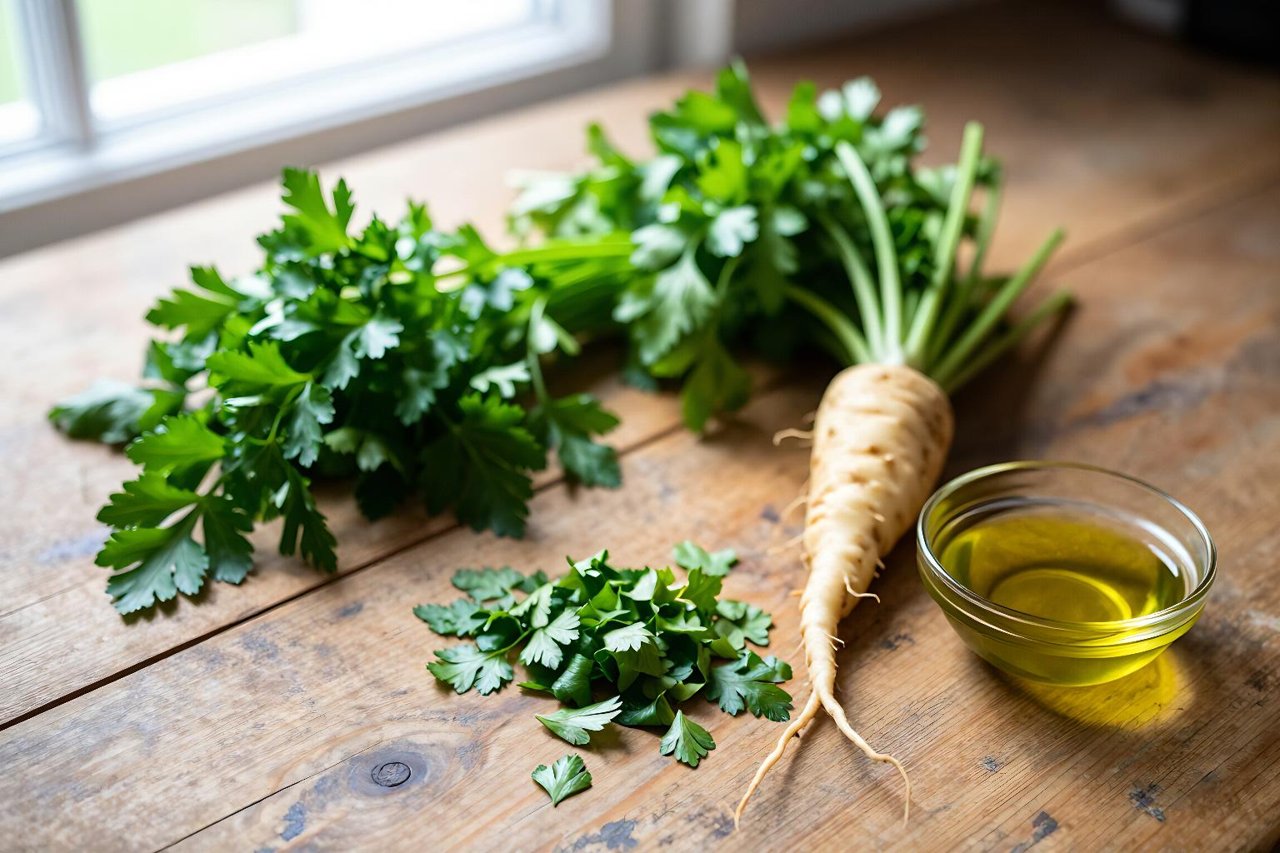
Grown for its white, parsnip-shaped root rather than its leaves. It is common in Polish, German, and Czech cooking, where it goes into soup alongside celeriac and carrot. The flavour sits somewhere between parsley leaf, parsnip, and celery, and it is sweeter and milder than celeriac. Look for it at farmers’ markets in autumn. Roast it in chunks at 200°C for 35 to 40 minutes, purée it with butter, or grate it raw into a remoulade.
Two other herbs borrow the name and neither is related: coriander leaf is sold as Chinese parsley, and mitsuba as Japanese parsley.
Parsley Nutrition: Big Numbers, Small Portions
Per 100g of raw curly parsley you get about 36 calories, 3g protein, 3.3g fibre, 133mg vitamin C (an orange has roughly 53mg per 100g), 1,640µg vitamin K, 421µg vitamin A as retinol equivalents, 152µg folate, and 554mg potassium.
The catch is obvious. Nobody eats 100g of parsley. A generous garnish is closer to 10g, and that portion still delivers around 164µg of vitamin K, about 140% of a typical adult daily target, plus 13mg vitamin C and 15µg folate. Two tablespoons of chopped parsley a day is a realistic way to nudge those figures up without eating a salad made entirely of herbs.
Parsley is also one of the more concentrated everyday sources of apigenin, a flavonoid that has been studied for its role in inflammation and cell signalling. Most of that work is lab-based or small, so treat the dramatic headlines with caution and enjoy the herb for what it is.
- Blood thinners: the vitamin K content matters for people on warfarin. Consistency beats avoidance. A steady small amount is easier to manage than a week of none followed by a parsley-heavy feast.
- Oxalates: parsley is moderately high, at roughly 170mg per 100g. A garnish is a non-issue, but juicing whole bunches daily is not a good habit for anyone prone to calcium oxalate stones.
- Iron: 6.2mg per 100g looks impressive on a label, but it is non-haem iron paired with oxalates, so absorption is poor. Pair it with lemon juice or tomato to help.
- Dried parsley: most of the volatile oils disappear in drying. It adds colour and little else.
Where Parsley Earns Its Place in the Kitchen
Stirred in raw
Persillade is chopped parsley and raw garlic, added off the heat to finish sautéed potatoes, snails, or a piece of fish. Gremolata adds lemon zest to the same idea and goes over osso buco. Chimichurri blends a packed cup of flat-leaf parsley with half a cup of olive oil, red wine vinegar, garlic, oregano, and chilli. Tabbouleh, properly made, is a parsley salad with a little bulgur in it rather than the reverse, often three parts herb to one part grain.
Stems in the pot
Stems carry as much flavour as the leaves and stand up to long cooking. Tie them with thyme and bay for a bouquet garni, or drop them straight into stock, chicken soup, or tomato sauce and fish them out later. Frozen stems go in whole and are easy to retrieve.
Cooked by the handful
Some cuisines treat parsley as a vegetable. Kuku sabzi, the Iranian herb omelette, uses 300 to 500g of mixed herbs, with parsley usually the largest share. Ghormeh sabzi simmers a similar volume down over hours. British parsley sauce, made from a butter and flour roux loosened with milk and finished with a big handful of chopped leaf, is worth making at least once. Deep-fried parsley is another one: dry the sprigs thoroughly, fry at 180°C for about 30 seconds until the sizzling stops, and serve next to fried fish. Any water left on the leaves will make the oil spit.
Root and all
Root parsley slices into coins and simmers with chicken stock and a bay leaf for a clean, sweet soup base. It also mashes well with potato at a ratio of about one part root to three parts spud.
Buying and Keeping It Alive Longer
- Choose bunches with dark, stiff leaves and no yellowing. The stems should snap rather than bend.
- Store it like flowers: trim a centimetre off the stems, stand them in a glass with an inch of water, cover loosely with a bag, and refrigerate. Change the water every couple of days and you will get seven to ten days.
- A damp paper towel inside a lidded container works almost as well and takes less fridge shelf height.
- Freeze chopped parsley in ice cube trays topped up with olive oil or water, about two tablespoons per cube. Drop a cube straight into a hot pan.
- Skip oven drying. The flavour loss is severe and freezing takes less effort.
Growing It, and the Lookalike That Sends People to Hospital
Parsley is a biennial, so it flowers and runs to seed in its second year. Let a single plant bolt and it will self-seed generously for years afterwards. From seed it is slow, taking three to four weeks to germinate, so soak the seeds overnight before sowing. Give it at least six hours of sun and expect 70 to 90 days to a usable harvest. Pick the outer stems first and the plant keeps producing from the centre. In mild climates it survives winter and gives a second flush in early spring.
One serious warning. Poison hemlock has flat, fern-like leaves that look much like flat-leaf parsley, and it grows in the same hedgerows and waste ground. The tells are purple blotches on a hollow stem and a musty, mouse-like smell. Fool’s parsley is another close relative with similar looks. Garden parsley smells clean and green when you crush a leaf between your fingers. Anything that smells rank, or that you found growing wild without absolute certainty, should stay where it is.


