
Table of Contents
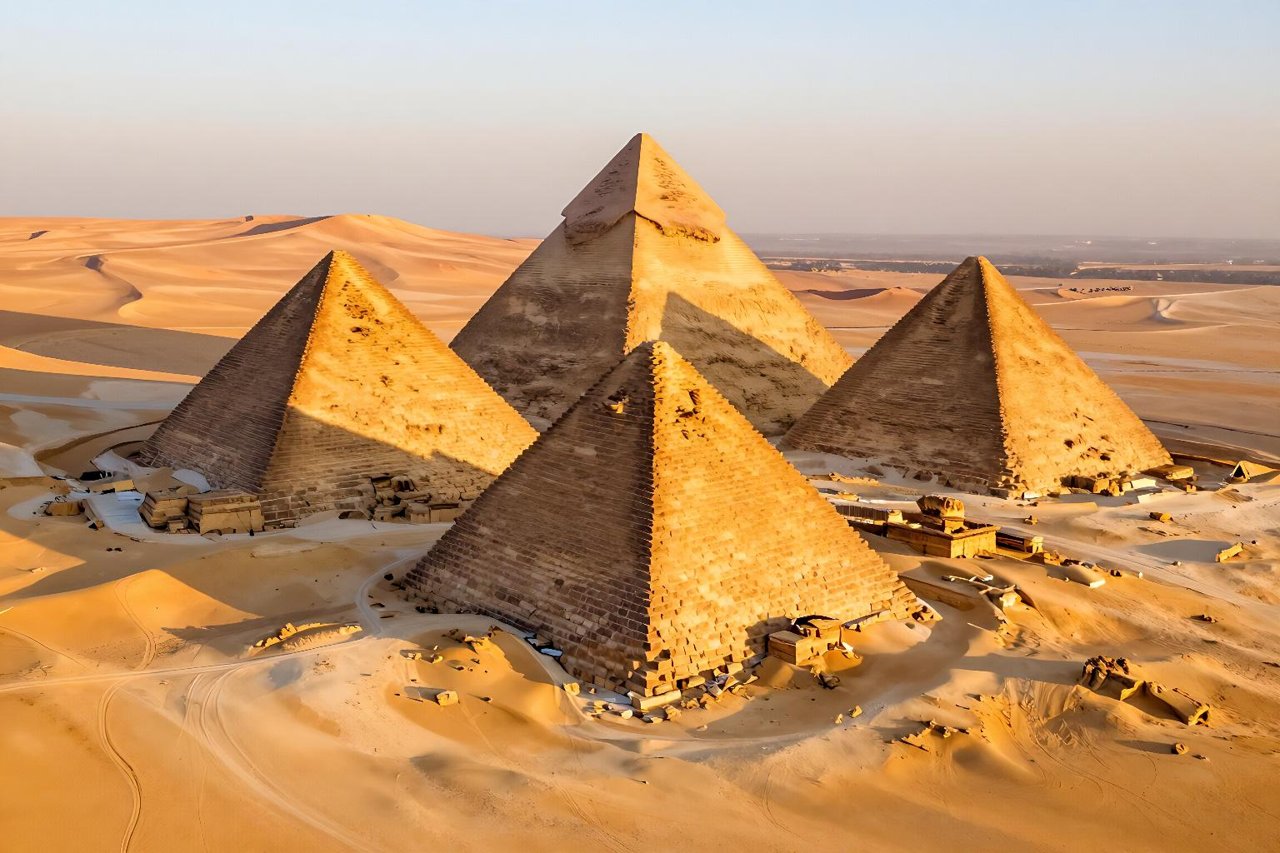
Drive four hours north-east of Khartoum and the desert suddenly fills with pyramids. They are not the smooth, enormous kind at Giza. These are steep, narrow-sided tombs crowded close together behind a ridge of rock, and there are more than two hundred of them scattered across the sand near a village called Bagrawiya. They were built by the rulers of Meroë, capital of one of the most powerful states of the ancient world, and most visitors to Sudan have never heard of them.
The ancient Nubian kingdoms stretched along the Nile from roughly the first cataract at Aswan south to the confluence of the Blue and White Nile. They traded with Egypt, conquered it once, fought Rome to a draw, and produced their own script, their own gods, and a line of ruling queens who led armies. Their story runs for three thousand years, and it is only patchily told in the museums and textbooks that usually frame the Nile Valley around Egypt alone.
Before Kush: The Kingdom of Kerma
The first great Nubian state rose around 2500 BC, roughly as Egypt was building its own pyramids, and its capital was at Kerma, just downstream of the third cataract. The city’s most striking monument is the Western Deffufa, a mud-brick tower that still stands about eighteen metres high and once formed the core of a temple complex. This was no village. Kerma controlled the trade in ivory, gold, ebony and cattle moving between sub-Saharan Africa and the Mediterranean, and its kings were buried in enormous circular tumuli, some over ninety metres across.
Excavations of the largest royal graves turned up hundreds of sacrificed retainers laid out in ordered rows, along with thousands of cattle skulls arranged around the tomb. The scale of it signals a ruler with real command over people and livestock. Egypt eventually grew nervous of its southern neighbour and, around 1500 BC, pharaoh Thutmose I pushed south and destroyed Kerma, absorbing Nubia into the Egyptian empire for the next four or five centuries.

Napata and the Twenty-Fifth Dynasty
Egypt’s grip loosened after the New Kingdom collapsed. By the ninth century BC a new power had consolidated around Napata, near the holy mountain of Jebel Barkal, where the god Amun was said to dwell. This was the kingdom of Kush, and in about 744 BC its king Piye marched north, took Memphis, and founded the Twenty-Fifth Dynasty of Egypt. For roughly seventy years Nubian pharaohs ruled from the delta to the sixth cataract.
Piye commemorated his campaign on a granite stele at Jebel Barkal, a text that reads less like imperial boasting and more like a travel diary, complete with complaints about the state of Egyptian horse stables. His successors ruled from Memphis but were buried back home, in steep pyramids at El-Kurru and later at Nuri, where twenty-one royal tombs still stand.
Taharqa’s building spree
The best known of these kings, Taharqa, ruled from 690 to 664 BC and left monuments from Karnak to Kawa. He added a colonnade at Karnak, rebuilt temples in Nubia, and pushed building work harder than any Egyptian pharaoh of the preceding century. His reign ended badly. Assyrian armies under Esarhaddon and then Ashurbanipal swept into Egypt, sacked Memphis, and drove the Kushites back south. The dynasty never recovered Egypt, but Kush itself carried on.
Meroë: Iron, Trade and Warrior Queens
Around 590 BC the royal court shifted south to Meroë, between the fifth and sixth cataracts, and over the following centuries the city became one of the most cosmopolitan places in Africa. It sat at the junction of Nile trade routes and the overland tracks heading east to the Red Sea, and imports reached it from the Mediterranean, Arabia and, in small quantities, India. Meroitic graves have yielded cotton textiles, glassware, ivory and bronze vessels from as far away as Roman workshops.
The city’s reputation as an iron-working centre is usually overstated. Excavators found vast heaps of slag and assumed Meroë had smelted iron on an industrial scale, arming half of Africa. More recent analysis of the furnaces suggests output was modest, aimed largely at local tools and weapons. What’s not in doubt is that the kingdom had a serious metallurgical tradition and the fuel supply to sustain it, in a belt of acacia woodland that has since retreated south.
Who were the kandakes?
Meroitic society gave women a prominence that startled Greek and Roman observers. Several rulers bore the title kandake, often translated as queen mother, though in practice these women commanded armies, issued decrees in their own names and were buried in their own pyramids. The most famous, Amanirenas, fought a war against Rome.
- Amanirenas (c. 40–10 BC) attacked Roman garrisons at Syene, Philae and Elephantine around 25 BC, taking prisoners and pulling down imperial statues.
- The Roman writer Strabo described her as a one-eyed woman of formidable courage; she had lost an eye in battle.
- In 1910 archaeologists found a bronze head of Augustus buried beneath the threshold of a Meroitic temple, positioned so worshippers would trample it on the way in.
- The peace treaty of around 20 BC ended the war on terms favourable to Meroë, and Rome dropped its demand for tribute.
Writing, Gods and Everyday Life
The Meroites developed their own writing system, a set of twenty-three signs adapted from Egyptian hieroglyphs but used to record a language with no relation to Egyptian. Roughly two thousand inscriptions survive, on temple walls, stelae, offering tables and ostraca. The script was deciphered phonetically in 1911 by the British scholar Francis Llewellyn Griffith, so we can read the sound of the words. Nobody can fully understand what they mean. The language itself died out, and no bilingual text has ever been found.
Religion at Meroë blended Egyptian and local traditions. Amun remained central, honoured at Jebel Barkal and in the great temple at Meroë itself, alongside Nubian deities such as Apedemak, a lion-headed god of war depicted on temple reliefs at Musawwarat es-Sufra and Naqa. Kings and queens were buried in pyramids with chapels on their eastern faces, their tombs filled with pottery, jewellery, bronze lamps and shabti figures.
Ordinary life ran on mud-brick housing, sorghum and millet farming, cattle herding, and fishing in the Nile. Excavated domestic quarters at Meroë show workshops, granaries and kilns packed tightly together, a dense urban fabric rather than a ceremonial centre with nothing around it.
The Christian Kingdoms of Nubia
Meroë went into slow decline by the fourth century AD, weakened by shifting trade routes and pressure from the desert east. An inscription of the Aksumite king Ezana, from around 350 AD, records a campaign against the Noba people, and the old kingdom fragmented.
What replaced it was a trio of Christian states. Missionaries sent from Constantinople in the sixth century converted the kingdoms of Nobatia in the north, Makuria with its capital at Old Dongola, and Alodia in the south. Faras, near the modern Egyptian border, became a major bishopric and bishop’s seat, and its cathedral was decorated with more than a hundred painted murals, discovered in the 1960s and now split between museums in Warsaw and Khartoum.
Makuria’s most remarkable achievement was a treaty. In 652 AD, following an Arab siege of Dongola, the two sides agreed the Baqt, a pact that permitted trade, imposed an exchange of slaves and goods, and effectively halted the southward expansion of early Islamic armies in the Nile Valley. It held, with interruptions, for nearly seven centuries. Alodia lasted until about 1504, when the Funj Sultanate absorbed it.
What Survives, and Where to See It
The best introduction sits inside the UNESCO-listed necropolis at Jebel Barkal and the nearby royal cemeteries at El-Kurru and Nuri, where you can walk between pyramids the size of a garage and still see the painted chapel entry of a Kushite queen. Meroë, listed separately as the Island of Meroë, offers the royal pyramid field, temple ruins and rows of slag heaps marking the old iron works.
In the north, Old Dongola shows the mud-brick walls of its cathedral and the granite columns of a church built into a hilltop. Then there is the Nubian Museum in Aswan, opened in 1997 as part of the compensation for the communities displaced by Lake Nasser, which holds carved relief, jewellery and pottery from the towns now under water.
Somewhere between fifty and a hundred thousand Nubians were resettled during the 1960s to make way for the Aswan High Dam. Their descendants still live along the new lake shore and in cities across Egypt and Sudan, speaking dialects of a language that descends from the same family as those inscriptions no one can translate. The pyramids at Bagrawiya are a two-hour-walk from the nearest paved road. A guard will unlock the gate of the royal cemetery for a few dirhams and, if you are lucky, walk you past tombs his grandfather also showed to visitors.


