
Table of Contents
A sliver of bone from a cave floor. A charred seed the size of a grain of rice. A scrap of linen. Put any of them in the right laboratory and, a few weeks later, you can get a number that places a human life, a fire, or a burial within a century or two of a specific moment in the past. Few scientific techniques have done more to reorganise our picture of prehistory, and few are more widely misreported.
So here is the whole method, from cosmic rays to calibration curves, without the hand-waving.
What the Method Actually Measures
Carbon-14 is an unstable isotope created high in the atmosphere when cosmic rays smash into nitrogen atoms. The newly formed carbon-14 oxidises into carbon dioxide, mixes through the air and oceans, and gets pulled into plants during photosynthesis. Animals eat the plants. Every living thing, humans included, is slightly radioactive.
The proportion is tiny. Roughly one carbon atom in a trillion is carbon-14; the rest is stable carbon-12. Because living tissue constantly exchanges carbon with its surroundings, that ratio holds steady throughout an organism’s life, give or take small variations.

The Clock Starts at Death
Once an organism dies, the exchange stops. No new carbon comes in, and the carbon-14 already present begins to decay back into nitrogen at a fixed rate. The half-life is 5,730 years. After 5,730 years, half of the original carbon-14 remains. After 11,460 years, a quarter. After about 50,000 years, so little is left, roughly 0.2 per cent, that contamination and instrument noise swamp the signal. That is the practical ceiling of the technique, and why radiocarbon dating works beautifully on a 9,000-year-old burial but cannot touch a dinosaur.
Why Raw Radiocarbon Ages Need Correcting
Willard Libby developed the method in the late 1940s and won a Nobel Prize for it. He also assumed that carbon-14 production had been constant through time. It hasn’t. Solar activity and the Earth’s magnetic field both shift the amount of carbon-14 in the atmosphere, which means a sample that looks 4,000 radiocarbon years old might actually be 4,400 calendar years old.
The fix arrived through tree rings. By measuring carbon-14 in individual growth rings of long-lived trees, and cross-referencing with timber from ancient buildings and lake sediments, researchers built a calibration curve that translates radiocarbon years into calendar years. The current version, IntCal20, was published in 2020 and stretches back 55,000 years, stitched together from tree rings, corals, speleothems and foraminifera.
The Bomb Peak
Atmospheric nuclear tests in the 1950s and 1960s nearly doubled the carbon-14 concentration in the atmosphere before it dispersed. That spike is a gift for forensic scientists: it lets labs date tissue formed after 1950 with alarming precision. Teeth, hair and bone can pin down a person’s year of birth or death, and wildlife investigators use the same signal to identify illegally traded ivory from animals killed after the test era.
One useful quirk: “before present” in radiocarbon reporting means before 1950, not before today.
What Happens Inside the Lab
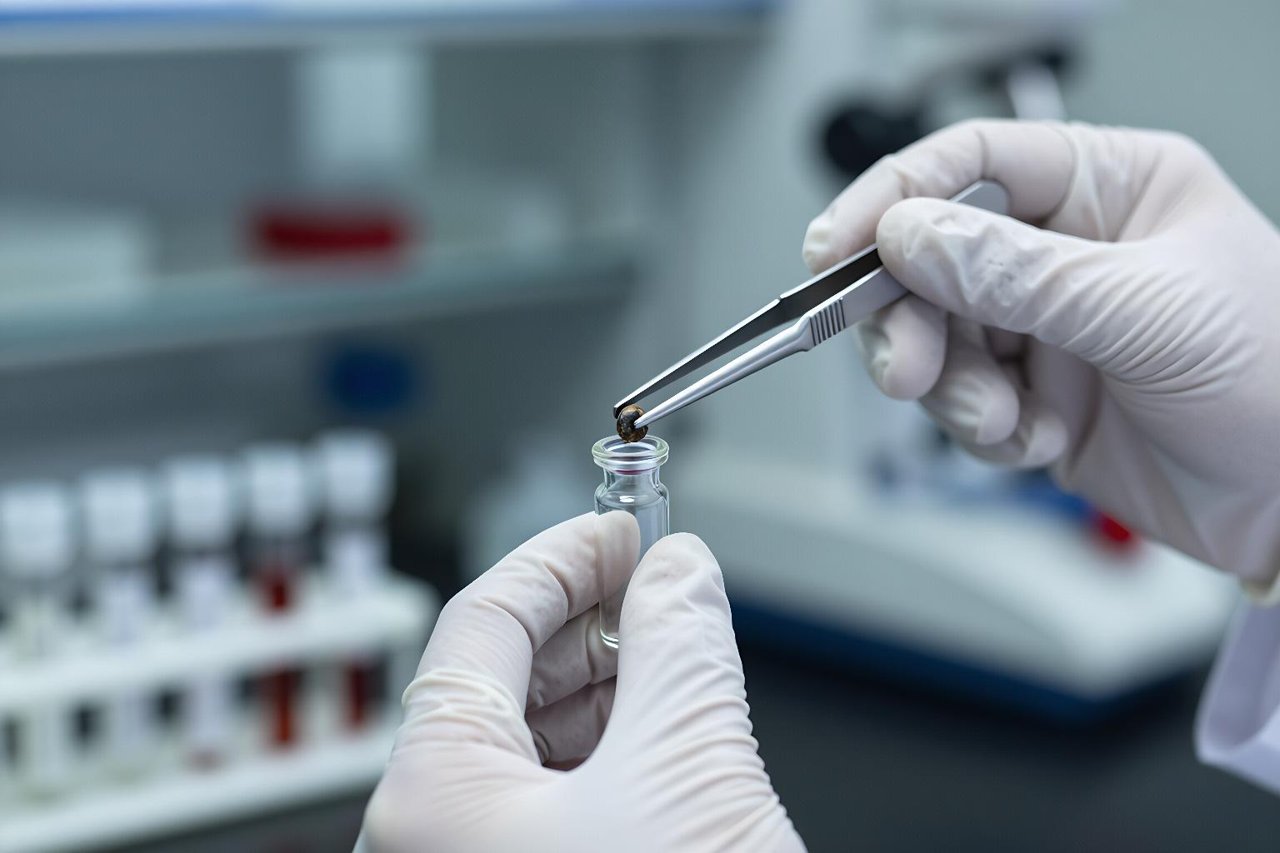
Most of the work is chemistry, not counting. Samples are cleaned, and cleaning means stripping away everything that could smuggle in modern carbon: rootlets, humic acids, museum varnish, conservation glue, the oils from a researcher’s fingers.
- Bone and antler: labs extract collagen, the protein that survives when mineral has leached away. Poorly preserved bone yields nothing usable.
- Charcoal and charred seeds: treated with acid and alkali to remove carbonates and soil contamination.
- Shell and coral: dated with care, because the ocean’s carbon reservoir can be several centuries out of step with the atmosphere.
- Textiles and wood: cleaned, then dated, though a timber beam only dates the year the tree was felled, not the year a building went up.
After pretreatment, the carbon is converted to graphite and loaded into an accelerator mass spectrometer, which counts individual carbon-14 atoms rather than waiting for them to decay. AMS needs only a few milligrams of carbon, so a single seed or a fragment of a bowstring can now yield a date that would once have required a bucketful of charcoal.
Three Ways Dates Go Wrong
Contamination. A couple of per cent of modern carbon worked into an old sample can shave thousands of years off its apparent age.
The reservoir effect. Freshwater fish, seals and shellfish can show up centuries older than they are, and a human who ate a marine-heavy diet carries that offset in their bones. Archaeologists now measure local offsets before trusting coastal dates.
The old wood problem. A long-lived tree used as fuel can give a date centuries earlier than the hearth it burned in. Excavators prefer short-lived material, twigs and seeds, for exactly this reason.
Reading a Result Properly
A radiocarbon result is never a single year. It arrives as a range with a stated confidence: for example, 1260 to 1390 AD at 95 per cent probability, the figure reported for the Shroud of Turin in 1988. Calibration curves are bumpy, with plateaus where several calendar centuries produce nearly identical radiocarbon values, which is why some samples yield wide, frustrating spans.
Modern practice layers dates together. Bayesian statistical models combine a sequence of radiocarbon results with stratigraphy, the principle that lower layers are older, to tighten a site’s chronology dramatically. A settlement dated by six messy individual ranges can be resolved into a tight sequence of occupation phases.
Where the Technique Changed the Narrative
Radiocarbon dating dismantled the assumption that human cultural development radiated outward from Europe on a fixed schedule. It pushed the earliest occupation of the Americas back past 14,000 years at sites such as Monte Verde in Chile, and it showed that Australia and New Guinea were settled more than 50,000 years ago, long before any European cave art existed. Many of these reversals are now taught as turning points in how we understand the human past, alongside the other biggest discoveries in history that shaped our world.
The method also underpins geology and planetary science. When researchers argue that a cosmic airburst flattened a region without leaving a crater, the case often rests on radiocarbon dates from charred wood and burned sediment, analysed closely enough to separate a genuine event from ordinary fire history. That kind of claim lives or dies on sample quality, which is why papers on ancient airbursts that ravaged Earth without leaving craters attract such fierce scrutiny.
What It Cannot Do
Radiocarbon dating cannot date a flint tool, a bronze axe or a pot, because none of them was ever alive. It dates the organic material found beside them, which is a subtle but vital distinction: the date belongs to the sample, not necessarily to the object you care about. It cannot resolve a rock art panel painted with mineral pigment, and it cannot reach beyond the 50,000-year horizon.
What it can do, when the sample is clean and the calibration is sound, is remarkable. A charred hazelnut shell from a hearth can place a band of hunter-gatherers at a specific spot within a human lifetime. The number comes with error bars, caveats and a chain of chemistry behind it, and that honesty is what makes it trustworthy.


