
Table of Contents
Most sleep advice starts with you: go to bed earlier, put the phone away, stop scrolling at 11pm. All of that helps. But the room around you is doing quiet work all night, and it’s usually easier to change than your willpower is. A bedroom that’s two degrees too warm, glowing faintly from a router, and doubling as an ironing station will keep pulling you out of deep sleep no matter how good your intentions are.
The fixes below are mostly cheap and can be done in an evening. Some you’ll feel tonight. Others take a fortnight to show up.
Start With Temperature, Because It’s the Fastest Fix
Your core body temperature drops by roughly half a degree Celsius in the hour before sleep, and that drop is part of the signal telling your brain to switch off. A warm room fights the process.
Most sleep researchers point to 16–20°C (around 60–68°F) as the range where adults sleep best. That’s cooler than most homes are kept in winter, which is why bedrooms are often the warmest room in the house and the worst sleep happens there. Turn the radiator down or off in the bedroom and shut the door. Two degrees is enough to notice.

What touches your skin matters as much as the air. Cotton or linen sheets, a lighter duvet in summer, and a mattress topper that doesn’t trap heat all help. Cold feet are the exception to every rule: if your toes are icy you won’t fall asleep, so keep socks by the bed for the first ten minutes and kick them off once you’re warm.
Get Serious About Light
Melatonin is sensitive to less light than you’d think. A strip of hallway bulb under the door, a standby LED on a smoke alarm, the glow of a charging cable. Any of these can register. Total darkness isn’t realistic in most homes, but near-darkness is.
- Blackout curtains, or a decent sleep mask. The mask is cheaper and works in rented flats where you can’t drill.
- Electrical tape over LEDs. Four minutes of work, and a surprisingly big difference.
- Charge the phone in the hallway, or at least face-down and out of arm’s reach.
Morning light is half the job
What you do at 7am shapes how easily you fall asleep at 11pm. Ten to fifteen minutes of daylight soon after waking, ideally outdoors, anchors your body clock and makes the evening melatonin surge arrive on time. If your bedroom gets no morning sun, open the curtains the second you get up and get outside before you check your phone. There’s a version of this built into my balancing morning routine (and how to create your own), which is worth borrowing from if your mornings currently run on autopilot.
Handle Noise Before It Wakes You
It’s the spikes that wake you, not the volume. A steady hum of traffic is easier to sleep through than one slammed car door at 3am, because your brain stops registering the predictable and jolts at the novel. That’s the logic behind white noise: it doesn’t block everything, it smooths the gaps.
Practical fixes include foam earplugs (look for roughly 30dB of reduction), a fan on low, a rug over bare floorboards, and a draught excluder along the bottom of the door, which cuts noise and cold air at the same time. If a neighbour’s dog is the problem, a pair of soft silicone earplugs beats lying there fuming.
Spend Money Where Your Body Touches the Bed
Mattresses last eight to ten years, then they quietly stop doing their job. Pillows are worse: most should be replaced every 18 months to two years, and a flat pillow is a common cause of waking with a stiff neck. If you’re up more than twice a night with an aching back or shoulder, the bedding is a fair suspect.
Joints get less forgiving with time, and a mattress that felt fine at 30 can be punishing at 50. If you’re thinking about how your body changes as you get older, these healthy aging tips that actually work at any age are a useful companion read, since sleep quality and joint comfort tend to move together.
Sheets: wash weekly at 60°C where the fabric allows, which kills dust mites rather than just shifting them around. Keeping two sets in rotation makes that far more likely to actually happen.
Clear the Air Without Freezing the Room
Bedrooms get stuffy fast. An adult exhales around half a litre of water vapour overnight, and a closed door plus a closed window means humidity climbs while you sleep. Aim for 30–50% relative humidity; above 60% and dust mites and mould thrive. A cheap hygrometer costs less than a takeaway and settles the argument.
The fix is unglamorous. Open a window for ten minutes before bed, even in winter, or crack it an inch overnight if the radiator is off. In colder months the opposite problem shows up: heating plus sealed windows dries the air out, which is rough on throats and noses. What you need to stay healthy this winter covers the humidity side of that in more detail.
Make the Room Slightly Boring
Your brain learns associations quickly. If the bedroom is where you work, argue about bills, watch series and fold laundry, it becomes a room for being awake. If it’s mostly a room for sleeping, getting into bed starts doing some of the work for you.
That usually means dealing with the laundry chair. Visual clutter is mildly stressful, and mild stress is not what you want at 11pm. The same principle runs through the rest of the flat, which is why creating a more comfortable and relaxing living environment tends to start in the rooms where you spend the most time.
The bed does one job
Where space allows, keep the desk out of the bedroom and don’t take calls from under the duvet. If your flat is small and there’s no other option, put the laptop in a drawer at night and drape a cloth over the desk. Small barriers are more effective than they look.
Use Scent and Ritual as Signposts
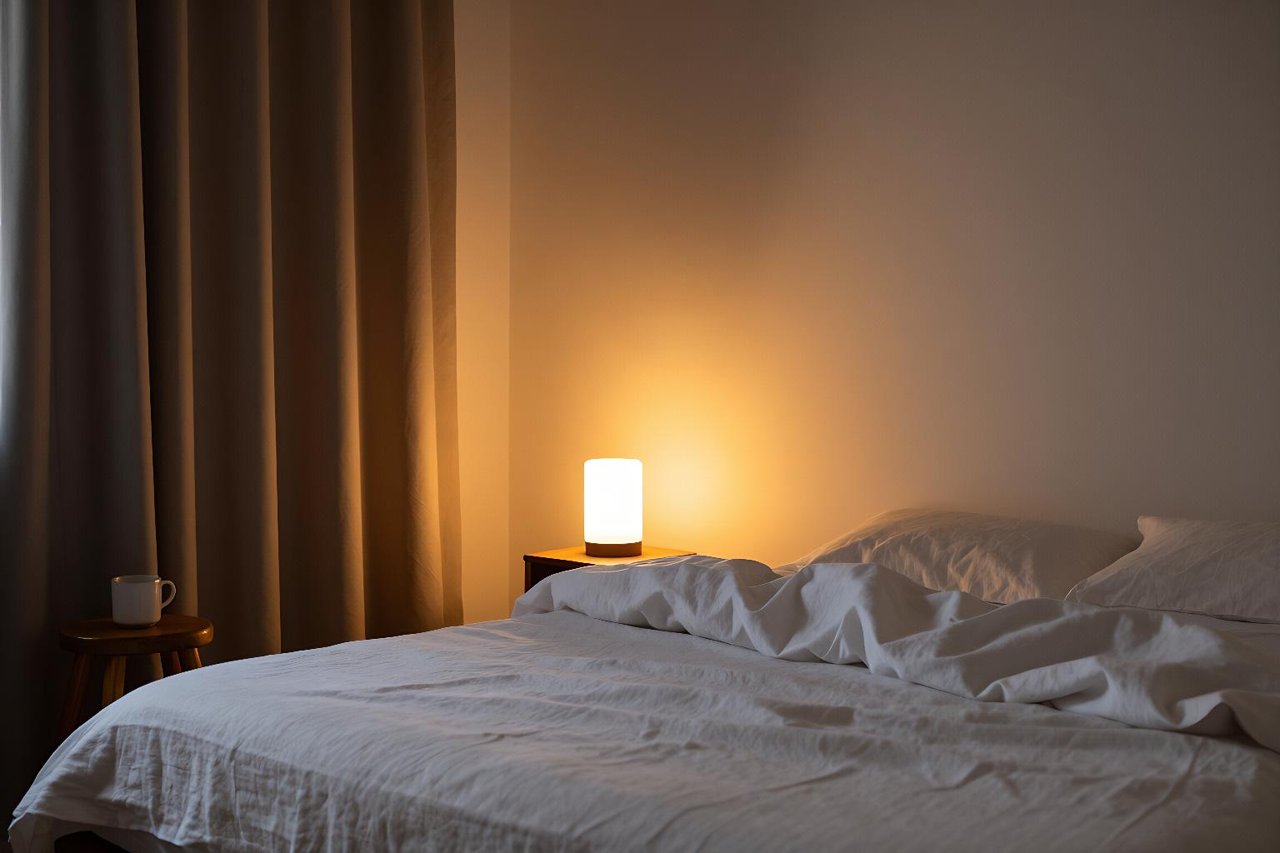
The evidence for lavender is modest but real. More useful is the routine itself. A predictable sequence before bed, done in the same order, tells your body what’s coming next. Lamp on instead of the ceiling light. Curtains closed. Ten pages of a book. Same every night.
Keep the bedside table sparse: a lamp, a book, a glass of water. Everything else lives in a drawer. The less there is to look at, the less there is to think about at midnight.
If You Only Do Three Things
- Drop the bedroom temperature a couple of degrees and close the door.
- Kill the light: tape the LEDs, fit a blackout blind, or wear a mask.
- Get outside in daylight within an hour of waking up.
Run those for two weeks before adding anything else. Change six things at once and you won’t know which one worked.
Give It a Fortnight Before You Judge It
Sleep is hard to assess night by night, because one bad Tuesday says nothing. Keep a one-line note each morning instead: roughly what time you fell asleep, how many times you woke, how you felt at 9am. Two weeks of that gives you something real to compare against.
And be honest that the room is only half of it. Caffeine has a half-life of five to six hours, so a 4pm coffee still has a quarter of its punch at bedtime, and alcohol reliably fragments the second half of the night even when it knocks you out fast. The habits you carry into the bedroom matter as much as the room itself, and the ones in the daily health habits I can’t live without do more for sleep than most gadgets on the market. Fix the room, then fix the last coffee of the day. In that order, both get easier.


