
Table of Contents
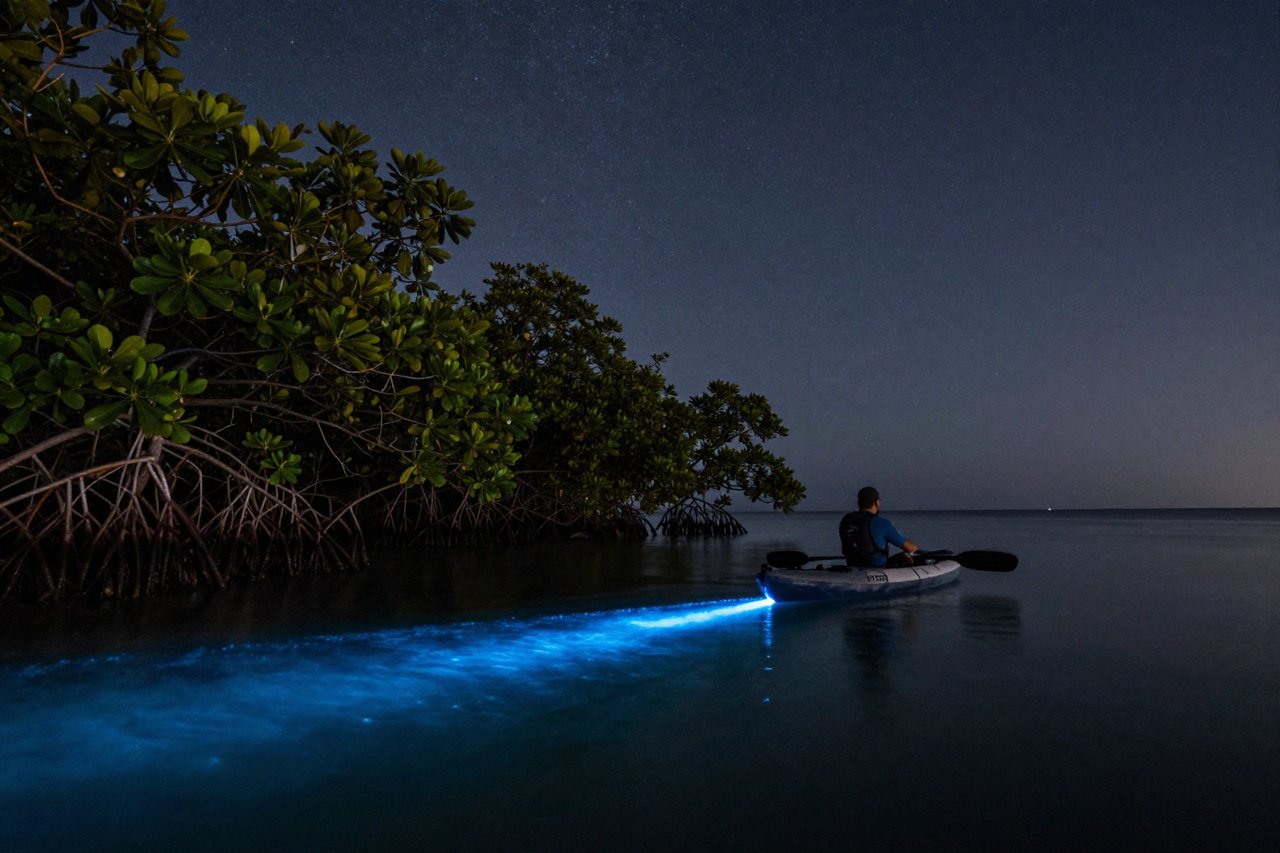
Stand waist-deep in Mosquito Bay on the island of Vieques and drag your hand through the water. A line of electric blue light follows your fingers, then fades within a second or two. Fish moving below the surface look like small comets. Every paddle stroke throws sparks.
No glow sticks. No trick photography. Just a single-celled organism called Pyrodinium bahamense, packed into that bay at concentrations that can exceed half a million cells per gallon. It is the brightest bioluminescent bay on record, and it is only one of several places on Earth where the natural world behaves in ways that seem frankly unreasonable.
The seven phenomena below share a quality: the scientific explanation is genuinely interesting, but it does almost nothing to prepare you for the first time you see one. A few are worth building a whole trip around.
1. The Bay That Glows When You Touch It
Bioluminescence is common in the ocean. What is rare is the density. Mosquito Bay holds its glow because of a narrow, shallow inlet, a thick border of red mangroves, and very little tidal flushing, so the dinoflagellates stay put instead of drifting out to sea.

Timing matters more than most guides admit. You want a new moon or a thin crescent, cloudless skies, and no recent rain. Kayak tours run after dark from several operators on Vieques, and the rules are strict: no swimming in the preserve, no insect repellent on your hands, life jackets required. The payoff is a wake that glows for meters behind the boat.
Other options exist but are dimmer. There’s a bay on Grand Cayman, a few in the Maldives, and Toyama Bay in Japan, where the glow comes from firefly squid washing ashore in spring rather than from plankton.
2. Lightning That Has Been Flashing for Centuries
At the southern end of Lake Maracaibo in Venezuela, where the Catatumbo River empties into the lake, thunderstorms form on roughly 260 nights a year. Locals call it the Relámpago del Catatumbo. Bolts can strike dozens of times a minute, and the flashes are visible from 400 kilometres away, which historically made it a navigational aid for ships in the Caribbean.
The mechanism is a collision of geography and wind. Warm, humid air off the lake meets cold mountain air sliding down from the Andes, and the resulting convection towers reach heights that support near-continuous electrical discharge. It isn’t a permanent storm in one spot. It’s a repeating pattern, which means the odds of seeing it on a given night in the wet season are unusually good.
September and October are the strongest months. Access is limited and has been complicated for years by travel advisories, so most people see it from a distance, from a boat on the lake or from the Colombian side of the border.
3. Clouds That Roll Like Waves
Morning Glory clouds are long tubes of cloud, sometimes a kilometre wide and up to a thousand kilometres long, that travel across the sky like a slow-motion breaking wave. They are rare enough that atmospheric scientists still argue about exactly how they form, though the leading explanation involves sea breezes colliding over the Gulf of Carpentaria and producing a soliton: a wave that holds its shape as it moves.
The reliable window is late September into early November, and the unlikely capital of Morning Glory tourism is Burketown, Queensland, a town of roughly 200 people that fills with glider pilots each season. The clouds create the only conditions where sailplanes can genuinely surf the leading edge for hours. If you want to see one from the ground, camp near the coast and watch east just after dawn.
4. Rocks That Sail Across a Dry Lakebed
On the Racetrack Playa in Death Valley, rocks weighing up to 700 pounds sit at the end of long, curving trails scraped into the cracked mud. Nobody saw them move for the better part of a century. Explanations ranged from magnetic fields to dust devils to pranksters.
In 2014, researchers Richard and James Norris settled it using GPS-tagged rocks and time-lapse cameras. The recipe is specific: a shallow pond forms from winter rain, a thin sheet of ice freezes overnight, the ice breaks up into floes carrying rocks, and a light breeze of around 10 mph pushes those floes across the surface for a few minutes at a time. Wind does the pushing. Ice does the carrying. The trails can take months to accumulate.
Getting there means 43 miles of rough dirt road from the nearest paved highway, and a three-mile hike to the playa. Take plenty of water and don’t budge a single rock. The trails are fragile records that took years to form.
5. The Lake That Drains Into Dots
Spotted Lake (Kliluk) sits beside Highway 3 near Osoyoos, British Columbia, and for most of the year looks like a fairly ordinary body of water. Then summer evaporation takes over. The lake is dense with magnesium sulfate, calcium and sodium sulfates, and small amounts of silver and titanium. As water levels drop, those minerals concentrate into a few hundred separate pools, each with its own colour, from pale grey-blue to olive to yellow.
The effect is strongest in July and August. The lake is sacred to the Syilx/Okanagan people and has no public access, so you view it from the roadside pullout. Plan it as one photo stop on a longer drive through the Okanagan Valley rather than a destination on its own.
6. A Rainbow Made of Ice, Not Rain
The circumhorizontal arc gets called a fire rainbow online, which is wrong on both counts. It isn’t on fire and it isn’t a rainbow. It appears as a wide, flat band of pastel colour, often near-horizontal, sitting under a thin layer of cirrus cloud.
The physics are strict. Sunlight has to pass through plate-shaped ice crystals arranged flat and parallel, and the sun has to sit at least 58 degrees above the horizon. That rules out any location above roughly 55 degrees latitude entirely, and limits the season to a couple of hours either side of solar noon in summer at mid-latitudes.
In the US, the eastern edge of the Blue Ridge mountains is a decent place to watch for one, and a high summer stay around Cashiers, North Carolina puts you on ridges with clear western views. Look up around midday, not at sunset, and scan the high cloud rather than the horizon.
7. Columns of Light Standing Over a Frozen Town
On a very cold, clear night, streetlights can appear to fire narrow beams straight up into the sky. Light pillars look like the aurora for about five seconds, until you realise the colours match the lamps below them, not the sky above.
The cause is ground-level ice. Flat hexagonal crystals drift in calm, frigid air, typically well below minus 10 degrees Celsius, and they float in roughly horizontal alignment. Light bounces off their flat faces and stacks into a column in the viewer’s eye. The same thing can happen with a low sun, producing sun pillars at sunrise, or with a bright moon.
Cities with a mix of coloured LED, sodium and mercury lamps get the showiest displays, because the pillars stack into layered bands. Cold inland towns in the northern US, Canada, Scandinavia and Siberia all get them. Michigan’s Upper Peninsula is usefully cold and dark at the same time, and if you want to combine light pillars with aurora hunting, our Upper Peninsula guide covers the stretches of coastline with the least light pollution.
How to Give Yourself a Real Chance of Seeing One
Most people who miss these phenomena miss them for boring, practical reasons rather than bad luck. A few habits do most of the work:
- Check the moon phase first. Anything bioluminescent needs darkness. A full moon is genuinely enough to wash out a glowing bay.
- Give each event a season, not a date. Catatumbo lightning and Morning Glory clouds have strong months but no guarantees on any given night. Budget several nights per target.
- Read the weather, not the forecast app. Cloud cover at ground level tells you almost nothing about cirrus at 8,000 metres, which is exactly what you need for ice halos.
- Get away from town lighting. This matters for pillars, arcs and aurora far more than most trip guides suggest.
The patience part is unavoidable. These sights happen on physics’ schedule, not yours, and a week of clear skies followed by a single socked-in night is entirely normal. That waiting is where the trip lives, in my experience, and it’s the thing that brings back that feeling we forgot until this trip brought it back: standing still somewhere strange, with nothing to do but look up.
Rain and cloud are part of the deal, so have a fallback. A decent downloaded show goes a long way on a washed-out night, and our list of Netflix shows that actually deserve your binge time is a reasonable place to start. Then set the alarm for 4am, check the sky, and go back out.


