
Table of Contents
5G is often sold as faster mobile internet. That is true, but it misses the interesting part. The speed comes from a set of engineering choices that change the radio link, the antennas, and the core network behind the tower. A 5G phone can hit hundreds of megabits per second in the right spot, and a fixed wireless link can replace a home broadband line. Understanding how 5G technology works means following the signal from the handset to the cell site and into the packet core.
To trace how 5G technology works, follow a single request. The phone encodes data into radio waves, a nearby cell site receives it, and that site passes traffic into a 5G core. The core routes it to the internet or to another device. The first hop is the hard part, because radio spectrum is finite, buildings block signals, and thousands of users share the same air.
A New Radio Interface, Not Just a Faster LTE
5G uses a radio interface called 5G NR, short for New Radio. LTE and 5G NR both rely on OFDM, a modulation scheme that splits a wide channel into many smaller subcarriers. The difference is flexibility. LTE uses a fixed 15 kHz subcarrier spacing. 5G NR can use 15 kHz, 30 kHz, 60 kHz, or 120 kHz depending on the band and the job. A 15 kHz slot lasts 1 ms; a 30 kHz slot lasts 0.5 ms. Shorter slots help with low-latency traffic, while wider spacing suits dense, short-range deployments.
5G also uses wider channels. A mid-band 5G carrier can be 100 MHz wide, and mmWave can use 400 MHz or more. More bandwidth means more bits per second. An LTE carrier is often 20 MHz. That gap explains why a 5G phone on a clean mid-band signal can outperform an LTE phone by a wide margin, even before you count antennas and network design.

The Spectrum Trade-Off: Low, Mid, and High Bands
Radio physics sets the ground rules. Lower frequencies travel farther and push through walls more easily. Higher frequencies carry more data but fade quickly and hate obstacles. 5G operators use all three layers:
- Low-band 5G, roughly 600 to 900 MHz: good coverage and indoor penetration, but limited capacity. A low-band 5G site can cover kilometres, yet it may feel only modestly faster than good LTE.
- Mid-band 5G, around 2.5 to 3.7 GHz: the capacity sweet spot for most networks. A site can cover a few kilometres, and a 100 MHz channel can deliver hundreds of megabits per second to many users at once.
- mmWave, roughly 24 to 47 GHz: huge bandwidth and very high speeds, but short range. A mmWave cell might cover a few hundred metres and struggle behind glass, foliage, or a hand.
No single band does everything. Operators layer low-band for coverage, mid-band for capacity, and mmWave for stadiums, airports, and dense hotspots. That layering is why two phones showing a 5G icon can have wildly different experiences.
Massive MIMO and Beamforming: Pointing Capacity at People
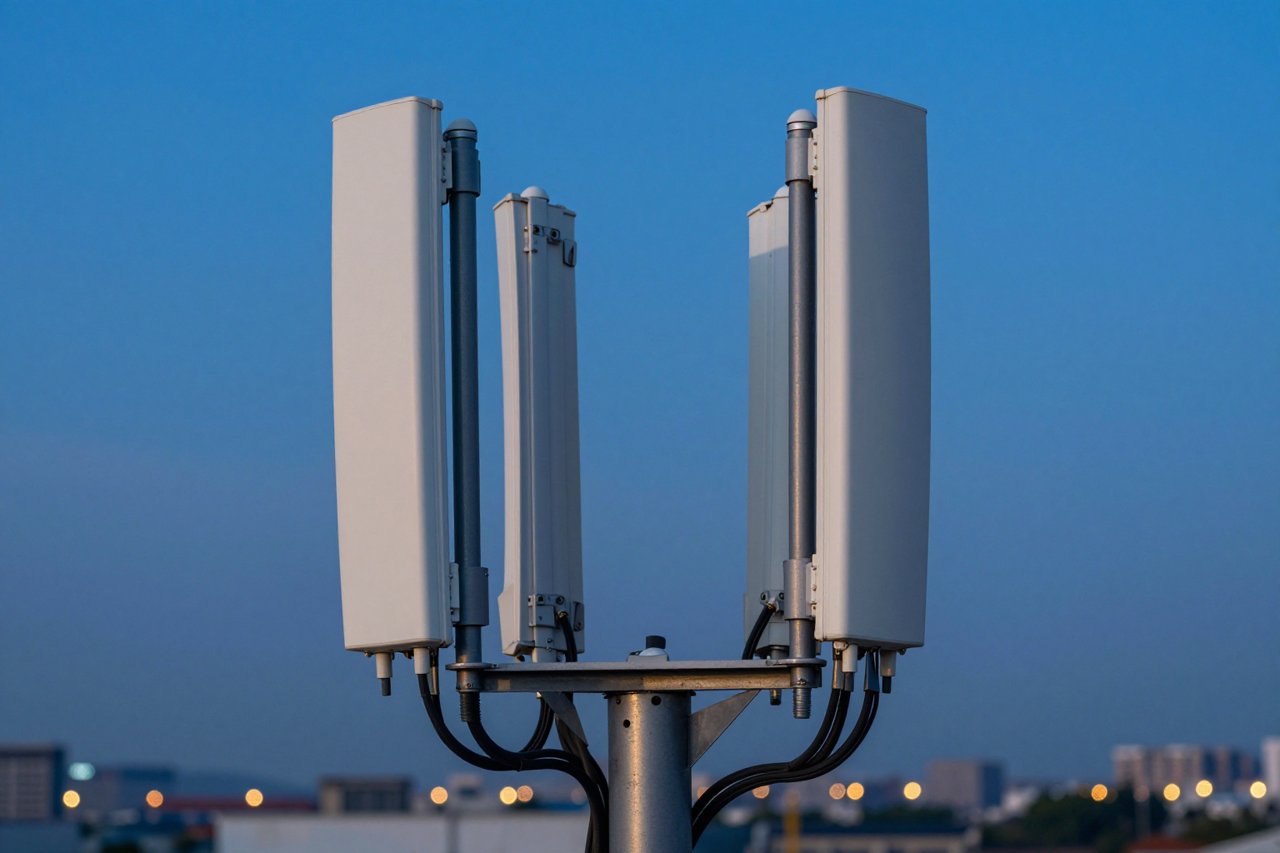
A 5G cell site is not a simple metal panel. Many mid-band sites use massive MIMO arrays with dozens of antenna elements and 64 transmit and receive paths. The array can shape radio energy into beams and steer those beams toward users. This is beamforming. The site calculates phase shifts across the elements so the signal adds up in one direction and cancels in others.
Beamforming does more than improve range. It lets the same frequency band serve multiple users in different directions, a form of spatial reuse. A busy street can get one beam while a nearby square gets another. Massive MIMO also supports multi-user MIMO, sending separate data streams to separate devices on the same time and frequency resources. Small cells fill the gaps in hotspots, adding capacity where macrocells are congested.
What Happens Behind the Radio: The 5G Core
The radio link gets the attention, but the core network decides what 5G can do. In standalone 5G, the core is cloud-native and separates control functions from user traffic. A component called the UPF can sit close to the cell site and break traffic out locally, which cuts latency. This is the foundation for edge computing, where a factory or hospital keeps data on-site instead of sending it across the country.
Standalone vs. non-standalone
Many early 5G networks were non-standalone. They used an LTE anchor for control signalling and added 5G NR for extra data capacity. That was a practical upgrade path. Standalone 5G is the fuller design, with the 5G core handling authentication, mobility, and policy from end to end. Standalone matters for network slicing and for latency-sensitive applications.
Network slicing
Slicing divides one physical network into virtual networks with different guarantees. A factory slice can reserve low latency and high reliability. A video streaming slice can favour throughput. A public safety slice can prioritise traffic during an emergency. The same towers and fibre serve all three, but the core keeps their traffic separate. If you want a structured path into these concepts, IEEE’s new training program on 5G and 6G basics covers the architecture and radio fundamentals in more depth.
Why the 5G Icon Does Not Always Mean 5G Speed
A 5G icon tells you the phone is attached to 5G, not that the connection is fast. A low-band 5G signal may post numbers close to LTE. A congested mid-band cell can slow to a crawl at rush hour. The backhaul link from the tower to the core can bottleneck traffic. Building materials, distance, and even how you hold the phone affect mmWave. In good mid-band conditions, real-world downloads often land between 100 and 400 Mbps. mmWave can pass 1 Gbps close to the site, but it drops off quickly.
Device support matters too. Many 2025 handsets handle more 5G bands and carrier aggregation than earlier models, as covered in this look at smartphones and mobile technology in 2025. A phone with a good modem and a carrier that owns strong mid-band spectrum will usually beat a flagship on a thin low-band network. The plan matters as well. Some tariffs cap speed or deprioritise heavy users.
Private 5G and the Industrial Case
Factories, ports, mines, and hospitals are building private 5G networks on their own premises. A private network can reserve spectrum, keep data local, and guarantee latency for robots and sensors. A port can coordinate cranes and automated vehicles without relying on public Wi-Fi. A hospital can connect infusion pumps and tracking tags on a network it controls. The broader technology trends for 2025 put connectivity alongside AI and edge computing for exactly this reason: the useful applications need both fast radio links and local processing.
Security and Reliability Are Part of the Design
5G encrypts traffic between the phone and the core, authenticates devices with SIM credentials, and can isolate slices from one another. Those are real protections. The software-defined core also expands the attack surface. More functions run as software, more APIs connect network components, and more traffic breaks out at the edge. Security teams are watching how AI changes the economics of attacks. A recent dispute over an alleged AI-powered cyber attack shows the concern, even when the headline claim is contested.
Where 5G Still Has to Prove Itself
Uplink is one weak spot. Downlink speeds get the marketing, but video calls, cloud backups, and industrial cameras need strong upload. Mid-band 5G uploads often sit between 20 and 80 Mbps, and mmWave upload can be fragile. Indoor coverage is another gap. Higher bands struggle through walls, so venues need indoor small cells or fibre-backed distributed antennas. Power consumption is a third issue. Massive MIMO and mmWave radios draw more energy, which raises operating costs and makes battery life a design constraint.
The next phase, 5G-Advanced, aims at better uplink, more precise positioning, and tighter integration with AI for network management. None of that changes the basic story. 5G works by combining wider channels, flexible radio scheduling, steerable antenna arrays, and a software-defined core. The speed is real, but it depends on where you stand, which band you get, and how much fibre and compute sit behind the tower.


