
Table of Contents
Press the shutter and a photo lands on your screen in roughly a quarter of a second. In that window, light passes through six or seven moulded plastic lens elements, strikes a silicon chip smaller than your thumbnail, gets converted into electrical charge, is digitised, and then blended with eight or nine other frames you never saw. The file you end up with looks nothing like what the sensor actually recorded. It looks better, deliberately.
Following that chain from photon to JPEG explains a lot of things you’ve probably noticed in daily use: why night mode makes you hold still for three seconds, why portrait mode sometimes swallows a strand of hair, and why a 200-megapixel sensor doesn’t automatically beat a 12-megapixel one. Here’s what’s actually happening inside the module.
The Lens Stack: Six Tiny Elements Doing the Work
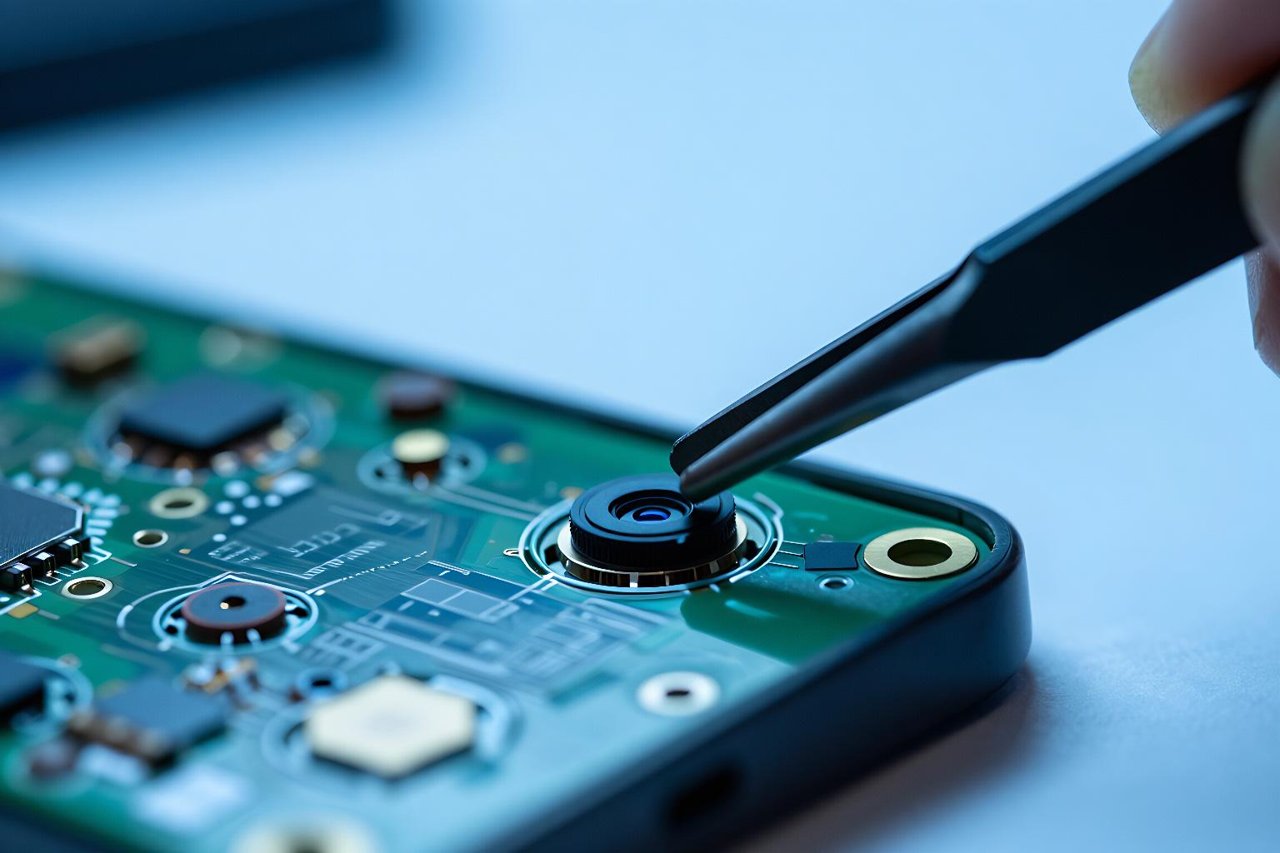
A phone camera module is about 6mm deep. Into that space engineers squeeze a stack of plastic lenses, usually described in spec sheets as 6P or 7P (six or seven plastic elements). Each one is moulded aspherical, meaning its curve isn’t a simple sphere, which lets a handful of elements correct the distortion and colour fringing that would otherwise need a much longer barrel.
Most main cameras have a fixed aperture between f/1.6 and f/1.9. There’s no iris, no blades, nothing that closes down. That’s a cost decision as much as a space one, and it has a real consequence: the lens always gathers as much light as it can, so exposure is controlled entirely by shutter time and sensor gain.

Telephoto modules solve the thickness problem with a periscope. A small prism folds incoming light through 90 degrees, so the lens group lies sideways along the body of the phone instead of poking out of it. That’s how a handset barely 8mm thick manages a 120mm-equivalent view.
Light gathering is where physics gets stubborn. A main camera with an f/1.8 aperture and a 1/1.3-inch sensor collects a fraction of what even a cheap dedicated camera does. Researchers have spent years chasing that gap with new materials and folded optics, and some of the more interesting work on startups boosting light capture in phone cameras targets exactly this bottleneck.
Inside the Sensor: Photodiodes, Filters and Microlenses
At the bottom of the stack sits a CMOS image sensor, a grid of millions of photodiodes etched into silicon. Each site converts incoming photons into electrons, and the number of electrons collected is proportional to the light that landed there. On top of every photodiode sits a tiny colour filter (red, green or blue, arranged in a Bayer pattern of two greens for every red and blue) and, above that, a microscopic microlens that funnels light past the wiring and into the active area.
Backside illumination, standard on phones for over a decade now, moves that wiring behind the silicon so it stops blocking light. Stacked sensors go further by bonding the processing layer underneath the pixel layer, freeing up more of the surface for light collection.
The sensor’s family tree runs back to Bell Labs, where the charge-coupled device was invented in 1969, a piece of work honoured among seven groundbreaking IEEE and Bell Labs innovations. CMOS eventually won on cost and integration, but the underlying idea, turning light into measurable charge, hasn’t changed.
Why 50 Megapixels Often Outputs 12.5
Many phones use a quad-Bayer layout where four same-colour sub-pixels sit under one microlens. In good light the sensor reads all 50 million individually. In dim light it merges each 2×2 block into a single large pixel, giving 12.5 megapixels with roughly four times the light per output pixel. Samsung’s 200MP sensors do the same 16-to-1, producing a 12.5MP image from sub-pixels just 0.6 micrometres wide.
This is why megapixel numbers mislead. The binning decision is made by the camera app, frame by frame, based on how much light it thinks it has.
Autofocus and the Rolling Shutter
Focus on a phone is contrast detection plus phase detection, usually. Phase-detect pixels sit in pairs, half-masked in opposite directions, so the sensor can compare two views of the scene and calculate instantly whether focus is in front of or behind the subject. Dual Pixel sensors split every single pixel in two to do this across the whole frame, which is why focus tracks a running dog so reliably. Some modules add a laser or time-of-flight sensor for the first few centimetres.
Then there’s the shutter, which on almost every phone is electronic. Rows of the sensor are read out sequentially over roughly 1/30 of a second rather than all at once. Point the camera at a spinning propeller and it bends. Film an LED bulb in slow motion and you’ll see dark bands crawling through the frame. It’s a genuine limitation of the technology, and it’s why video stabilisation and subject tracking need to be so aggressive.
The Image Signal Processor: Where Data Becomes a Picture
The raw sensor output is a mess: a red, green or blue value per pixel, no white balance, no colour, and a black-level offset that varies with temperature. The image signal processor, a dedicated block inside the phone’s system chip, handles the fix-up at billions of operations per second. It subtracts black level, applies lens shading correction, interpolates the Bayer pattern into full colour (demosaicing), estimates the scene’s white balance, and then applies a tone curve that maps the sensor’s linear response into something that looks right on a display.
Noise reduction runs here too, and it’s the single biggest driver of how a phone photo looks. Aggressive noise reduction produces smooth, plasticky skies. Too little produces a snowstorm of colour speckle in the shadows.
Computational Photography: Nine Frames, One Image
This is the part that separates a modern phone from a 2010 compact camera. When you press the shutter, the phone usually captures a burst rather than a single exposure.
- HDR merging: the camera fires short and long exposures milliseconds apart, then combines them so the sky keeps its detail without the foreground going black.
- Night mode: a three-second handheld shot might stack 9 to 30 frames, each around 1/10 of a second. The phone aligns them using gyroscope data and image features, discards frames where you moved, and averages the rest to cut noise.
- Semantic segmentation: a small neural network labels regions of the scene (sky, skin, foliage, food) and applies different tone mapping and sharpening to each.
- Depth mapping: portrait mode builds a depth map from dual-pixel phase differences or a time-of-flight sensor, then blurs everything behind the subject.
Optical stabilisation matters enormously here. A tiny electromagnetic suspension floats the lens or the sensor itself, nudging it against handshake a thousand times a second. Without it, stacking a dozen frames would produce mush.
What Actually Matters in the Spec Sheet
Deal roundups like this list of the best Prime Day phone deals for 2025 tend to lead with megapixels, because that’s the easiest number to print. The things that genuinely change your photos are less photogenic:
- Optical format (1/1.3-inch beats 1/2.5-inch far more than 50MP beats 12MP)
- Aperture, since a wider opening means shorter shutter times in low light
- Whether optical stabilisation is present, and whether it’s lens-shift or sensor-shift
- The quality of the processing pipeline, which is why two phones with identical sensors can produce very different files
- Lens coatings, which decide how badly a streetlight smears across the frame at night
Where the Physics Still Bites
Diffraction sets a hard floor. At f/1.8, light bending around the aperture edge starts to soften detail at the pixel pitches phones now use, and no amount of sharpening recovers information that was never resolved.
Photon shot noise is the other wall. Light arrives randomly, and in a dim room a pixel might collect only a few dozen photons. The statistical variation in that small number is the grain you see in shadow areas, and it can only be averaged away with more frames or more sensor area. That’s why one-inch sensors in the latest flagships made such a visible difference, and why sensor fabrication advances reported from the research labs where display and sensor technology is developed keep showing up in shipping phones a few years later.
Heat is the invisible constraint. Record 4K at 60fps for ten minutes and the processor throttles, noise reduction gets lazier, and the image softens. Photon-counting sensors and event-based chips, which report changes in brightness rather than absolute levels, promise to sidestep some of these limits, but for now the biggest gains keep coming from the software stack on top of a sensor that is, physically, barely bigger than it was five years ago.


