
Table of Contents
Maya’s alarm goes off at 3:50am on Monday. By Thursday she isn’t due in until 2pm, and Saturday she’s on nights. She’s worked this roster for two years and still can’t answer a simple question: what time do you go to bed?
If that sounds familiar, you already know the drill. You get home wired but wrecked, and the sleep you do get feels thin. Managing a changing work schedule and sleep at the same time isn’t a willpower problem. It’s a timing problem, because your body clock only shifts about an hour a day, and sometimes refuses to shift at all.
What’s Actually Happening to Your Body Clock
Your circadian rhythm is a roughly 24-hour internal timer that controls when melatonin rises, when your core temperature drops, and when you feel sharp versus foggy. Light is its loudest signal. Bright morning light tells the system to start the day; darkness in the evening tells it to prepare for sleep.
Here’s the number that explains most shift-work misery. Most people can push their clock later by 60 to 90 minutes a night, but can only pull it earlier by 30 to 45 minutes. A late start after a late weekend is a small adjustment. A 5am Monday after a weekend of midnight bedtimes is a big one.

Flip your start time two or three times a week and your clock never gets the message. You end up sleeping four to five hours before early shifts, then catching up in fragments, and carrying a sleep debt that quietly affects mood, appetite, and concentration long before you notice it.
Anchor Your Day With One Fixed Wake Time
You can’t control the roster, but you can control the one sleep you refuse to trade away. Pick a sleep window and defend it the way you’d defend a dentist appointment.
The core-four rule
Whatever the shift, guarantee yourself four uninterrupted hours in a dark room. If you get home at 8am after a night shift, be in bed by 8:45 and set one alarm for 1pm. If you’re on early starts, that means lights out by 9:30pm so 5:30am doesn’t hurt. Four solid hours beats six broken ones, and it gives you a floor to build naps on top of.
Keep the routine, move the clock
Your wind-down should be the same 30 minutes regardless of what the clock says: shower, lights low, phone charging in another room, a podcast you’ve heard before. A predictable sequence is a cue your brain learns to associate with sleep, and it works at 9pm and 9am alike.
Use Light Like a Tool, Not a Backdrop
If you change one thing this month, make it this. Get outside or in front of a 10,000-lux lamp within 30 minutes of waking. Twenty to thirty minutes of bright light is enough to firm up the clock and make you sleepy at the right end of the day.
After a night shift, do the opposite. Wear wraparound sunglasses on the drive home and skip the bright supermarket on the way. That sounds dramatic, but the point is simple: your body reads bright light as “start the day,” and you want it reading “go to bed” instead.
Make Daytime Sleep Actually Possible
Sleeping at 9am is an environment problem before it’s a discipline problem. Fix the room and half the battle is won.
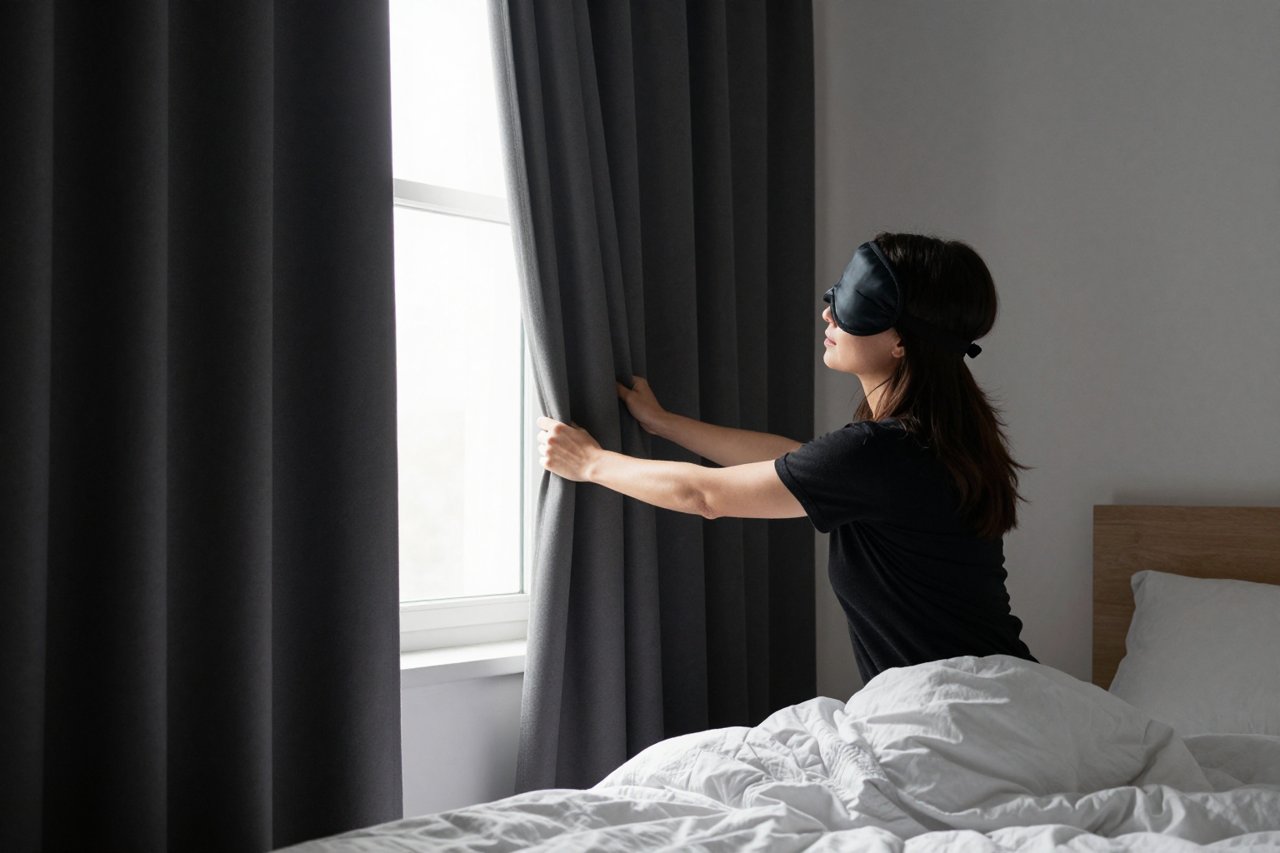
- Block the light properly. Blackout curtains plus a sleep mask that seals around the nose. A cheap mask that leaks daylight is barely worth wearing.
- Kill the noise. Foam earplugs around 32dB, or a fan running for steady white noise. Traffic and lawnmowers are the enemy at 8am.
- Cool the room. Somewhere around 16–18°C helps you drop off faster than a warm stuffy bedroom.
- Tell people. A note on the door, a status message, and a flatmate who knows not to vacuum at noon. Silence is easier to arrange in advance than to demand at the time.
- Eat light before bed. A heavy meal right before daytime sleep tends to leave you groggy and reflux-prone. Save the big meal for after you wake.
Then there’s the trap after your last night shift. It’s tempting to stay awake all day so you “reset” in one go, but most people crash by 2pm and wake at 8pm feeling worse. A better compromise: sleep two to three hours, get up, spend time in daylight, and go to bed at a normal hour that night.
Nap on Purpose, Not by Accident
Naps are the flexible part of the plan. A 20-minute nap before an evening shift sharpens alertness without leaving you groggy. If you have a bigger gap, 90 minutes lets you complete a full sleep cycle, which does more for recovery than three 20-minute naps scattered through the week.
Watch the caffeine. It has a half-life of roughly five hours, so a 4pm coffee is still a quarter-strength coffee at 9pm. Cut it off at least six to eight hours before your target bedtime, even if that bedtime happens to be breakfast time. If you need a boost before a night shift, try a coffee and then a 20-minute nap. You wake as the caffeine kicks in.
Quit the Small Habits That Quietly Cost You Sleep
Most people losing sleep to a tough roster are also losing it to a handful of habits that have nothing to do with work. The scroll in bed, the “one more episode” at 11:40pm, the vigorous workout at 10pm. None of these are crimes, but stacked on a rotating schedule they’re the difference between five hours and seven. It’s worth auditing the mindless habits that fuel overwhelm and exhaustion, because the fix is usually cheaper than you expect: better lighting, a phone out of reach, and a hard stop on decision-making an hour before bed.
Negotiate the Roster, Not Just Your Alarm
You have more leverage than you think, and a few specific asks go a long way. Forward rotating shifts, running days then evenings then nights, are easier on the body than a backward rotation, because your clock naturally drifts later rather than earlier. If you can get two or three weeks on the same shift instead of two or three days, take it.
Shift swaps with colleagues are the other lever. So is a short, factual conversation with your manager about the pattern rather than the pain: “Backward rotations are costing me sleep on my days off. Can we trial a forward rotation for a month?” If you’re still working out where the line sits between being flexible and being flattened, these basics of work-life balance for beginners are a reasonable place to start.
Protect the Recovery Day
The day after your last night shift is not a day for errands, deep cleaning, and a 9am gym class. Treat the first 24 hours as recovery: gentle light in the morning, a proper meal, a walk outside, and an early night. Trying to flip back to a normal schedule in a single day is how people end up spending their entire weekend in a fog.
And keep one non-negotiable on the calendar that has nothing to do with work, whether that’s a Tuesday football match or Sunday breakfast with your sister. A roster that owns every hour is a roster that owns you.
When Poor Sleep Stops Being Just Tiredness
There’s a line between being tired and being unwell, and shift work makes it blurry. If two or three weeks of better sleep habits still leave you flat, losing interest in things you normally enjoy, or waking at 3am with your mind racing on every single day off, that’s worth a conversation with a GP rather than another round of self-tweaking. Persistent low mood alongside disrupted sleep is a real pattern with real treatments, and you can read about evidence-based treatments for major depressive disorder before you sit down with anyone. A changing work schedule and sleep don’t have to be a permanent trade-off. With a defended sleep window, deliberate light, and a roster you’ve actually pushed back on, most people find a workable rhythm within a few weeks.


