
Table of Contents
A plastic bag resting on the floor of the Mariana Trench. A fish whose head is a clear dome. A neat, brick-paved road on the summit of a Hawaiian seamount. The deep ocean keeps offering up things that sound invented after a long night at sea.
We have decent high-resolution maps of roughly a quarter of the seafloor, which leaves a lot of unexamined real estate. What follows are seven finds that made researchers check their instruments twice. Most are now explained. One or two still aren’t entirely.
The Bloop: A Sound Nobody Could Place for 15 Years
In the summer of 1997, hydrophones lying on the seabed of the equatorial Pacific picked up a sound loud enough to register across 5,000 kilometres of ocean. It rose fast, lasted around a minute, and repeated several times that season. The recording got a nickname, the Bloop, and an enthusiastic internet following that ran straight to Cthulhu.
The explanation turned out to be geological. In 2012, NOAA attributed the Bloop to an icequake, large icebergs cracking and grinding in the Southern Ocean, with the noise funnelled for thousands of kilometres through the ocean’s sound channel. Blue whale calls and military airguns had already been ruled out. Worth remembering: the hydrophone network that caught it was originally built to track Soviet submarines.

Not every deep-sea detection gets that tidy an ending. A handful of cases like it appear in this collection of mysteries and strange events that still refuse to make sense, and the ocean supplies more of them than anywhere else on the planet.
A Fish With a Transparent Head and Rotating Eyes
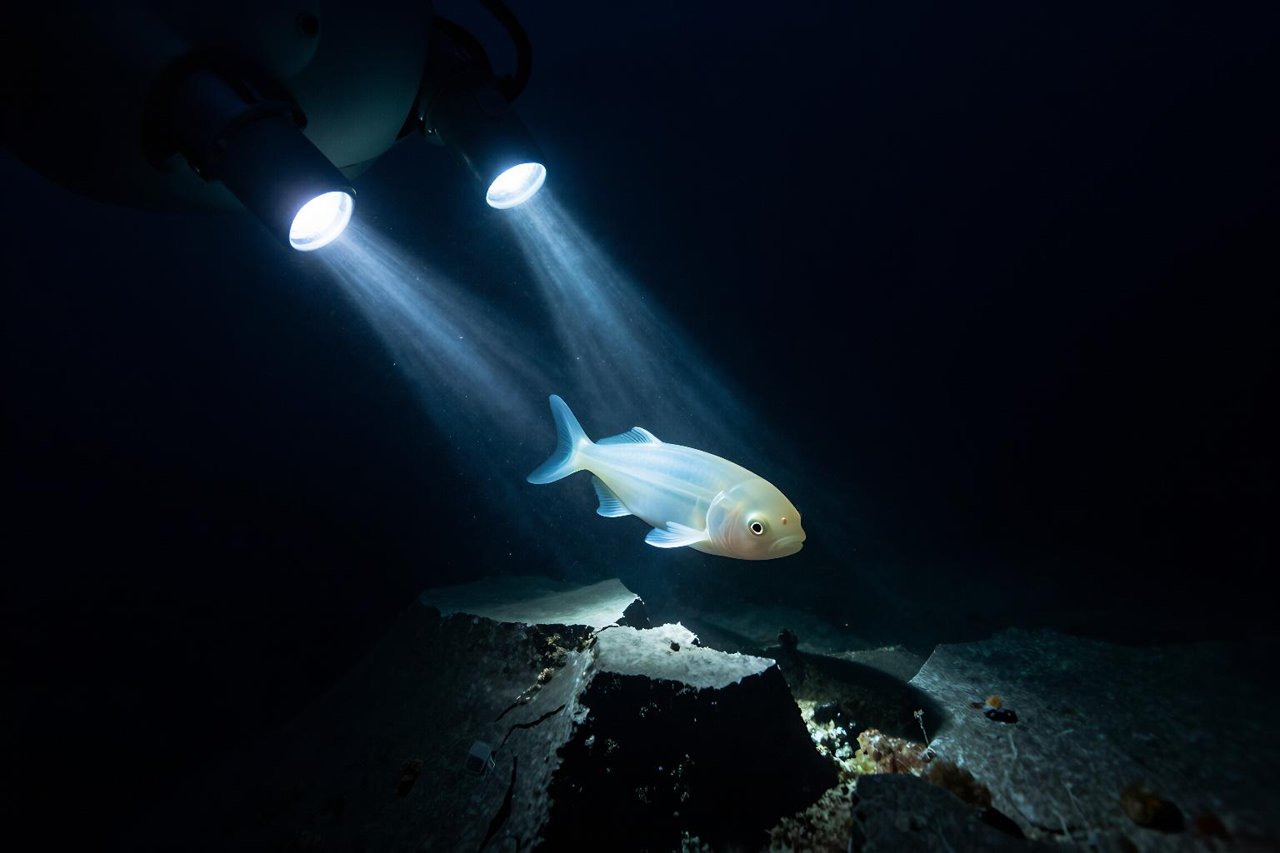
The barreleye, Macropinna microstoma, lives between roughly 600 and 800 metres down in the North Pacific, in water so dim that most shapes register as silhouettes. Its head is a clear, fluid-filled dome, and inside sit two tubular eyes with vivid green lenses.
For decades, textbook illustrations showed those eyes pointing permanently upward. Then in 2004 an ROV from the Monterey Bay Aquarium Research Institute brought one to the surface intact and filmed it alive. The eyes rotate, swinging forward when the fish wants to look ahead. And the two dark spots on its face, which look convincingly like eyes, are actually nostrils.
Those green lenses filter out the blue light that reaches that depth, which makes glowing prey easier to pick out against the gloom. The trick is less extraordinary than it sounds. Plenty of animals pull off things that shouldn’t be anatomically possible, as this list of animals with abilities that seem impossible makes clear.
The “Yellow Brick Road” on a Hawaiian Seamount
In April 2022, researchers aboard the Exploration Vessel Nautilus were mapping the Liliʻuokalani Ridge inside Papahānaumokuākea Marine National Monument when the camera found what looked like a paved road: flat, angular, brick-shaped slabs fitted together along the summit of an underwater mountain, about 1,000 metres down. The livestream chat christened it the road to Atlantis.
It is volcanic rock. Hyaloclastite forms when lava erupts into cold water, cools almost instantly and shatters into straight-edged fragments. Heating and stress over time break it into near-regular blocks that look suspiciously like masonry. The individual “bricks” are a few tens of centimetres across, and the dried-looking cracks are sediment packed into the joints.
Seamounts around Hawaii are full of that sort of thing, and so are many of the spots gathered in these places where nature looks almost unreal without a filter. Geology rarely needs help being strange.
Brine Pools That Preserve Whatever Falls In
At the bottom of the Gulf of Mexico, about 1,000 metres down, there are lakes. Actual lakes, with shorelines. They form where salt buried in the seabed dissolves into the surrounding water. The resulting brine is four to five times saltier than seawater, dense enough to sit in a basin and refuse to mix. One, discovered in 2015, is nicknamed the Jacuzzi of Despair because the fluid is warm, methane-rich and lethal.
Fish and crabs that swim in are hit by the salinity, go into shock and die. The brine is hostile enough to pickle them. Researchers have recovered whole crabs and small fish from the pool floor, some of them years old and otherwise intact. Around the rim, mussels, tube worms and shrimp crowd the edge in densities you wouldn’t expect a metre away from a death trap.
Similar pools have since turned up in the Red Sea, where a survey found dead animals piled in the brine, unable to survive the crossing and unable to decay properly.
A Shopping Bag at 10,975 Metres
In 2018, Alan Jamieson’s team at Newcastle University trawled through decades of deep-sea video and trawl records looking for debris. They found it in places it had no business being. The deepest item was a plastic bag, photographed at 10,975 metres in the Mariana Trench, more than a kilometre deeper than Everest is tall.
The chemistry is more troubling than the litter. A 2017 study from the same group found PCBs in amphipods from the Mariana and Kermadec trenches at concentrations far above what you’d measure in surface waters near factories:
- A plastic bag at 10,975 m in the Mariana Trench, the deepest debris yet recorded
- PCB concentrations in trench amphipods around 50 times higher than in crabs from some of the most polluted industrialised waterways
- Microplastics in sediment cores across abyssal plains, thousands of metres down and hundreds of kilometres from the nearest coast
Nothing down there is genuinely isolated. It’s cold, it’s dark, and it sits downstream of everything.
Oxygen Being Made in Pitch Darkness
In 2024, a team led by Andrew Sweetman published measurements from the Clarion-Clipperton Zone, a nodule field in the Pacific about 4,000 metres down. They lowered chambers to the seabed expecting oxygen levels to fall as microbes consumed it. Oxygen went up instead.
The likely cause is the nodules themselves: lumpy concentrations of manganese, nickel, copper and cobalt that generate close to a volt across a single lump. That is enough to split water molecules and release oxygen, with no light and no photosynthesis involved. The finding complicates plans to mine the nodules commercially, and it complicates the story of how life on Earth got started.
Deep-sea drilling has a history of odd turns. Project Mohole, the early 1960s race to reach the Earth’s mantle, got about 180 metres into basalt off Mexico before costs exploded and Congress pulled the funding. It ranks among the more bizarre events in world history that genuinely happened.
A Squid With Eyes the Size of Dinner Plates
For most of recorded history, the giant squid was known only from corpses washed ashore and from the circular scars left on sperm whales that had fought them. The first images of a live one came in 2004, when Tsunemi Kubodera’s team dangled a camera off Japan and came back with more than 500 photographs. The first footage of one hunting in open water followed in 2012, at around 900 metres.
Its cousin, the colossal squid, is heavier, reaching perhaps 500 kilograms, and carries the largest eyes in the animal kingdom at up to 27 centimetres across. Fully grown colossal squid have been filmed alive only a handful of times, the first in Antarctic waters in 2012. Nobody has yet watched one hunt.
That’s the pattern with the deep sea generally: one photograph, a decade of argument, a new piece of equipment, and then another surprise nobody had a category for.


