
Table of Contents
Ask most people to date the Industrial Revolution and you get a shrug, then something vague about the Victorians and smokestacks. The shorthand, machines replaced muscles, misses the strangest part of the story. For thousands of years, output per person had barely budged. Then, across roughly three generations in the north of Britain, it started climbing and never really stopped.
The Industrial Revolution explained in a single sentence: it was the moment an economy stopped running on muscle, wind and water and started running on coal. Everything else, the factories, the crowded cities, the railways, the empire, the pollution, followed from that swap.
What actually changed, and when
Historians usually put the first Industrial Revolution between about 1760 and 1840, with a second wave from roughly 1870 to 1914. It was never one event. It was a cluster of breakthroughs in textiles, iron, power and transport that kept feeding each other.
The growth rates look almost embarrassing by modern standards, maybe one to one and a half percent a year. But growth that compounds for a century is a different animal from growth that stalls every few decades. Britain’s economy in 1850 was unrecognisable from Britain’s economy in 1750, and the gap kept widening.

Why Britain, and not France or China
China and India had larger economies and sophisticated manufacturing for centuries. What Britain had was geology and incentives lined up in an unusually convenient way.
- Coal sitting near the surface, often close to rivers and the sea, in a country small enough to move it around.
- Expensive labour, which sounds like a disadvantage until you realise it made machines worth buying. Cheap coal plus costly workers is a recipe for automation.
- Capital and institutions: a national bank, workable patent law, insurance markets, and a merchant class already trading across oceans.
- Canals. The Bridgewater Canal, finished in 1761, roughly halved the price of coal in Manchester overnight.
Cotton mattered too, and it arrived on the back of enslaved labour in the Americas. That uncomfortable link is part of the honest version of the story.
The cotton mill and the invention of the factory
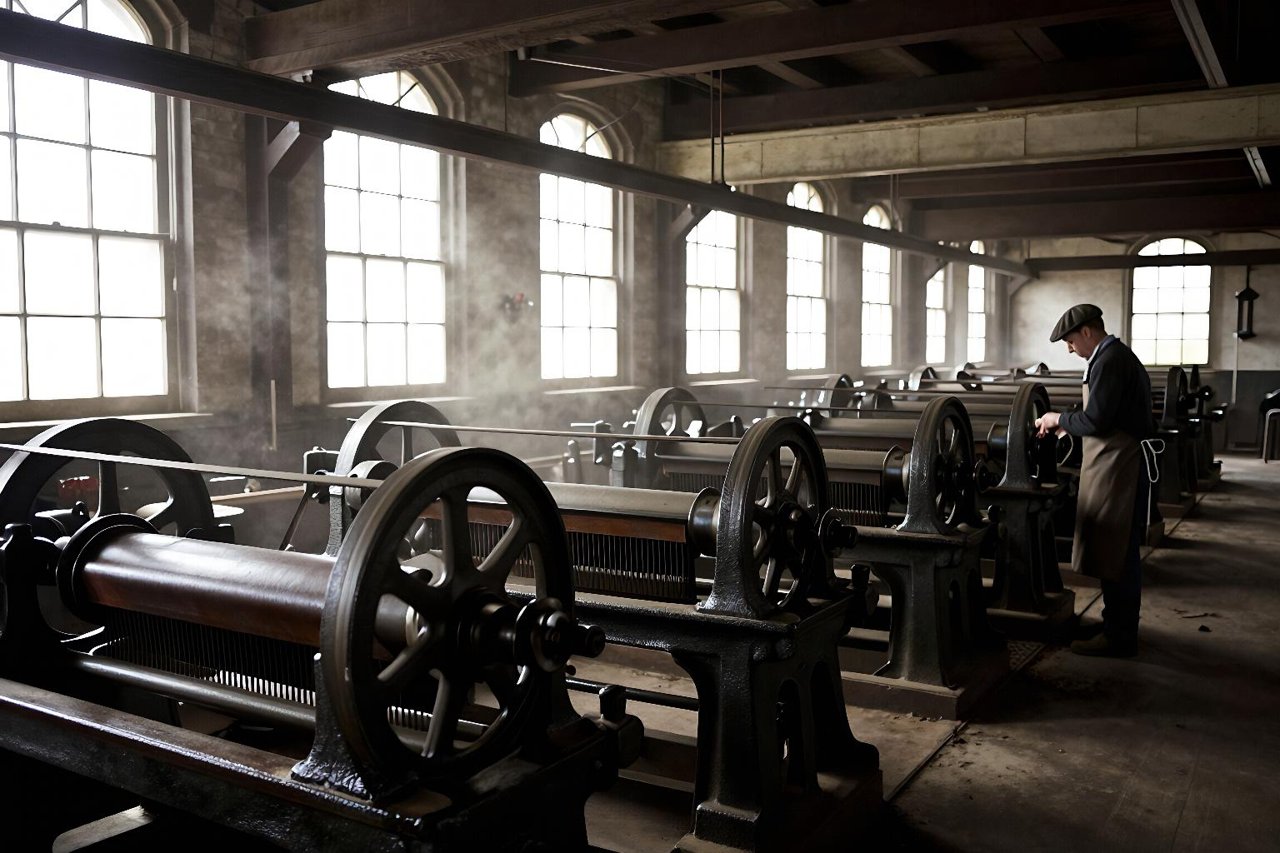
The textile trade was where the new logic showed up first. James Hargreaves built the spinning jenny around 1764. Richard Arkwright’s water frame followed in 1769, and his Cromford Mill, opened in 1771, is often called the first true factory: water-powered machinery, hundreds of workers under one roof, shifts timed by a bell.
Samuel Crompton’s spinning mule in 1779 produced thread fine enough and strong enough to compete with Indian hand-spun cloth. Edmund Cartwright patented a power loom in 1785, though it took another forty years for power weaving to sweep the industry.
What Cromford introduced was less about machinery than about discipline. Work moved from the cottage, where a weaver set his own hours, to a building where someone else owned the clock. That shift in control, more than any single engine, is what people mean when they talk about industrialisation.
Steam, iron and the collapse of distance
Thomas Newcomen had built pumping engines for mines back in 1712, crude machines that wasted most of their fuel. James Watt’s separate condenser, patented in 1769, made steam power dramatically more efficient, and his partnership with Matthew Boulton from 1775 turned it into an engine that could do almost anything: drive bellows, turn shafts, spin cotton.
Cheap iron came alongside. Abraham Darby had worked out how to smelt iron with coke at Coalbrookdale in 1709, and by the 1800s iron was going into rails, bridges and machines rather than just pots and cannon.
Then transport gave way. The Stockton and Darlington Railway opened in 1825, the Liverpool and Manchester line in 1830, and Stephenson’s Rocket hit about 30 mph at the Rainhill trials in 1829. Within two decades railways had dragged Britain onto standardised time, because a timetable is meaningless if every town keeps its own noon.
What industrialisation did to ordinary people
Manchester had around 75,000 people in 1801 and more than 300,000 by 1851. Nothing in the country had ever grown that fast, and nothing was built fast enough to cope.
- Twelve-hour days, six days a week, in buildings heated by machinery and lit by tallow.
- Children as young as six sweeping under moving looms, because they were small enough to fit.
- Wages paid in tokens spendable only at the company shop.
- Housing thrown up back-to-back, sharing one pump and one row of privies per street.
Reform came slowly and grudgingly. The Factory Act of 1833 banned children under nine from textile mills and put inspectors in place, which was itself a novelty: the state telling an owner what he could do with his own property. The Ten Hours Act followed in 1847.
Sanitation was the bigger killer. Edwin Chadwick’s 1842 report on the sanitary conditions of the labouring population read like a horror story, and cholera outbreaks in 1832, 1848 and 1854 forced the issue. London’s Great Stink of 1858 finally pushed Parliament into funding Bazalgette’s sewer system. The long argument about what industrial city living did to human bodies is still being had, and the story of the decline of health in modern living picks up where the Victorians left off.
The factory clock reshaped sleep as well, splitting the day into work and rest in a way no agricultural society had needed. There is a decent argument that humans sleeping less than any other ape is tied to exactly this kind of pressure, and industrial shift work pushed it to an extreme.
The second Industrial Revolution: steel, chemicals, electricity
From around 1870 the machinery got much better. Henry Bessemer’s converter in 1856 made steel cheap enough for bridges, ships and skyscrapers. Electricity moved from laboratory curiosity to street lighting and factory motors. The telegraph and then the telephone compressed communication the way railways had compressed travel. Internal combustion put engines on wheels.
This phase mattered politically too. Germany and the United States overtook Britain in steel and chemicals, partly by building research labs inside companies, an idea Britain was slow to adopt. Industry became something governments deliberately cultivated rather than merely permitted.
It also changed war. Railways moved armies, telegraphs coordinated them, and factories armed them at a scale no previous century could imagine. The American Civil War is the clearest early demonstration: rifled muskets, ironclad ships and rail-fed supply lines turned a domestic dispute into a preview of industrialised slaughter.
The revolution that still isn’t finished
Two things the Industrial Revolution set in motion are still running today, and neither is close to settled.
The first is fossil fuel dependency. Burning coal, then oil, then gas lifted billions out of grinding poverty and loaded the atmosphere with carbon in the same motion. Every serious energy debate now is a negotiation with that inheritance. Some of the more interesting bets are on rebuilding the energy system from the ground up, like the Robinhood founder trying to reinvent energy production, which is a very industrial ambition dressed in modern clothes.
The second is automation, and the argument about whether machines take jobs or make them. Textile workers smashed looms in the 1810s for reasons that were entirely rational. Today’s equivalent argument plays out on factory floors wired with sensors and private 5G, where industrial AI and automation running on Cisco URWB is doing to the shop floor roughly what the power loom did to the cottage: raising output, and shifting who decides how the work gets done.
What makes the period worth understanding is not the nostalgia for smokestacks. It is that the Industrial Revolution is the origin story for nearly every uncomfortable modern question, from carbon emissions to the four-day week to why your job feels like it belongs to a clock rather than to you. The weavers of Lancashire would recognise the argument immediately. They just had worse lungs.


