
Table of Contents
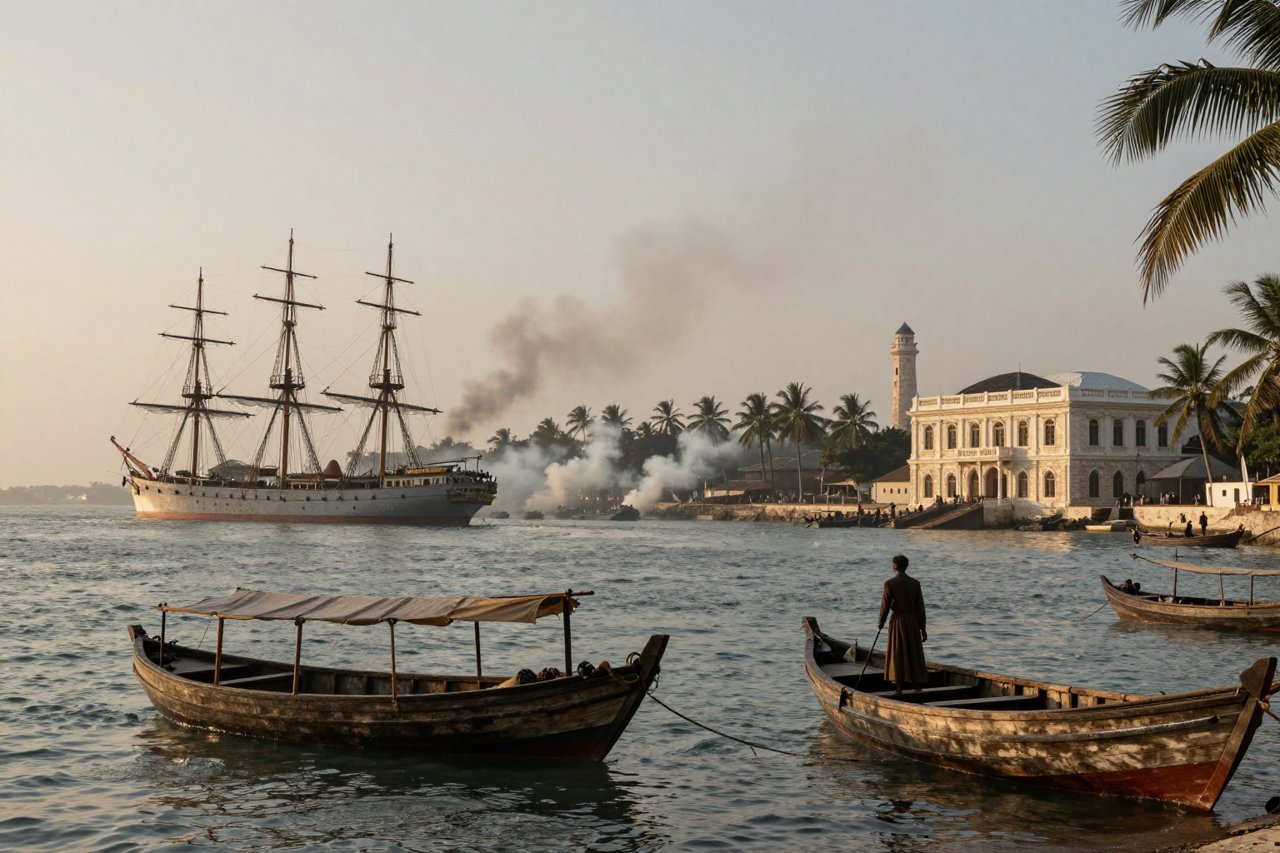
At 9:02 on the morning of 27 August 1896, British warships in Zanzibar Harbour opened fire on the Sultan’s palace. By 9:40, the flag above the building had been hauled down and the fighting was over. The Anglo-Zanzibar War had lasted roughly 38 minutes, and it still holds the record as the shortest war in recorded history.
Short wars are not always small wars. Some are lopsided, some are barely wars at all, and some redraw maps that remain contested decades later. The shortest conflicts tend to share a few ingredients: a political crisis with no room for compromise, a crushing imbalance of power, and a military plan that works before the other side can organize a response. These are the wars that ended before most newspapers could print a second edition.
The 38-Minute War: Anglo-Zanzibar, 1896
The trigger was a succession dispute. Sultan Hamad bin Thuwaini died on 25 August 1896, and his nephew Khalid bin Barghash seized the throne without the approval of the British consul. Britain, which had made Zanzibar a protectorate, wanted a different candidate. An ultimatum followed: stand down by 9:00 on 27 August or face the consequences. Khalid refused.
At 9:02, the Royal Navy began shelling the palace compound. The Sultan’s forces had around 2,800 men, several artillery pieces, and a royal yacht. They were facing warships armed with modern guns. The palace caught fire, the yacht was sunk, and the flag came down 38 minutes later. British casualties numbered one wounded sailor. Zanzibar’s losses were far higher, with hundreds killed or wounded. Khalid escaped to the German consulate and later went into exile.

The speed was not an accident. It was a demonstration of what happens when a 19th-century coastal state meets an industrial naval power with clear political aims. The ultimatum itself was a piece of brinkmanship, the kind of moment that can turn famous speeches in history into declarations of war. In this case, the talking stopped before the guns had even warmed up.
The Six-Day War: A Week That Redrew the Middle East
Not every short war is measured in minutes. The Six-Day War of June 1967 remains one of the fastest major conflicts in modern history. Israel launched preemptive air strikes on 5 June, destroying much of the Egyptian air force on the ground. Jordan and Syria entered the fighting, and by 10 June Israel had captured the Sinai Peninsula, Gaza, the West Bank, East Jerusalem, and the Golan Heights.
The war lasted six days and changed the region’s borders, politics, and military balance. It also created occupation arrangements and disputes that are still unresolved. A short war can produce a very long aftermath. That is one reason historians treat duration as only one measure of a conflict’s importance.
The Hundred Hours War: Football and a Four-Day Conflict
In July 1969, Honduras and El Salvador fought a war that lasted about 100 hours. It is often called the Football War because riots broke out during World Cup qualifying matches between the two countries. The label is catchy but misleading. Land reform, population pressure, migration, and economic inequality had been building for years. The football matches were a spark, not the fuel.
El Salvador launched a ground offensive on 14 July. Honduran forces were outnumbered and poorly equipped. The Organization of American States negotiated a ceasefire, and the fighting ended on 18 July. Around 2,000 people are estimated to have died, though figures vary. The war disrupted the Central American Common Market and left a diplomatic rift that took years to heal. A four-day war can still leave a decade of damage.
The Ten-Day War: Slovenia, 1991
When Slovenia declared independence from Yugoslavia on 25 June 1991, the Yugoslav People’s Army moved to secure the republic’s borders. The result was the Ten-Day War, fought from 27 June to 7 July. Slovenian territorial defence units blocked barracks, ambushed convoys, and held key roads. The Yugoslav army was built for a different kind of war, and its command structure struggled with a small, dispersed conflict.
Fewer than 100 people died. A ceasefire and the Brioni Agreement allowed Yugoslav forces to withdraw from Slovenia. The war did not end Yugoslavia’s violent breakup. It simply marked the opening chapter of a much longer and bloodier series of conflicts in Croatia and Bosnia. Slovenia’s quick exit is a reminder that a short war can be a prelude rather than a resolution.
Short Wars That Barely Fired a Shot
Some conflicts earn a place in the record books because they were over before they could become real wars. These are the strange, often bloodless standoffs that history books mention in a footnote. They are also the kind of historical facts most people never learned in school.
- The Pig War (1859-1872): A dispute over the San Juan Islands between the United States and Britain began after an American farmer shot a pig belonging to a British company. Troops occupied the island, but no humans were killed. The crisis was settled by arbitration more than a decade later.
- The Toledo War (1835-1836): Ohio and Michigan argued over a strip of land near Toledo. Militias mobilized, and a Michigan sheriff was wounded during an arrest, but there was no battle. Congress resolved the boundary dispute by giving Michigan the Upper Peninsula.
- The Aroostook War (1838-1839): Maine and New Brunswick quarreled over a timber region. Militias gathered, but the war produced no combat deaths. Diplomats eventually sorted out the border.
Why Do Some Wars End So Fast?
Duration depends on what you count as the start and the end. A declaration of war, the first shot, the first casualty, a ceasefire, or a formal treaty can each produce a different number. Even so, the fastest conflicts usually follow a recognizable pattern.
Overwhelming force is the most obvious factor. When one side controls the sea, the air, or the supply lines, the other side may collapse before it can mobilize. The Anglo-Zanzibar War is the extreme example. The Six-Day War is the large-scale version.
Limited political aims matter too. A war fought over a border post or a succession is easier to stop than a war fought over the survival of a state. The Ten-Day War ended with a negotiated withdrawal because neither side wanted a wider conflict in Slovenia at that moment.
External pressure can shorten a war. The Organization of American States helped end the Football War. Great powers, the United Nations, and regional bodies can impose ceasefires when the belligerents are exhausted or exposed. That pressure does not always work, and when it fails, the short war label can look optimistic.
Speed can also be a strategy. Preemptive strikes, rapid advances, and decapitation attacks are designed to create facts on the ground before the other side can respond. They can shorten a war. They can also produce a fragile peace and a longer political crisis.
The Long Shadow of a Short War
The shortest wars in history are not necessarily the least important. The Anglo-Zanzibar War cemented British control over Zanzibar and became a textbook example of colonial gunboat diplomacy. The Six-Day War reshaped the Middle East and created disputes that still shape headlines. The Football War damaged regional trade and trust in Central America. The Ten-Day War opened the door to the Yugoslav wars.
Duration is a useful filter. It gives us a list of conflicts that ended with startling speed, and it reveals how quickly political reality can change. It does not measure suffering, displacement, or the length of the aftermath. A war can last 38 minutes and still cast a shadow across generations. The record belongs to Zanzibar, but the lesson is broader: the shortest wars in history are often the ones whose consequences refuse to stay brief.


