
Table of Contents
Most people who abandon an instrument quit inside the first three months. It’s rarely a talent problem. It’s usually a mismatch: a $40 violin with a warped bridge, a drum kit on the third floor of an apartment building, or a guitar with action so high it shreds your fingertips by day four.
Pick well and the early wins come fast enough to keep you going. Pick badly and you’ll spend six weeks fighting the equipment instead of learning music. Here’s an honest look at the best instruments to learn, sorted by how quickly you’ll be able to play something recognisable.
What actually makes one instrument easier than another
Difficulty isn’t a single number, and reputation is a poor guide. Four things matter far more.
- Who is responsible for pitch. On a piano or a fretted guitar, the notes are laid out for you. On a violin, trombone or fretless bass, you build every single note with your ear.
- The physical cost. Nylon strings and a practice pad are kind to beginners. A brass instrument demands lip strength most adults don’t have yet, and a double bass demands a van.
- Where you can practise. An acoustic drum kit at 10pm in a flat will end badly. A digital piano with headphones won’t.
- Entry price. You can start ukulele for $70 and a playable used keyboard for $150. A decent student cello starts closer to $900.
The quick wins: playable within a week
Ukulele
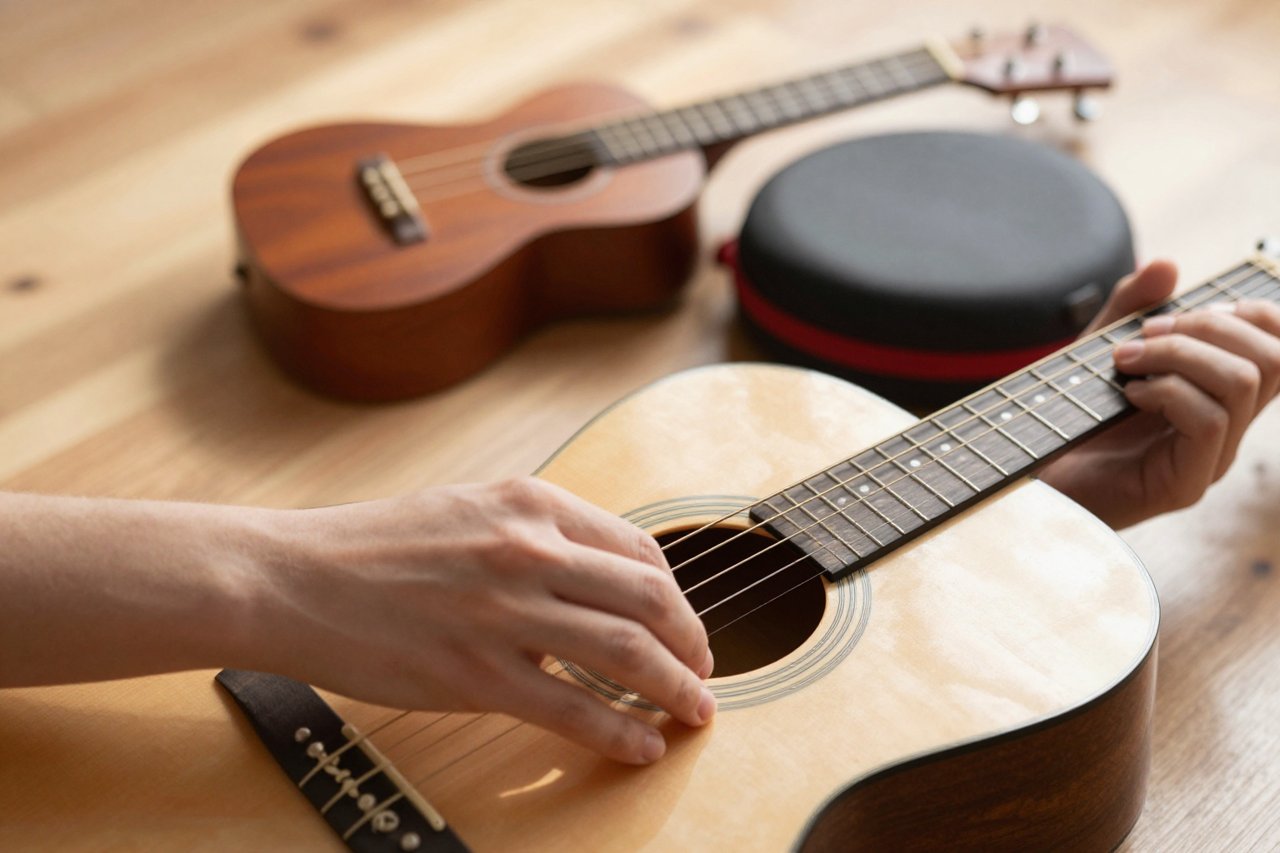
Four strings, four chords, and a genuinely enormous songbook. Learn C, G, Am and F and you can busk your way through hundreds of pop songs. Nylon strings mean no fingertip bloodshed, and a decent soprano uke costs less than a takeaway dinner for four. It also travels well, which matters more than people admit.

Harmonica
A ten-hole diatonic harmonica is $40, fits in a jacket pocket, and makes a sound the moment you breathe into it. Single notes take a couple of weeks; bending them takes longer. Blues players spend years on the same $40 instrument, which is a rare thing in music.
Cajón and hand percussion
Rhythm is the fastest route to playing with other people. A cajón is a wooden box you sit on and hit, it costs around $100, and you can hold a groove with a guitarist within days. Djembe and bongos work the same way.
Piano and keyboard: still the best all-rounder
Nothing beats the layout for learning how music actually works. Every note is visible, chords look like shapes rather than puzzles, and the theory you absorb transfers to almost anything else you pick up later.
Start with a 61-key digital piano with touch-sensitive keys, roughly $200 to $300 new. Weighted, hammer-action keys feel better but push the price past $450. Add headphones and you can practise at midnight without a single complaint from the neighbours. The one real catch is that serious two-hand independence takes months, so expect a slower first month than a ukulele gives you.
Guitar: the best return on effort
Three chords, a capo and a bit of rhythm gets you through an astonishing number of songs. The trade-off is physical: steel strings hurt for two to three weeks until calluses form. Push through and it stops being an issue. If you want to skip that stage, a nylon-string classical guitar or an electric strung with 9-gauge strings is noticeably gentler.
You don’t need lessons to start. A tuner, a metronome and a chord library in your pocket cover the first few months, and there are plenty of good options in this roundup of the best music apps for beginners. Fifteen minutes a day beats a two-hour Sunday session every time.
Bass and drums: the rhythm section route
Bass guitar
Four thick strings, one note at a time, and a role that’s easier to fill than most people think. Bands are permanently short of bassists, so a competent player with six months of practice can end up gigging while guitarists are still arguing about who plays lead. Root notes carry you a long way.
Drums
Independence between limbs is the hard part, but the entry point is cheap and immediate. A practice pad and a pair of sticks cost $30, and most electronic kits run $300 to $500 with a headphone jack. Volume control is the deciding factor here, not coordination.
The steep ones, and why people still fall for them
Violin is the classic example. No frets, no keys, four strings tuned in fifths, and a bow that punishes every wrong angle. Most adults need six to twelve months before the sound stops resembling a cat in distress. Saxophone is similar in a different way: the fingering is logical, but the embouchure takes weeks to hold, and reeds are a recurring expense.
That said, the difficulty is front-loaded. Violinists who survive year one tend to stay for decades, because the instrument rewards patience in a way few others do. If you’re drawn to it, rent before you buy. A $40 monthly rental on a decent student violin is far smarter than a $150 VSO-shaped object from a marketplace listing.
A realistic first-year budget
- Under $100: harmonica, ukulele, practice pad, tin whistle, shakers.
- $150 to $350: digital keyboard, entry-level acoustic guitar, cajón, electronic drum pads, student flute.
- $350 to $800: weighted-key digital piano, mid-range electric guitar plus a small amp, four-piece electronic kit, student saxophone (used).
- Ongoing costs: strings every few months, reeds, drum sticks, and lessons if you want them. Budget $20 to $60 a month for tuition or a good app subscription.
Buying used is normal and sensible. Choosing an instrument carries far less risk than picking one of the best trading platforms for stocks and crypto, mostly because you can walk into a shop and test the thing for ten minutes before spending anything. If you do change your mind, an unused instrument holds value reasonably well, and there are plenty of places to sell musical instruments for cash once you’ve decided it isn’t for you.
The one that gets played on a Tuesday in February
Enthusiasm is easy in the first week. What matters is the ordinary evening six months later, when you’re tired and the instrument is in the other room. So ask practical questions before you spend a penny.
Where will it live? Can you reach it in under thirty seconds, or does it need unpacking from a case and a trip to the garage? Can you play it after the kids are asleep? Does it fit in the car for the weekly lesson?
An instrument that’s easy to start and easy to ignore is a worse investment than one with a steep first month and a permanent spot in the corner of your living room. A $90 ukulele you play every night beats a $1,200 classical guitar that never leaves its case. Pick the one that suits your hands, your flat and the twenty minutes you can genuinely find before bed, then play it badly for a month and keep going anyway.


