
Table of Contents
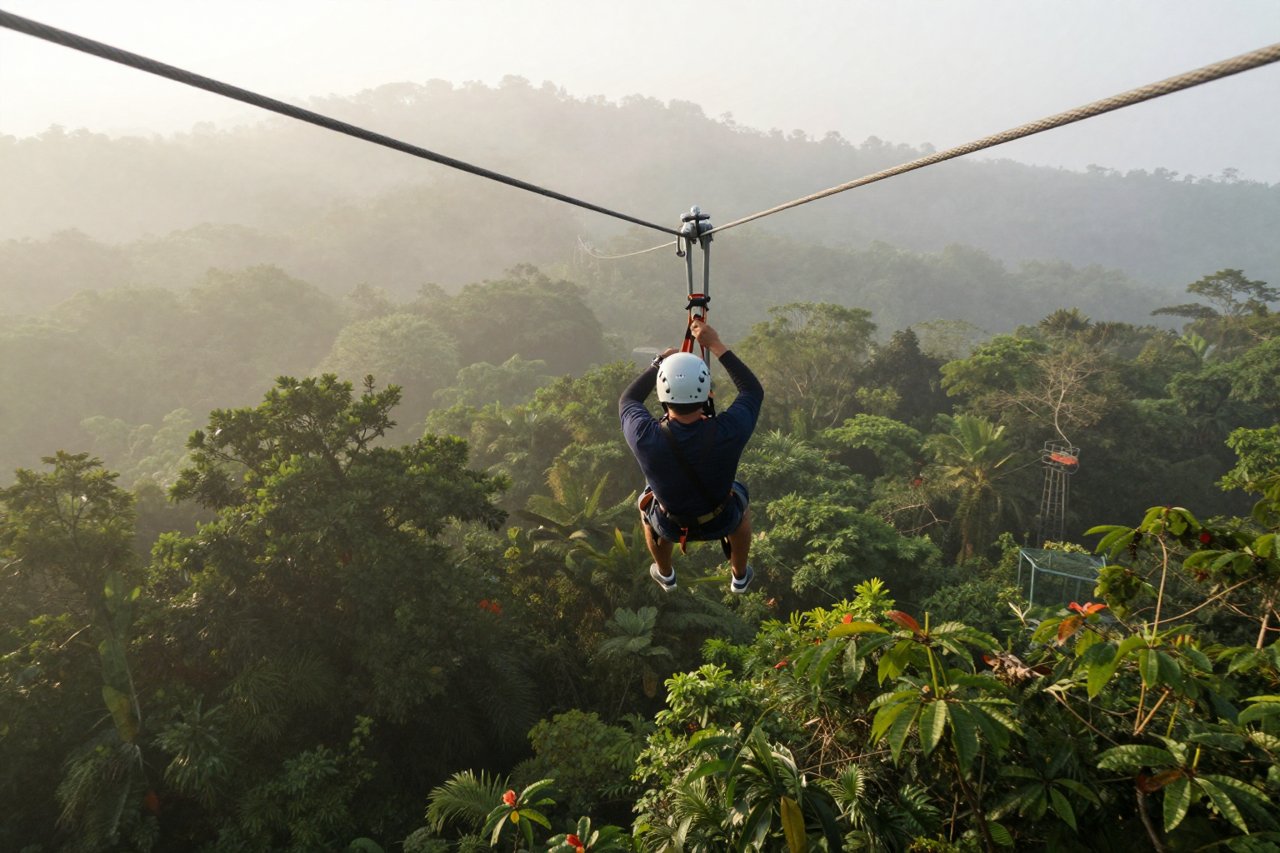
The first canopy tours were strung up in Costa Rica’s cloud forest, where researchers needed a way to move between treetops without climbing down and back up again. Half a century later, the same rope-and-pulley idea has migrated to flooded slate quarries in Wales, volcanic ridges above Queenstown and cliff faces in the Sacred Valley. Some ziplines are twenty-second glides past a car park. Others drop you off a mountain fast enough that your cheeks flap. Choosing well comes down to the setting, the cable length and how much of the braking you have to do yourself.
Monteverde and La Fortuna, Costa Rica
Costa Rica still sets the standard, partly because there are so many operators and partly because the terrain does half the work. Two areas are worth planning a trip around.
Monteverde: where it all started
Up in the misty Tilarán range, outfits like Selvatura and Sky Adventures run long networks of cable — Selvatura’s course alone covers around 3km across more than a dozen lines, finishing with a Tarzan swing that drops you off a platform into open air. Go early. Cloud cover rolls in by late morning and the volcano views vanish. Bring a light rain shell; this is a rainforest, not a theme park.
La Fortuna: bigger cables, better photos
Sky Trek above La Fortuna runs eight cables, the longest stretching roughly 770m, with Arenal’s cone sitting in the frame the whole way down. Speeds touch 70km/h on the steep sections. Pair it with an afternoon at the hot springs, since your legs will be done by lunch. Costa Rica also happens to be one of the better-value tropical trips going, which helps if you’re watching the budget — these tropical getaways that won’t drain your savings are worth a look while you’re planning.

The Sacred Valley, Peru
Natura Vive’s Skylodge is the odd one out on this list: a set of transparent capsule rooms bolted to a cliff above the Sacred Valley, reached by a via ferrata climb and exited by zipline. Five cables, roughly 400m of descent, at around 3,000m of altitude. The combination of thin air and exposure makes it feel far more serious than the cable length suggests. Book weeks ahead, and give yourself a couple of days in Cusco to acclimatise before you clip in. If you’re building a longer Andean itinerary around it, this guide to where to stay and what to do in the region is a decent starting point.
Queenstown, New Zealand
ZipTrek’s course on Bob’s Peak is the polished version of the sport: four lines, about 1.2km of cable in total, top speeds near 70km/h, and a gondola ride to the start so nobody has to hike in harness. The guides talk about the native beech forest as you go, which sounds like filler until you’re 30m up and realise they’re the only thing keeping the mood light. They run evening tours too, with headtorches and the town lights below you.
Whistler, British Columbia
Sasquatch is the headline act: a 2km line strung 600 feet above Fitzsimmons Creek, hitting around 100km/h in a prone position. It’s one of the longest in North America and it only operates in summer, so the window is narrow. Ziptrek also runs a gentler multi-line course through the same valley if you’re travelling with someone who’d rather look at the trees than scream past them. Whistler works well as a road trip from Vancouver, and the drive up the Sea-to-Sky is half the reason to go.
Where the records live: Wales, South Africa and Nepal
If speed and vertical drop are what you’re chasing, three sites are worth booking a flight for.
Penrhyn Quarry, Wales
Zip World’s Velocity 2 sends you headfirst across a flooded slate quarry at over 150km/h, on a 1.5km line that finishes on a raised platform in the middle of impossible blue-green water. It’s the fastest in Europe. The same site runs cavern trampolines and a slower forest course, so a mixed-ability group can split up and meet for lunch.
Mossel Bay, South Africa
This one crosses the Indian Ocean — 1.1km of cable at up to 90km/h, with the stop built out over the water. It slots neatly into a Garden Route drive between Cape Town and Port Elizabeth, and the coastal views from the launch platform are as good as the ride.
Pokhara, Nepal
The Zipflyer drops roughly 600m over 1.8km, which makes it one of the steepest commercial lines anywhere. You start above Sarangkot with Annapurna filling the horizon and arrive in a valley village that smells of woodsmoke. Weather cancels runs often, so leave a spare morning.
Hawaii and Puerto Rico
The Big Island’s Umauma Falls course strings multiple lines over a series of rainforest gullies, with waterfalls underneath and the ocean in the distance. Maui has a handful of options on the Haleakala slopes, most of them shorter and gentler. Puerto Rico’s Toro Verde is the one to know about: The Monster stretches roughly 2.5km and is regularly cited as one of the longest in the Americas, with the ride taking well over a minute. Both islands pair easily with beach time, which is the point.
A shorter drive: Ontario’s canopy tours
Not every good zipline needs a passport. Long Point Eco-Adventures, about two hours southwest of Toronto, runs a proper canopy course through Carolinian forest, and Blue Mountain has lines above the escarpment for anyone already heading up for the weekend. If you’re working around a city schedule, these day trips from Toronto worth planning around make a decent shortlist for pairing a drive with an afternoon in a harness.
What actually separates a great line from a forgettable one
Two ziplines can both advertise “1km of cable” and feel nothing alike. The variables that matter are less photogenic than the brochure shots.
- Drop versus length. A long, gently angled line is a scenic float. A short line with a steep gradient is a rollercoaster. Decide which you actually want before you book.
- Who brakes. Some courses are hand-braked, which means you’re responsible for slowing yourself down at the end — fun, but not for everyone. Others are fully guide-controlled.
- Access and walking. A gondola or 4×4 to the top is a very different day from a 25-minute uphill hike in a harness.
- Weight and age limits. Most operators run roughly 35kg to 125kg, and wind can shut a line even when the sun is out.
- Weather policy. Ask whether a cancellation gets you a refund or a credit note that expires. Mountain sites cancel often.
- Photo pricing. Onboard cameras are usually an upsell, and the markup on digital files can rival the ticket.
The best rides tend to be the ones where you book the first slot of the day, before the queue builds and the light flattens out. Arrive early, travel light — pockets empty, glasses secured with a strap — and expect to sign a waiver that nobody reads. Then let go of the bar and look around, because the view is the part you’ll remember longer than the speed.


