
Table of Contents
Cats are very good at hiding discomfort. That isn’t a personality flaw, it’s survival wiring. A wild cat that limps or cries out becomes someone’s dinner, so the instinct to mask weakness runs deep. By the time an owner notices something’s wrong, the problem has often been building for weeks.
Which is why learning the signs your cat is in pain takes a bit of deliberate effort. You won’t get a clear signal. You’ll get a scattering of small details, a shifted sleeping spot, a skipped meal, a tail that flicks differently when you run your hand along the left hip.
Start With a Baseline: What Does Your Cat’s Normal Look Like?
You can’t spot a change if you don’t know the starting point. Spend a week actually watching. Where does your cat sleep at 2pm? How much does she eat at each sitting? Does she jump onto the counter in one clean motion or does she land with a thump? How does her belly feel when you press gently?
Write it down if that helps. A four-line note on your phone each evening is enough. Vets ask these questions constantly, and owners who can answer them get faster diagnoses.

Posture Changes That Say More Than a Meow
Cats in pain hold their bodies differently, and it’s often the first thing a professional notices across a waiting room. Look for these specific shapes:
The Loaf That Isn’t Relaxed
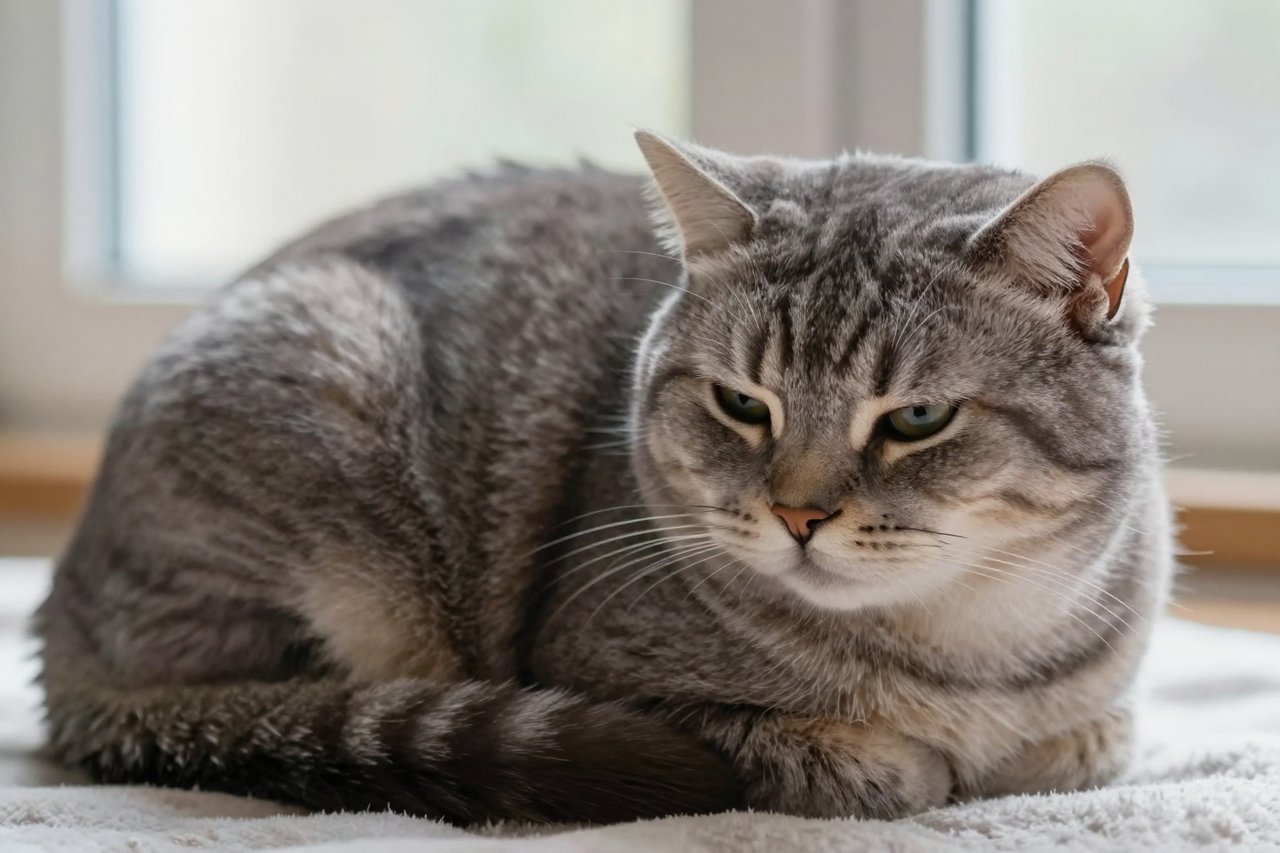
A comfortable cat loafs with soft shoulders and a rounded, relaxed back. A pained cat loaves tightly and holds her head low and forward, with her back slightly hunched and her front paws tucked in close. The difference is tension. If you slide a hand under her chest and she feels rigid rather than floppy, that’s worth noting.
Head, Ears and Whiskers
Ears that sit flatter or rotate outwards, whiskers that point down rather than out, and a nose pressed into a wall or the back of a sofa are all quiet distress signals. A cat resting her head against a hard surface for long stretches may be dealing with a headache or neck pain.
Also watch for the “guard” position: shoulders turned to protect one side of the body, or a leg held slightly off the floor. Cats do this with abdominal pain, back pain, and injuries to the limbs. Some of these overlap with ordinary health issues, which is why it helps to know which common cat health problems actually deserve a vet visit and which can wait until morning.
Grooming Cuts Both Ways
A sudden drop in grooming is a strong pain signal. Cats with sore mouths, aching joints, or nausea stop washing, and you’ll see it as greasy fur along the spine, dandruff, or a matted patch near the tail.
The opposite is just as telling. A cat who licks one spot raw, usually a flank, a paw, or the base of the tail, is often trying to soothe pain underneath. Over-grooming to the point of baldness or open sores needs a vet, not a cone and a wait-and-see approach.
Appetite, Water and the Litter Box
Cats in pain are often nauseated, and nausea kills appetite. A cat who sniffs her bowl and walks away, or eats a few bites and then sits staring at the wall, is telling you something. Dental pain makes chewing hurt, so watch for food dropped out of the side of the mouth, head tilting while eating, or a preference for soft food over kibble.
Water intake matters too. If your cat suddenly drinks a lot, or stops drinking altogether, that’s a red flag for several conditions. When you’re trying to encourage a reluctant drinker, these practical ways to get a cat to drink more water can help while you sort out the cause.
Litter box changes are easy to miss. Straining, crying out during urination, going outside the box, or urinating in small frequent amounts can all point to pain in the bladder or urinary tract. In male cats, straining with no urine produced is a medical emergency, so don’t wait it out.
The Sounds You Might Miss
Purring is not a happiness meter. Cats purr when they’re content, but also when they’re frightened, in labour, or hurting badly. Some research suggests purring at certain frequencies may even help cats self-soothe and heal. So a cat who purrs nonstop while hiding under the bed isn’t necessarily fine.
Listen for the rest of the vocabulary instead. A low growl when you pick her up. A short, sharp hiss when you touch a particular spot. A yowl in the hallway at night, or a meow that’s noticeably louder, flatter, or more persistent than usual. Sudden vocal changes deserve investigation.
Behaviour Shifts: Irritability, Hiding and Clinginess
Pain makes cats short-tempered. A cat who was always tolerant may snap when you touch her back, or she may swat at a child who reaches for her too fast. Owners often describe this as the cat “getting mean,” when in reality she’s saying, in the only way available, that something hurts.
If your cat has suddenly started swatting or hissing, it’s worth working through the real reasons behind sudden cat aggression before assuming it’s a behavioural problem, since unrecognised pain is a common trigger.
Hiding is the other classic. Cats in pain retreat to quiet, dark spaces and stay there. Equally, some cats become unusually clingy and follow you from room to room. Both are changes in a routine, and both deserve attention.
Stiffness That Gets Blamed on “Getting Old”
Arthritis affects a huge number of cats over ten, and most owners never spot it. The signs are subtle: hesitation before jumping onto the sofa, using a chair as a stepping stone, or refusing the cat tree entirely. Some cats stop jumping altogether and start sleeping on the floor.
Watch for a cat who sits rather than standing to eat, or who walks with a shortened stride. Untreated joint pain changes a cat’s whole life, and modern treatments work well. A cat who moves less because moving hurts may also gain weight, which then makes the joint pain worse.
Dental Pain Is Under-Diagnosed
Fewer than half of cat owners ever brush their cat’s teeth, and dental disease is one of the most common problems vets find at check-ups. Cats with sore gums or resorptive lesions often eat normally until the day they can’t, because they’re that good at compensating.
Bad breath, drooling, a swollen jaw, or a sudden dislike of being touched near the face are all worth a look. If your cat will tolerate it, regular brushing helps prevent a lot of this; this guide to brushing a cat’s teeth without losing a finger is a reasonable place to start.
When to Call the Vet Today
Some signs can wait until a regular appointment. These can’t:
- Straining to urinate, or no urine produced in 12 hours (an emergency, especially in males)
- Not eating for more than 24 hours, which risks liver problems in overweight cats
- Crying or yelping when picked up or touched
- Collapse, disorientation, or a sudden inability to use the back legs
- Rapid, shallow breathing, or breathing with the mouth open
- Repeated vomiting, or vomiting that includes blood
- A swollen or hard abdomen
- Sudden collapse or a hind leg that won’t bear weight
Vomiting after eating is sometimes benign, and cats who chew grass often throw up right afterwards. This explainer on why cats eat grass, and when you should worry, helps separate routine hairball incidents from something more serious.
What to Do With What You’ve Noticed
Don’t try to diagnose your cat yourself. What you can do is gather evidence. Note when the change started, whether it’s getting better or worse, and which specific activities seem to hurt. A smartphone video of your cat walking, jumping, or eating is genuinely useful to a vet, because cats often behave perfectly normally the moment they’re on an exam table.
Try a gentle hands-on check at home. Run your palms along each leg, press lightly along the spine, open the mouth if she allows it, and watch for a flinch, a growl, or a sudden pulling away. Stop the moment she objects. That flinch is data.
Finally, remember that pain in cats is now treated far more aggressively than it was twenty years ago. Vets have real options: non-steroidal anti-inflammatories formulated for cats, nerve pain medications, joint injections, laser therapy, and multi-modal plans that combine several of these. If you suspect your cat is hurting, describing what you’ve observed out loud in an appointment is one of the most useful things you’ll ever do for her. Cats aren’t dramatic. When they show you something, it’s usually already been true for a while.


