
Table of Contents
Ask ten cat owners whether wet or dry food is better and you’ll get ten confident answers, most of them contradictory. The truth is that both formats can work well, and the right choice depends far more on your individual cat than on which side of the debate you land on. Here’s a practical breakdown of what each type actually does, where the marketing oversells it, and how to make a decision you can live with.
The Hydration Question Is the Real Story
Cats evolved as desert hunters, which means their bodies are built to extract most of their water from prey. A mouse is roughly 70% moisture. A bowl of kibble is around 10%. Wet food sits somewhere around 75–80%.
That gap matters because cats have a famously weak thirst drive. Many will drink less than they need, especially if the water bowl sits next to their food (cats often avoid water near a food source). Chronic mild dehydration is a genuine contributor to urinary crystals, bladder inflammation and, over years, kidney stress.
For a cat who rarely touches the water bowl, wet food is the simplest fix available. Two 85g pouches a day can add well over 100ml of water to their intake without any effort from you. If your cat is a enthusiastic drinker and produces good-sized clumps in the litter tray, the urgency drops — but it’s still worth knowing where the moisture is coming from.

Signs your cat may need more moisture
- Small, hard or infrequent clumps in the litter box
- Skin that stays tented for a moment when gently pinched at the scruff
- Dry gums or tacky saliva
- A history of FLUTD, cystitis or struvite crystals
- Persistently eating dry food only while drinking very little
Dry Food: Convenience, Cost and a Fairer Dental Reputation Than It Deserves
Kibble’s advantages are real and worth naming. It’s cheaper per calorie — often by a factor of three or four. You can leave it out without worrying about spoilage in warm weather. It doesn’t smell. And for multi-cat households or people working long shifts, self-feeding dry food is sometimes the only realistic option.
The dental claim is where things get murky. A standard kibble shatters between the teeth and barely touches the gumline; most cats swallow it largely whole. Only specifically designed dental kibble with a fibrous, aligned structure has any meaningful mechanical effect, and even then it’s a supplement to brushing, not a replacement. If dental health is your concern, wet food isn’t automatically the villain — a cat that never has its teeth brushed is at risk either way.
Quality varies enormously in this category. Two bags can look identical and differ wildly in animal protein content, carbohydrate load and the proportion of plant-based fillers. Learning to read a label properly is the single most useful skill you can develop here, and our guide to what makes high quality cat food walks through the ingredient panel line by line.
Wet Food: Higher Palatability, Higher Cost, More Waste
Wet food wins on aroma, texture and moisture. It’s also usually higher in animal protein and lower in carbohydrate on a dry-matter basis, which aligns better with an obligate carnivore’s physiology. For cats with diabetes, obesity, or a history of urinary issues, that profile is often easier to manage.
The downsides are practical rather than nutritional. A 400g tin of decent wet food costs more than a week’s worth of kibble. An opened tin keeps for about 24 hours in the fridge, and many cats refuse food straight from the fridge — you’ll be warming portions to room temperature twice a day. Picky cats also develop loyalties: serve one brand for six months and you may find yourself driving to three shops to find it.
There’s an emotional element too. Wet food smells strongly, and some owners worry about soft stools. Usually that settles within a week or two as the gut adjusts, especially if you transition gradually — a quarter new food, three-quarters old, for several days before shifting the ratio.
The Middle Ground Most Owners Actually Land On
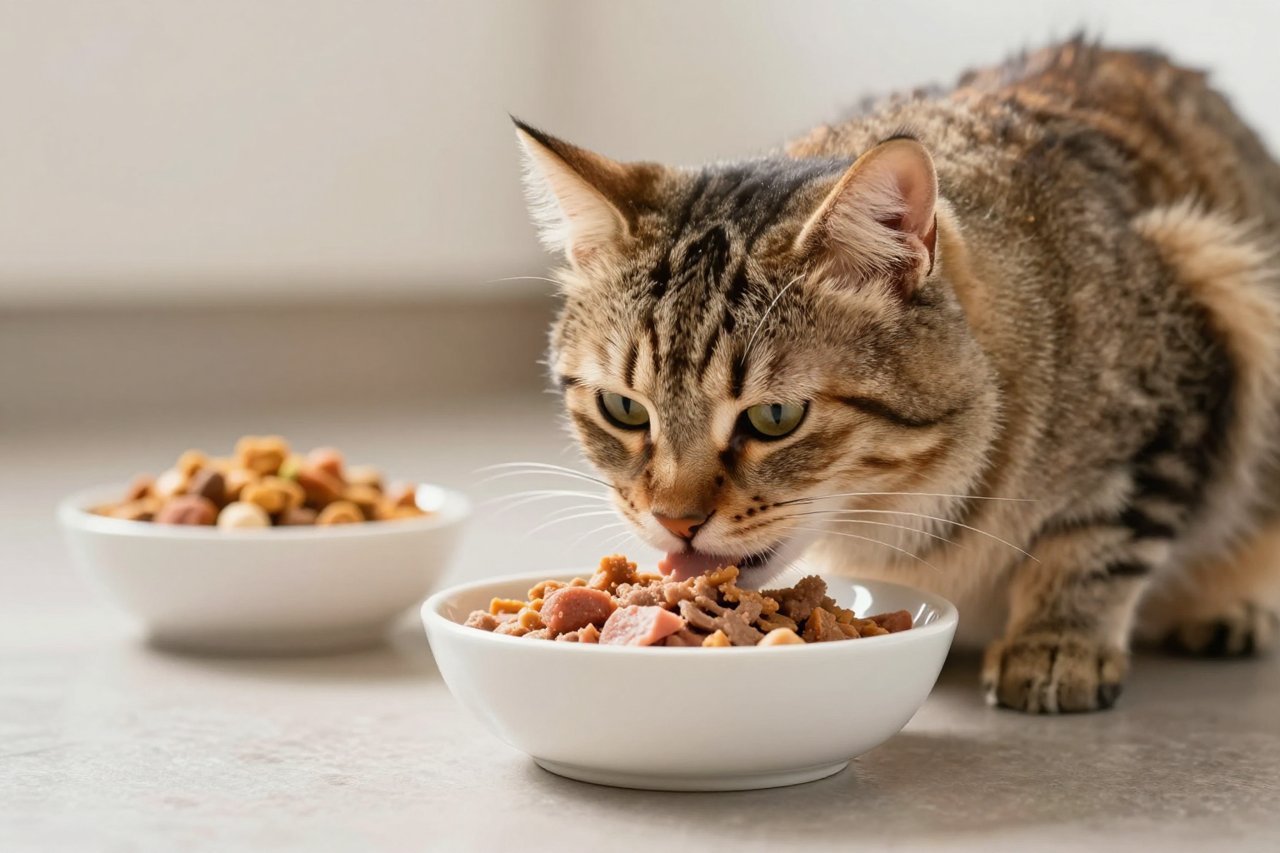
A mixed feeding routine solves more problems than it creates. A typical pattern: one or two wet meals a day for hydration and protein, with a measured portion of dry food left out or fed at a set time for convenience and a bit of crunch variety.
The critical word is measured. The most common feeding error isn’t the format — it’s doubling up. Owners feed a full portion of wet and leave a full bowl of kibble out, then wonder why the cat gains 800g in a year. Work out total daily calories from both foods combined, and split them however suits your schedule.
As a rough starting point, an average 4kg indoor adult cat needs somewhere in the region of 200–250 calories a day, adjusted for age, activity and body condition. Check the calorie density on both packages — wet food is often around 80–100 kcal per 100g, while dry food can run 350–400 kcal per 100g. Those numbers make it obvious why portioning dry food by eye goes wrong so often.
Where a specific health issue changes the answer
Kidney disease, cystitis and diabetes almost always push the decision toward wet, or at least toward a much higher moisture intake. Constipation and megacolon push toward higher fibre — and that’s achievable in either format, though it takes some label reading. Our breakdown of high fiber cat food and how to choose it covers the fibre types that actually help motility rather than just bulking stool.
Kittens are a different case again. They need calorie-dense, nutrient-dense food and they need a lot of it — growth is expensive. Wet food suits small stomachs well, but many kittens do better on a combination. There’s more detail in this guide to choosing kitten food for a healthy start if you’re feeding a cat under a year old.
What the Vets Tend to Say (and Where They Differ)
Veterinary opinion isn’t monolithic. Emergency and internal medicine vets skew strongly toward wet food because they see the dehydrated, blocked tomcats at 2am. Dental-focused vets are more likely to defend some dry food in the mix. Nutritionists tend to say the same thing repeatedly: the best food is a complete, balanced one your cat will actually eat, in an amount that keeps them lean.
That last point deserves emphasis. Palatability beats theory every time. A premium wet food your cat licks once and abandons is worse than a mid-range dry food they finish enthusiastically. For a closer look at how vet-recommended options stack up, this roundup of cat food recommended by vets is a sensible starting point.
How to Decide for Your Cat, Not for the Internet
Work through four questions and the answer usually falls out on its own.
- Does your cat drink? If not, weight the diet toward wet.
- What’s your realistic budget and schedule? Be honest. A plan you can’t sustain for two years is not a plan.
- Any health history? Urinary, renal or diabetic cats shift toward wet; constipation shifts toward fibre, in either format.
- Will they eat it? Buy small quantities first. Two tins and a small bag, not a bulk case.
Then do the boring part properly: transition slowly over seven to ten days, weigh your cat monthly (a cheap kitchen scale and a cat that tolerates being held works fine), and reassess at your next vet visit. Body condition is a far better signal than any rule about which format is superior. A lean cat on dry food is healthier than an overweight cat on pouches — and both are healthier than a cat whose owner never checked.
One last practical note: whatever you choose, keep the water bowl far from the food bowl, refresh it daily, and consider a fountain if your cat shows interest in running taps. That single change often does more for a cat’s hydration than switching brands entirely.


