
Table of Contents
A 20-mile day on rough ground is not a bigger version of a five-mile walk. It’s a different animal. The people who finish long hikes smiling usually aren’t the fittest ones on the trail — they’re the ones who sorted out their feet, their pack weight, and their pacing before they ever left the car park. Everything below is the stuff that actually moves the needle.
Start With the Distance, Then Work Backwards
Pick your target date and count backwards. Eight to twelve weeks is a comfortable runway for most hikers preparing for a big day out. Six weeks works if you’re already active. Two weeks is not a training plan, it’s a packing plan.
Build a base you can trust
Aim for three sessions a week, and make two of them time-on-feet rather than gym work. Weeks one to three: 60 to 90 minutes with a light pack. Weeks four to six: push one walk out to three hours with 5kg on your back. Weeks seven onward: one long walk of four to six hours, ideally on ground that resembles your objective — steps, loose scree, or long sustained climbs.
The single most useful session you can do is a hilly walk in the exact shoes and pack you’ll use on the day. Your body learns what 20km feels like at hour five, and you find out which strap rubs before it becomes a genuine problem 8km from the trailhead.

Train the descent, not just the climb
Everyone trains uphill. Most people blow up going down. Quads take roughly three times the eccentric load on a steep descent than on the climb, which is why so many hikers hobble into camp at the end of a big day. Add step-downs (find a high step, lower yourself slowly on one leg, 3 sets of 10 per side) and single-leg balance work twice a week. Your knees will notice the difference around mile 14.
Sort Out Your Feet Before They Sort You Out
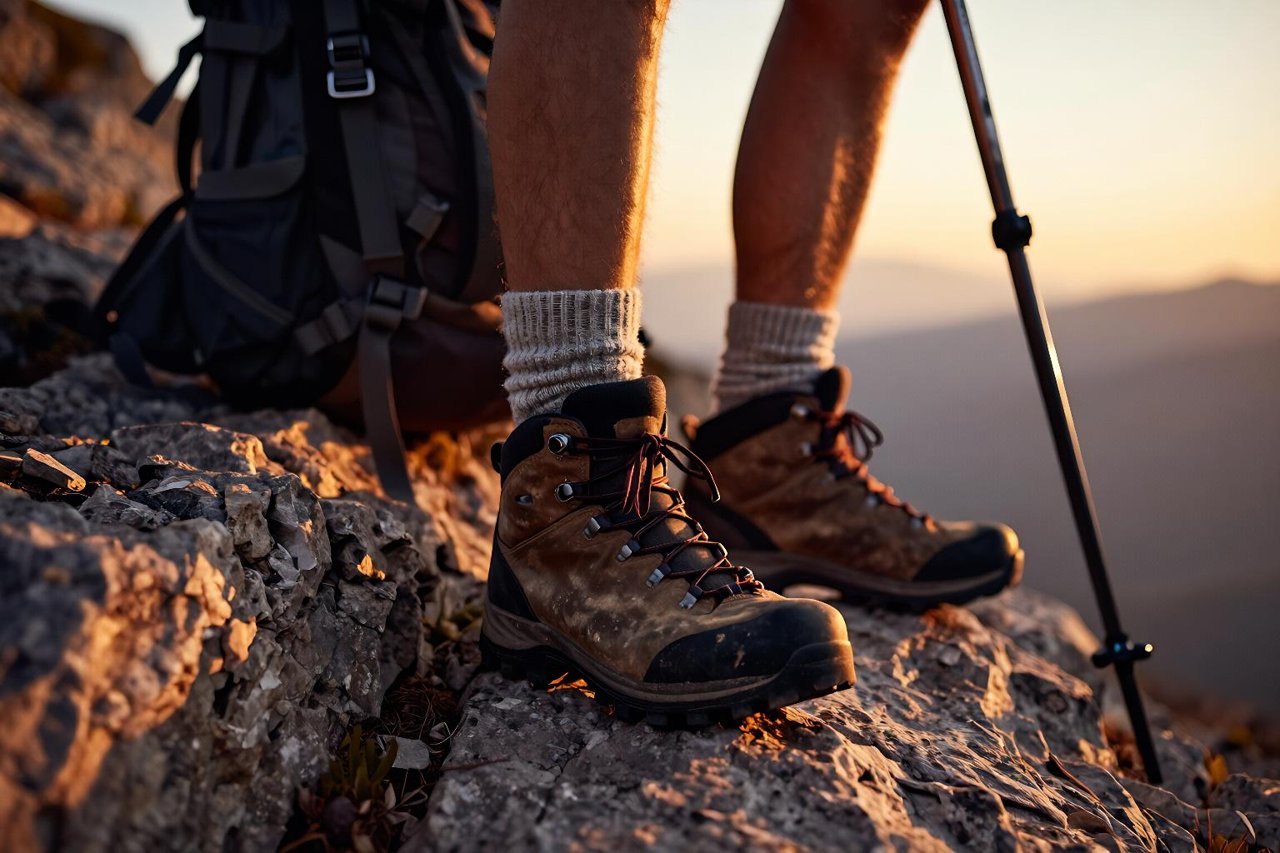
Blisters end more long hikes than fitness does. Decide on your footwear early enough to walk at least 50km in it before the real thing. Trail runners suit most hikers on well-graded paths; stiffer boots earn their keep on rocky, wet, or heavily loaded days. Neither is wrong, but a brand-new pair on the day is.
- Socks: merino or synthetic, never cotton. Take a spare pair and change at the halfway point — dry feet are blister-resistant feet.
- Toenails: trim them straight across a few days before, not the morning of. Short nails stop the black-toe shuffle on long descents.
- Pre-taping: if you know a spot rubs, tape it before you start walking, not after it’s already hot.
- Lacing: tighter through the midfoot, looser at the ankle, and re-lace when the terrain changes.
Pack Light, Then Weigh It
Get a kitchen scale out and weigh everything. Most hikers carry 4kg of things they never touch. A sensible target for a long day hike is under 8kg total, including water and food; for overnight trips, aim under 20% of your bodyweight. The big three — shelter, sleep system, pack — are where the real savings live, so spend your money there and economise on everything else.
Lay your kit out the night before and remove one item you’d only use ‘just in case’. Then repeat the exercise. A lighter pack means fewer stops, less fatigue, and noticeably happier knees on the descent.
Do the Food and Water Maths
Rough figures: 200–300 calories per hour of steady walking, more on steep ground. That’s a handful of nuts and a flapjack every 60 to 90 minutes. Eat before you’re hungry, because appetite tends to vanish around hour four and once you’re behind on calories it’s hard to catch up.
Water is more individual. In cool conditions, 0.5 litres per hour is a reasonable starting point; double it in heat. On desert trails like the ones in this guide to the best hikes in Moab, Utah, treat 4 litres as a minimum for a half-day and carry a filter as backup. Add electrolytes if you’re sweating hard for more than three hours — plain water alone stops being enough.
Know the Route Properly, Not Just the Name
Download the GPX file, but also learn the shape of the day: where the junctions are, how much elevation comes in the last third, and where you can bail out if something goes sideways. Screenshot the map, because phones die and cold weather eats battery.
Give someone your route and a hard deadline for a check-in text. That single habit has rescued more hikers than any piece of gear. If you’re planning something alpine, the trail notes for the best hikes in Rocky Mountain National Park are a good example of the level of detail worth reading beforehand — trailhead parking, exposure, and afternoon storm timing all matter more than the distance on the sign.
Dress for the Forecast, Not the Trailhead
The car park is almost always warmer and calmer than the ridge. Build your layers around a simple three-part system: a base that moves sweat, an insulating mid-layer, and a shell that blocks wind and rain. Add a warm hat and gloves even in summer, because summits run 8–10°C cooler than the valley.
Coastal routes are their own puzzle, with wind that arrives sideways and fog that swallows the path. The Michinoku Coastal Trail hike experience is a useful case study in packing for wet, changeable weather without carrying half a kilo of unnecessary weight.
Run a Shakedown Hike
Two or three weeks out, do a shorter version of your real hike with the full pack. Same shoes, same socks, same food. You’ll learn three things fast: whether the pack fits after three hours, whether your stomach tolerates what you’ve packed, and how long the morning routine actually takes. Fix what breaks on a six-mile day rather than a twenty-mile one.
Pace, Poles, and the Mental Middle
Start slower than feels natural. A conversational pace for the first hour saves an enormous amount of energy later, and the people who overtake you at 9am are often the ones you pass at 2pm. Poles are worth the weight on any sustained descent; they take roughly 20% of the load off your legs and give your arms something to do.
The middle of a long hike is where motivation dips, especially on big objectives. If you’re heading somewhere high — the multi-day hikes from Cusco being a classic example — build in an acclimatisation day and treat the first 48 hours at altitude as a slow-motion warm-up rather than a race.
The Last 48 Hours and the Day After
Don’t cram training into the final week. Taper it: a couple of easy 45-minute walks, plenty of sleep, and more carbs than usual the night before. Check the forecast one more time, lay your kit out by the door, and set two alarms.
Afterwards, eat protein within an hour, walk gently the next day rather than sitting still, and write down what annoyed you. That list — the strap that rubbed, the snack you couldn’t face, the layer you never wore — is the most valuable piece of preparation you’ll have for your next long hike.


