
Table of Contents
You know that moment when you walk into a room, stop, and completely forget why you walked into it in the first place? It happened to me twice in one morning last week. The first time I blamed the baby brain. The second time I blamed the fact that I hadn’t slept properly in days. The truth is, your brain health isn’t determined by one slip-up or a single bad night. It’s the product of every meal you eat, every step you take, and every night you sleep. And the good news is, you have far more control over it than you think.
What Does Brain Health Actually Mean?
Most people equate brain health with avoiding Alzheimer’s or remembering where they put their keys. But your brain is the command center for everything you do. It controls your mood, your focus, your decision-making, your hand-eye coordination, even your ability to control your appetite. Cognitive health and mental health are deeply connected. That’s why a brain that’s struggling can show up as anxiety, irritability, or a short temper, not just forgetfulness.
Your brain also has an extraordinary ability to change. Neuroplasticity means your brain rewires itself in response to your experiences, at any age. Every new skill you learn, every habit you form, and every memory you create actually alters the physical structure of your brain. That means decline is not inevitable. You can build what researchers call cognitive reserve, a buffer of extra brain tissue and connections that keeps you sharp even when some damage occurs.
The Food That Feeds Your Mind
The MIND Diet’s Recipe for Resilience
One of the most well-studied eating patterns for long-term brain health is the MIND diet. It’s a hybrid of the Mediterranean diet and the DASH diet, designed specifically to protect the brain. In one study published in the Journal of the American Medical Association, adults who followed the MIND diet closely had brain function equivalent to someone 7.5 years younger. That’s a massive difference from a few food choices alone.

If you’re curious about the specifics, my breakdown of the MIND diet walks you through the recommended foods and how to get started. The core principle is simple: eat more plants, fewer processed foods, and opt for foods packed with antioxidants and healthy fats.
Key Nutrients You’re Likely Missing
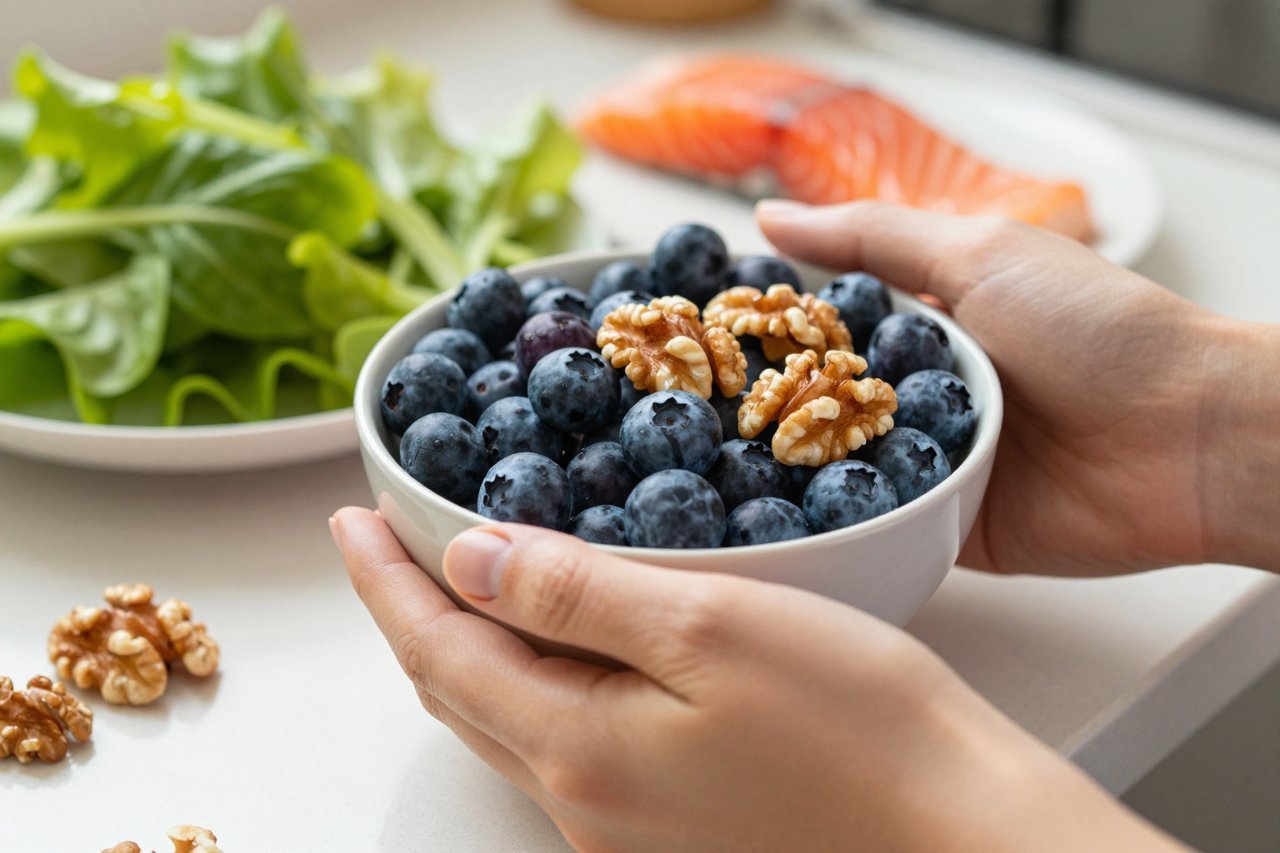
You don’t need a cabinet full of supplements to support brain health. Focus on getting these from food instead. Fatty fish like salmon, mackerel, and tuna are packed with DHA, an omega-3 fatty acid that makes up a large part of your brain’s cerebral cortex. A 2022 review in Nutrients found that higher omega-3 levels were associated with larger brain volumes in older adults.
Berries are another standout. Blueberries are rich in flavonoids called anthocyanins, which have been shown to improve memory and slow cognitive decline. In a famous study from Harvard, people who ate two or more servings of blueberries or strawberries each week delayed cognitive aging by up to 2.5 years. That’s a better reason than any dessert excuse to keep a bag of frozen berries in your fridge.
Dark leafy greens like spinach and kale are loaded with folate and vitamin K. One study of nearly 1,000 older adults found that those who ate at least one serving of greens a day had significantly slower rates of cognitive decline over five years, compared to those who rarely ate them. Walnuts, meanwhile, contain a healthy dose of alpha-linolenic acid, a plant omega-3 that supports brain cell structure. If you’re looking for a simple swap, try replacing processed snacks with a small handful of walnut halves. It’s an easy way to make your default snack a brain-friendly one.
Movement: The Best Pill for Your Brain
How Exercise Rewires Your Brain
Exercise is the closest thing we have to a magic elixir for brain health. It increases blood flow to the brain, delivers oxygen and nutrients, and triggers the release of BDNF (brain-derived neurotrophic factor), which acts like fertilizer for brain cells. BDNF helps create new connections, protects existing neurons, and improves memory.
Aerobic exercise, in particular, has been shown to increase the size of the hippocampus, the region responsible for converting short-term memory into long-term memory. Research from the University of British Columbia found that regular aerobic exercise (the kind that gets your heart rate up) actually increases the volume of the hippocampus in older adults. Strength training matters too. A 2020 study found that women who did strength training twice a week for six months improved their cognitive performance, and those benefits lasted long after the training period ended.
If you’re not sure where to start, these brain-boosting workouts from our Brain Health Challenge are a solid introduction. Some of them take less than 20 minutes and require no equipment.
The Magic of Simply Walking
You don’t need to run a marathon to benefit your brain. Walking is one of the most underrated brain health tools. A study published in JAMA Network Open in 2022 found that people who walked at least 4,000 steps a day experienced slower cognitive decline, and the benefits increased with every additional 1,000 steps. Even just a 10-minute brisk walk can immediately boost your attention and memory. Next time you’re stuck with a mental block, step outside for a quick walk instead of sitting at your desk and staring at the screen.
The Quiet Reset: Sleep and Stress Management
Why Your Brain Cleans Itself While You Sleep
Your brain has its own waste removal system, called the glymphatic system. It works mostly while you sleep, clearing out toxic proteins like amyloid-beta, which is associated with Alzheimer’s disease. If you consistently sleep less than 7 hours, you’re essentially preventing your brain from taking out the trash. Over time, that waste pileup can contribute to brain fog, memory issues, and even long-term neurodegeneration.
Prioritize sleep by setting a consistent bedtime, keeping your bedroom dark and cool, and avoiding screens for at least 30 minutes before your head hits the pillow. If you wake up feeling like you haven’t slept even after 8 hours in bed, it might be worth checking for underlying sleep issues like obstructive sleep apnea.
Managing the Stress Hormone That Shrinks Your Brain
Chronic stress is not just an emotional burden, it’s a physical one. When you’re constantly stressed, your body pumps out cortisol. At high levels over a prolonged period, cortisol can damage the hippocampus and impair your ability to form new memories. It also increases inflammation in the brain, which is linked to depression and anxiety.
That connection between stress and brain health is also why your gut plays a role. Your gut and brain communicate directly through the vagus nerve, and a stressed gut can send distress signals to your brain. If you’ve ever noticed a knot in your stomach when you’re anxious, that’s the gut-brain axis in action. In fact, there’s growing evidence that a rising brain disorder like Parkinson’s might actually begin in the gut, not the brain. I explored that gut-brain link in more detail and how core health secrets can affect your cognitive future.
Test Your Brain Health Knowledge
You’ve probably absorbed more than you realize. But are you aware of which everyday habits give you the biggest return on your cognitive investment? If you want a quick, fun way to check your understanding, this Brain Health Challenge quiz will test what you know and probably teach you something new about your daily routine.
A Blueprint for Long-Term Brain Health
Rather than trying to overhaul your life in one week, focus on small, repeatable upgrades. Here’s a simple starting list:
- Make one meal a day plant-rich: add a handful of spinach to your sandwich, top your yogurt with blueberries, or snack on walnuts.
- Move for at least 15-20 minutes daily. This could be a brisk walk, a quick yoga flow, or a strength session.
- Protect your sleep by setting a wind-down alarm one hour before bed to signal the end of screen time.
- Practice a short breathing exercise like the 4-7-8 method when you feel stressed to lower cortisol in that moment.
- Schedule social time with a friend or family member at least twice a week. Social connection triggers brain-protecting neural pathways.
These habits may seem small, but they compound over years. And they’re the same lifestyle factors backed by the longest-running studies on healthy aging. For a deeper look at how to eat for a longer, healthier life, the real anti-aging foods guide goes into the science behind the foods that are proven to slow down the aging process at a cellular level.
The next time you find yourself staring blankly at the kitchen counter, don’t panic. Your brain is not a fixed glass that gradually empties. It’s a living, breathing organ that responds to how you treat it. Feed it well, move your body, sleep deeply, manage your stress, and stay connected. That’s the real recipe for a sharp mind at every stage of life.


