
Table of Contents
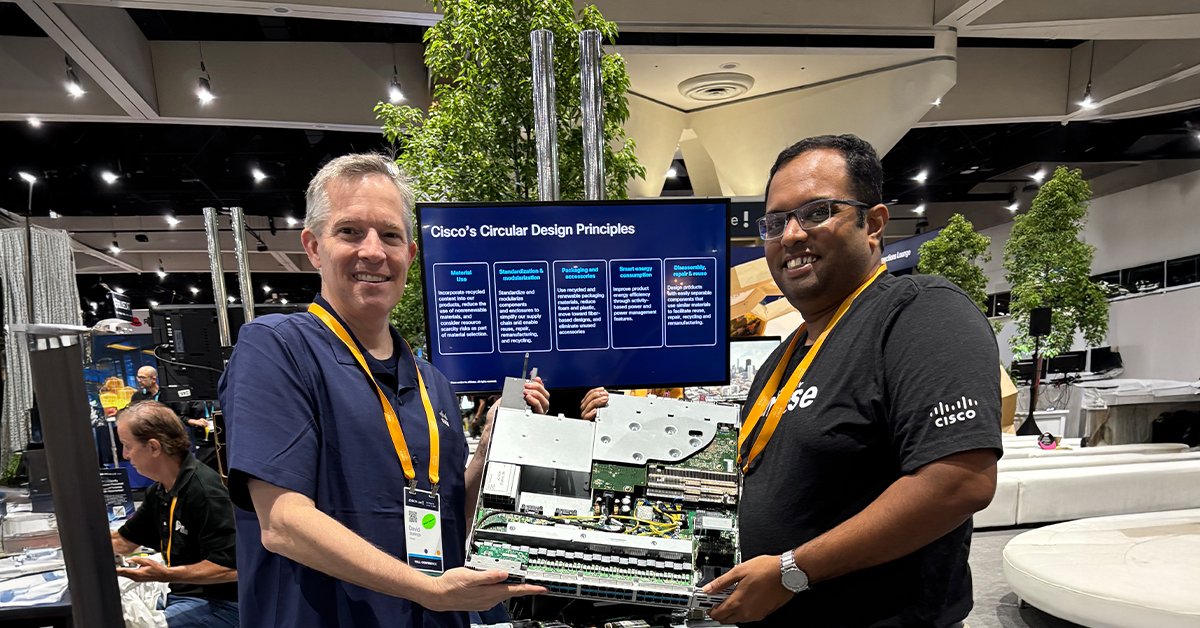
Three and a half years ago, when we started designing the Cisco C9350 network smart switch, sustainability wasn’t an afterthought; it was built into our engineering decisions from day one. At Cisco, we have made Circular Design Principles fundamental to how we innovate, and the C9350 is a perfect example of what’s possible when sustainability and cutting-edge technology work hand in hand.
Five ways we designed the C9350 for circularity
1. Modular design for reuse and efficiency
Look inside the C9350 and you’ll see something different from our older switches in the Catalyst 9000 family: a lot more pieces, all by design. The central processing unit (CPU) sits on a separate card that can be used across the entire product family or even in future products. We’ve standardized power supply form factors to share them across different product lines. This modular approach means fewer unique parts, simpler supply chains, and components that can live multiple lives.
We went a step further, and optimized each module separately, using different printed circuit board (PCB) layer counts for each design to reduce material usage and cost. Thanks to advances in high-bandwidth cable technology, we were able to do all this without adding expense to the system.
2. Smarter cooling without plastic waste
In the past, we used plastic air baffles to steer airflow over hot components. These plastic pieces made up 60 to 70% of plastic usage in these switches. In the C9350, they’re gone. Instead, we strategically placed components to naturally route air where it needs to flow. We also worked with suppliers to develop fans that are 23% more efficient, using less energy while running quieter. Since fans can consume 10 to 15% of total power during normal operation, and up to 30% at high temperatures, this makes a real difference. Plus, the handles and gaskets are made from post-consumer recycled plastic.
3. Intelligent power management
The C9350 features three power supply slots instead of the traditional two, and all power supplies are rated at least 80 Plus Platinum, with Titanium options available. But hardware efficiency is only part of the story. We developed Cisco Cold Redundancy, which intentionally drops the voltage on standby power supplies, so active ones operate in their most efficient 40 to 70% load range. In stacked configurations, our auto-offline feature manages up to 12 power supplies across four systems, automatically taking extras offline while keeping them ready to spin up instantly if needed. These software-driven optimizations avoid wasting power during normal operation.
4. Material reduction
Our Catalyst switches used to have a fancy plastic bezel on the front for aesthetics. But the C9350 is metal all the way to the edge, and I think it still looks great. We removed 15 to 19% of the metal weight from the top cover, reducing thickness from 0.9mm to 0.8mm, while maintaining the same structural integrity and passing our rigorous 200g drop shock tests.
5. Packaging reimagined
We eliminated foam from the C9350 packaging. The 48-port 10-Gig model ships with a minimum 80% recycled fiber-based cushion while the 1-Gig models ship with thermoformed endcaps using recycled plastic resin. This initially cost us more per box, and we ship a million units per year, so it could add up. But being all-in on circular design means making investments to drive the entire supplier ecosystem forward. And the good news is we are already seeing costs approach neutrality as the industry scales these solutions.
The C9350 proves that sustainability and innovation aren’t competing priorities—they’re complementary ones. When you design for circularity from the start, you don’t just build better products for the planet. You build better products, period.
Learn more about Circular Design at Cisco.