
Table of Contents
Search for advice on staying healthy after 65 and you will find no shortage of lists. Walk more. Lift something heavy twice a week. Eat more vegetables. Go to bed at the same time. Not one of those suggestions is wrong.
The trouble is that they arrive as one big pile with no sense of the trade-offs. A gym membership and a set of resistance bands both count as strength training, but they ask for very different amounts of money, time and nerve. A fitness app and a paper notebook both track your daily walks, yet only one of them nags you and only one never runs out of battery.
So this isn’t another overview. It’s a comparison of the main routes people actually take with healthy habits for seniors, including what each one costs you when you choose it.
The Question That Sorts Everything Out
Before comparing equipment or schedules, answer one thing honestly: what will you still be doing in six months?

Strong evidence is no help if the habit collapses in week three. The option that survives a rainy Tuesday in February, a rough night’s sleep, or a grandchild’s birthday party is the one worth building on. Everything below is judged on that standard, not on what looks best on paper.
Home Workouts vs. the Gym vs. a Walking Group
These are the three routes most older adults take with exercise, and they fail for completely different reasons.
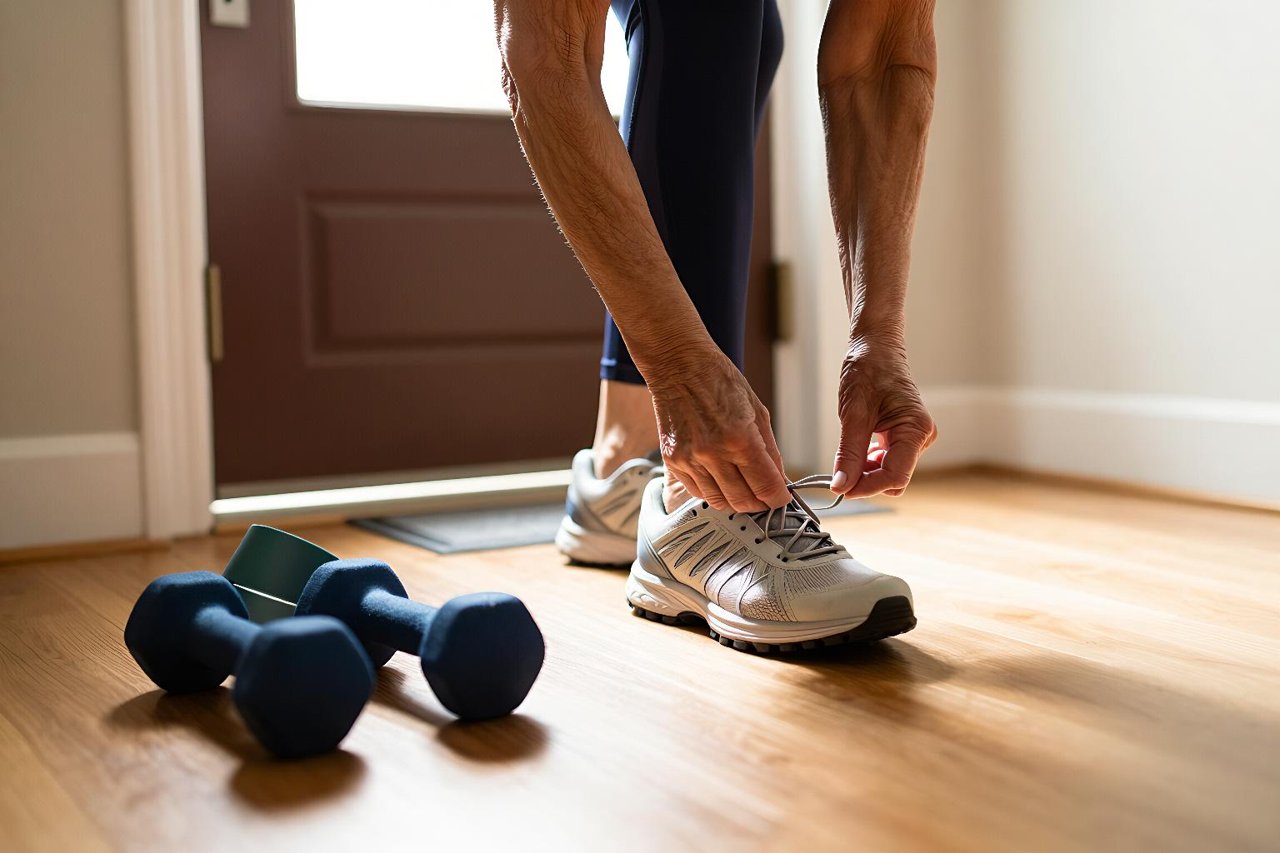
- Home workouts. A pair of dumbbells or a resistance band costs roughly $20 to $80 once. No travel, no schedule, no audience. The catch is that nobody is expecting you, and the kitchen is ten feet away.
- Gym or community fitness centre. Usually $10 to $60 a month, and often less at council-run centres with senior rates. You get equipment, warmth and staff who can correct your form. You also get a commute and opening hours, which is where memberships quietly die.
- Walking group. Free to a few dollars a session. The social pull is genuinely strong, since people notice when you don’t show. The weakness is that walking alone won’t maintain muscle mass, and the group doesn’t meet in heavy rain.
Official guidance is 150 to 300 minutes of moderate activity a week, muscle-strengthening work on two or more days, and balance training if falls are a concern. Most people hit the walking target and skip the strength half entirely, which happens to be the half that keeps you able to carry groceries and get up off the floor. If that’s you, structure helps more than good intentions, and a gentle four-week living room exercise plan for seniors covers both without a gym at all.
Where each option tends to break down
Home setups break on motivation. Gyms break on logistics. Walking groups break on weather and the calendar. If you know which of those three is your weak spot, you already know which option not to rely on alone.
Morning Routine or Evening Routine?
Timing gets treated as a personality quirk. It’s really a trade-off.
Mornings are protected time. Fewer people call, fewer errands compete, and alertness is usually on your side. The cost is that early rising only works if sleep is solid, and forcing a 5 a.m. start after a bad night just moves the problem around.
Evenings are flexible and suit people who wake slowly, but fatigue and interruptions stack up, and evening sessions have a habit of drifting later until they vanish.
A middle path beats both extremes: anchor the new habit to something you already do without thinking, whether that’s the kettle boiling or the evening news starting. If you want the mechanics spelled out, this morning routine built to survive a bad night’s sleep is a useful blueprint, and its logic transfers to any hour of the day.
Paper and Pencil vs. Apps and Wearables
Tracking works. The method matters less than people assume, but the trade-offs are real.
A notebook costs nothing, never needs charging, and takes ten seconds. It also can’t remind you, and there’s no trend line to look at after a month.
An app or a watch gives you reminders, step counts, sleep data and history. You pay for that with a learning curve, a charger and sometimes a subscription, plus the risk of turning a healthy habit into a scoreboard you feel guilty about.
One practical rule: track three things at most. Sleep, steps and whether you did your strength session. Anything beyond that becomes admin. A straightforward daily plan that keeps health tracking simple shows how little needs measuring for the picture to be useful.
Solo Habits vs. Group Habits
Going it alone is cheap, private and flexible. It also means the only person holding you to it is you, and self-discipline fluctuates with mood, illness and grief. That isn’t a character flaw; it’s how people are built.
Groups fix accountability and add company, which matters because loneliness carries real health risk for older adults. The cost is scheduling, sometimes a fee, and the small social effort of walking into somewhere new.
A hybrid usually wins. Two commitments a week that involve other people, with everything else done at home. The group day acts as the anchor; the solo days fill in around it.
Mediterranean, DASH, or Just Eating Real Food?
Three eating patterns get recommended most often to older adults, and they overlap far more than their reputations suggest.
- Mediterranean style. Olive oil, fish, beans, vegetables, nuts, little red meat. Strong evidence for heart health and pleasant enough to keep up. Watch the cost of fresh fish and the drift into extra bread and wine.
- DASH. Built around blood pressure, with vegetables, fruit, whole grains, low-fat dairy and limited salt. Effective, occasionally bland, and it means reading sodium labels, which is tedious.
- Real food, sensible portions. No rulebook, easy to follow at restaurants and family dinners. The weakness is vagueness, since portion creep is easy to miss without a target.
Whichever you choose, two numbers usually need attention after 65: protein, around 1.0 to 1.2 grams per kilogram of body weight daily to protect muscle, and fibre, roughly 25 to 30 grams, which most people fall well short of.
One Big Overhaul or Small Changes?
This is the trade-off with the widest gap between expectation and reality.
An overhaul (new diet, new exercise plan, new sleep schedule, all in the same week) produces fast results and strong motivation. It also demands energy and organisation that few weeks genuinely allow, and when one part slips the whole thing tends to go with it.
Small changes are slower and less dramatic, which is exactly why they last. Swapping one snack, adding a ten-minute walk after lunch, or doing three chair squats before your morning coffee will all survive a chaotic week. Stack enough of them and you reach the same destination by a road with fewer cliffs. If that sounds more realistic, this set of small healthy habit changes that make a big difference beats any 30-day challenge.
How to Choose Without Overthinking It
Take one option from each category above, choosing the version with the fewest points of failure in your normal week. Between a season pass at the pool and a weekly walking group, pick the one you can reach on a bad day rather than a perfect one. Between paper and an app, pick whichever won’t irritate you by Thursday.
If you’d rather have the order of operations handed to you, a step-by-step plan you can start this week removes the guesswork from the first seven days and gives you something concrete to revise later.
Then leave it alone for eight weeks. Two months of a mediocre routine outperforms eight days of an excellent one, and it gives you enough evidence to judge what genuinely needs changing.
If nothing has stuck so far, try a different combination rather than more willpower: a group for accountability, a home strength routine for the muscle, and a single tracking line in a notebook. The right mix is simply the one still running six months from now.


