
Table of Contents
You walk in at 4 p.m. and your face feels tight, warm, and faintly gritty where sunscreen met sweat and sand. Your shoulders are pink, your lips taste like salt, and the skin around your nose has that stretched, papery feeling that shows up after five hours outdoors.
That heat isn’t imaginary. UV exposure triggers inflammation in the skin, degrades collagen, and speeds up water loss through your barrier. What you do in the first few hours afterwards has a real effect on how red you look tomorrow, how quickly peeling starts, and how long your skin stays irritated.
Here’s a practical, roughly hour-by-hour approach to caring for skin after sun exposure.
Get the heat out of your skin first
Resist the urge to reach for serum the second you get home. Your skin is running hot, and the first job is bringing the temperature down before you put anything on top of it.

Rinse with lukewarm water for 30 seconds if you’re desperate to feel clean, but keep the actual shower for later, and keep it short. Five to eight minutes in tepid water is plenty. Hot water strips the lipids that are already under strain and leaves you tighter and itchier than you started.
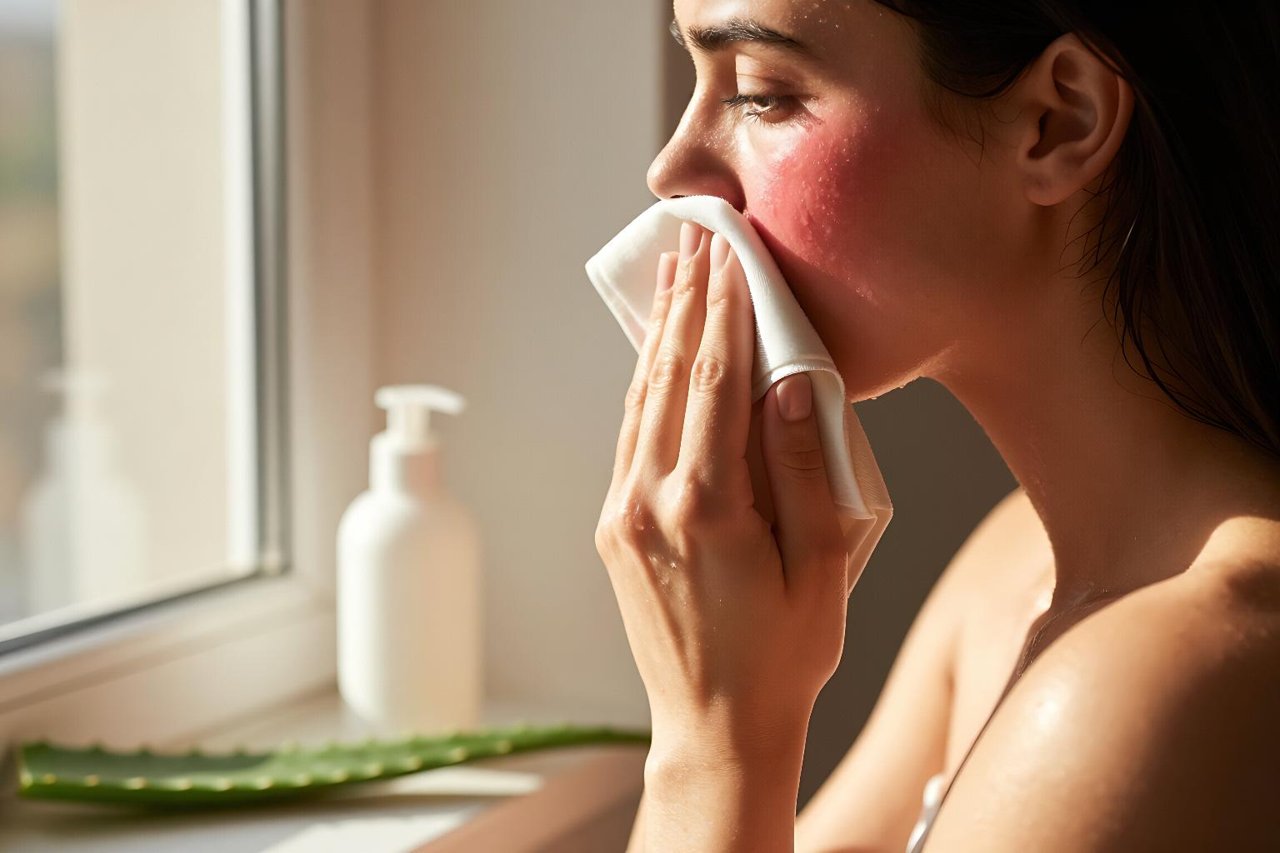
If a patch of skin feels genuinely hot to the touch, a cool damp washcloth for 10 minutes helps. So does plain aloe straight from the fridge. Pat dry with a soft towel instead of rubbing, and leave the skin slightly damp rather than bone dry.
Skip the ice cubes
Ice directly on sun-stressed skin can cause cold burns, and it constricts surface blood vessels abruptly, which slows down the body’s own cooling. A cool compress is fine. A handful of ice pressed to your cheek for five minutes is not, and it’s the kind of thing people do once and regret.
Cleanse gently, then put the water back in
Once your skin has cooled, use a non-foaming cleanser with a pH around 5.5. Cream or gel textures work best here. Skip anything with a scrub bead, a muslin cloth, or a “tingling” sensation, which is usually just menthol or a mild irritant.
Then, within about a minute of patting dry, apply a hydrating layer to damp skin. Glycerin, hyaluronic acid, panthenol, and aloe all pull water into the upper layers and hold it there. If you’re not sure which of those your bottle actually contains, this breakdown of what skincare products actually do is a decent starting point for reading a label without a chemistry degree.
Follow with a light lotion rather than a thick balm. Heavy occlusives trap heat against the skin, which is the opposite of what a hot, flushed face needs on hour one.
Hold off on your actives for a night or two
Retinol, glycolic acid, salicylic acid, benzoyl peroxide, vitamin C serums at low pH, anything labelled “resurfacing” or “peeling”: all of it sits out for 24 to 48 hours. Your barrier is already compromised, and actives on top of compromised skin turn a mild pink flush into a stinging, flaking mess.
What you can use instead: niacinamide at 4 to 5 percent to calm redness, ceramide creams, squalane, and a plain antioxidant serum in the morning. That’s it. The fancy stuff can wait until your skin stops feeling warm.
Give your lips and the skin around your eyes the same attention
Lips have no sebaceous glands and a barrier roughly a third the thickness of the skin on your forearm, so they burn and peel faster than anywhere else. A sunburned lower lip can split within 24 hours. Keep a balm with SPF 30 nearby, and at night switch to something with petrolatum or shea butter. The full routine, including the bit about not licking your lips no matter how tempting, is covered in this guide to a proper lip care routine.
The skin around your eyes is thin enough to show damage quickly. A cool compress for five minutes beats rubbing, and eye creams with a bit of caffeine can help with puffiness by morning.
Watch for the signs your barrier is struggling
Redness that fades by evening is normal. Redness that gets worse, stinging when you apply plain moisturiser, or a sudden breakout two days after a long beach day are different. Those are signs your skin is irritated rather than just sun-warmed, and they mean you should simplify your routine rather than add more products to fix it. This list of early warning signs that your routine isn’t working is worth a read if you keep hitting the same wall after every sunny weekend.
Rebuild over the next 48 hours
The damage from UV doesn’t stop when you walk indoors. Free radicals keep working for hours, so antioxidants earn their keep here. A vitamin C serum in the morning, green tea in the afternoon, and plenty of water through the day all help.
Moisturiser does the heavy lifting. Look for ceramides, cholesterol, and fatty acids in roughly a 3:1:1 ratio, which mimics what your barrier is made of. Something rich but breathable is ideal, and athletes who spend whole days in sun and wind tend to gravitate towards the same few formulas. Case in point: this post-slopes moisturiser Jamie Anderson swears by for skin that has been baked, wind-whipped, and snow-reflected all day.
Things that quietly make sun-stressed skin worse
Most of the damage in the 24 hours after sun exposure comes from well-intentioned corrections. These are the ones to avoid:
- Hot showers and long baths. Ten minutes of scalding water will undo everything your moisturiser just did.
- Alcohol-heavy toners and astringents. That satisfying tingle is dehydration in progress.
- Scrubs, peel-off masks, and body brushes. Mechanical exfoliation on fragile skin leads to microtears and, later, uneven pigmentation.
- Picking at peeling skin. Peeling is your barrier shedding damaged cells. Pulling at it takes healthy skin with it and can leave a mark that lasts months.
- Heavy training in tight, sweaty clothing. Friction plus sweat plus already-inflamed skin is a recipe for heat rash on top of sunburn.
- A second round of “just a quick top-up” tanning. Your skin needs a break, not more UV.
When it’s more than a bit of redness
Blistering, chills, a headache that won’t shift, nausea, or sunburn covering a large area all point to something that needs medical attention rather than a better moisturiser. Blisters should never be popped at home. If you’re in that territory, drink water steadily, take an anti-inflammatory if you can safely do so, stay out of the sun entirely, and speak to a pharmacist or doctor.
Habits that make the next sunny day easier
Recovery is only half the job. The other half is making sure the next long day outside doesn’t land you in the same spot. Apply SPF 30 to 50 about 15 minutes before you leave, and use roughly a shot-glass amount for your body plus a teaspoon for your face and neck. Reapply every two hours, and sooner if you’ve been swimming or sweating heavily.
A wide-brimmed hat and a UPF shirt do more than any serum you’ll buy this year. Seek shade between 11 a.m. and 3 p.m. when the UV index climbs above 6, and check the index on your weather app before you plan a hike or a long lunch outside. If you notice a mole changing shape, colour, or border, get it looked at rather than watching it. Skin that’s been sun-exposed for decades deserves an annual once-over from a dermatologist, and that single habit catches more problems earlier than any product on your shelf.


