
Table of Contents
Week three is where most daily walking habits quietly fall apart. The first fortnight feels like a decision you made. Then the loop gets familiar, the novelty wears off, and a 20-minute walk turns into one more chore competing with everything else on your list.
What usually needs changing isn’t the walking itself. It’s the routine wrapped around it. Swap the route, the soundtrack, the company or the timing and the same physical act feels completely different. These are the adjustments that make the biggest difference, roughly in the order I’d try them.
Borrow novelty from your own neighbourhood
Boredom is a bigger threat to a walking habit than rain. If you could walk your usual loop with your eyes closed, that’s your cue to change something.
- The one-new-turn rule. Take your normal route but add a single unfamiliar turn each time. You’ll learn your area faster than any map app will show you.
- Reverse it. Walking the same streets in the opposite direction changes which houses, gardens and shopfronts you notice. It sounds trivial. It works surprisingly well.
- Pick a destination, not a duration. “Walk 30 minutes” is easy to skip. “Walk to the bakery on the corner and back” isn’t, because now there’s a purpose and a reward at the end.
- Collect streets. Some people tick off every road within a mile of home. It turns the neighbourhood into a puzzle you’re slowly solving.
The point isn’t novelty for its own sake. A walk you’re curious about is a walk you’ll actually repeat, and repetition is what delivers the health benefits of walking in the first place.

Give your ears a job
Music, podcasts and audiobooks are the cheapest entertainment available, and they pair beautifully with pavement. The trick is a little structure. Save one specific podcast for walks only, so the next episode becomes a small thing to look forward to. Keep audiobooks for longer weekend routes. Play faster music when you want pace and something conversational when you don’t.
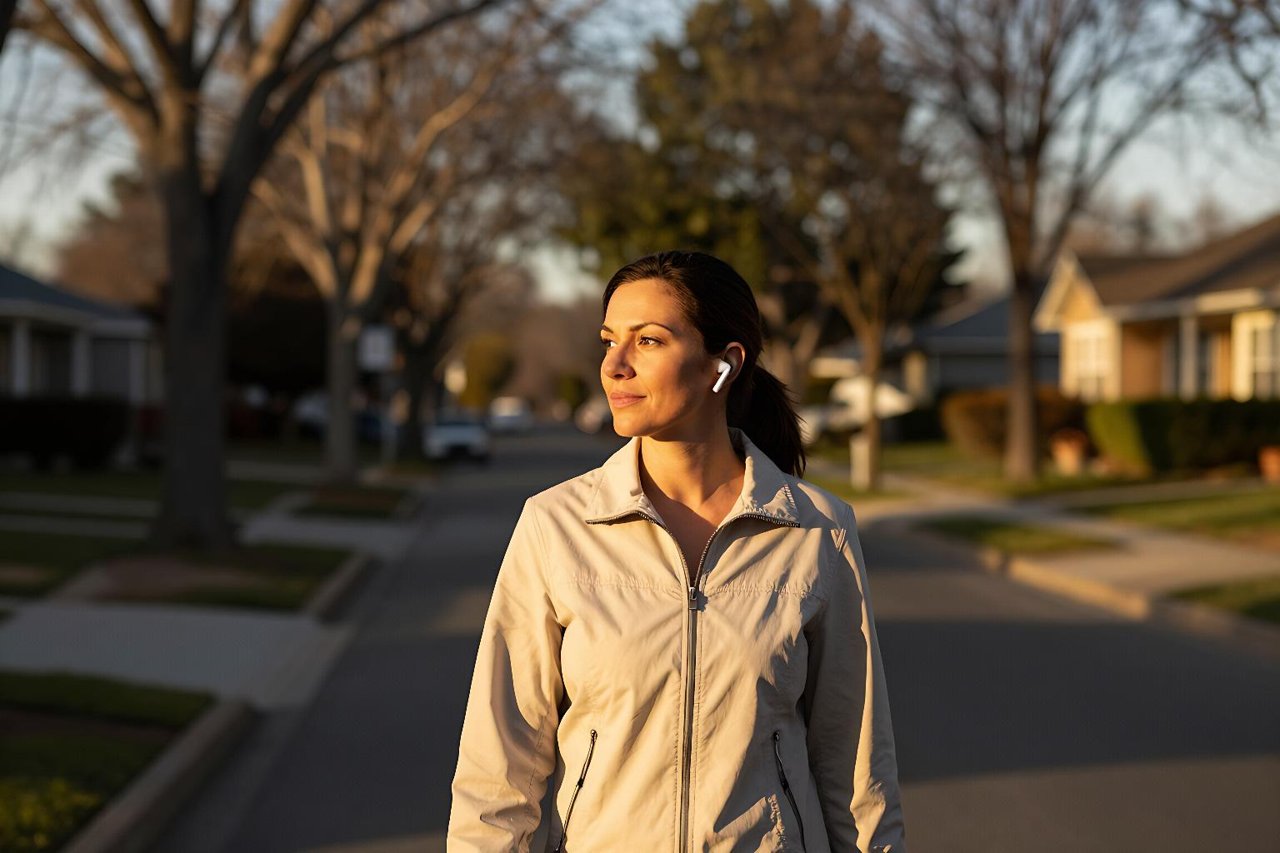
Two practical notes. On busy roads, keep one earbud out or use a setting that lets traffic noise through. And if you walk the same time every day, try a phone-free walk once a week. It’s strange for the first ten minutes and genuinely restful after that.
Walk with someone, or deliberately without them
A standing arrangement with a friend, partner or neighbour does more for consistency than any app notification. Pick a fixed day and time, keep it short enough that neither of you dreads it, and treat it as a social slot rather than exercise. Half an hour of talking passes in a way that half an hour of counting minutes never does.
Family walks work the same way, especially once the school year gets busy and evenings fill up. If you’re trying to build the habit with kids in the house, there are some useful ideas in this guide to a back-to-school wellness routine for the whole family, including how to make an after-dinner walk stick when everyone is tired.
Bolt it onto something you already do every day
New habits survive best when they hitch a ride on existing ones. Rather than finding a spare 30 minutes, attach the walk to something that already happens without fail.
Take the lunch break you already have and use twenty minutes of it outside. Walk to the shop instead of driving. Pace the length of the garden or the corridor during long phone calls. If your working day is mostly desk-bound, this matters more than it sounds, because prolonged sitting puts real strain on your heart and short, frequent movement breaks interrupt it far more effectively than one big session squeezed in at 9pm.
Anyone juggling a demanding job will recognise the pattern where good intentions collapse by Wednesday. There’s some honest advice on that in building a balanced lifestyle while working full time, and the walking habit fits neatly into it once it’s attached to something fixed rather than something optional.
Make the shoes the easy part
Most skipped walks come down to friction, and friction usually lives by the front door. A pair of shoes you can slip on without thinking, a jacket on a hook at eye level, and a charged pair of headphones in a bowl will do more for your consistency than any motivational trick.
Comfort matters more than features here. Shoes that pinch, socks that bunch and a coat that’s too warm all turn a pleasant 25 minutes into a small ordeal. Your feet and lower legs are doing the actual work, so it’s worth reading up on why leg health is a key part of overall wellness and treating footwear as maintenance rather than an afterthought.
Use numbers as a nudge, not a scoreboard
Step counts and streaks can be genuinely motivating for a few weeks. They also have a habit of turning a nice walk into a numbers problem. Ten thousand steps is a marketing figure, not a medical threshold, and missing it on a rainy Tuesday means nothing.
A better approach: track for six weeks to build awareness, then let the habit carry itself. Keep a simple log on paper or a calendar if you like the satisfaction of crossing off days. Just don’t let a device decide whether a walk counted.
Have a bad-weather plan you don’t resent
There is no such thing as bad walking weather, only the wrong layers. A light waterproof shell, a cap with a brim and shoes with some grip handle most of what a British winter will throw at you. If rain genuinely ruins your mood, build in an indoor fallback you don’t hate: a covered shopping centre loop, a park with mature trees, or a stair-and-corridor circuit at home.
Heat is easier. Walk early, walk in shade, take water. Anything above about 25°C is not the moment for a personal best.
Let some walks be slow and pointless
Not every outing needs a purpose, a pace target or a podcast. A slow wander with no destination is a different activity from a brisk training walk, and it’s the one most people stop allowing themselves. Leave the headphones at home. Stop to look at things. Let the dog set the route. Those walks are often the ones you remember, and they keep the habit alive on days when your legs are tired.
What to do on the days you really don’t want to go
Use the five-minute rule. Put your shoes on, walk to the end of the street, and give yourself full permission to turn around. Most of the time you won’t want to, because the hardest part of any walk is the first two minutes of cold legs and second thoughts. Occasionally you will turn around, and that’s fine too.
On genuinely flat days, shorten the walk rather than cancelling it. A ten-minute loop around the block still counts. The habit is the thing worth protecting, not the distance, and a short walk today makes the long one on Saturday far more likely.


