

By Aleks Cvetkovic
The low double-breasted jacket is arguably one of the most romantic expressions of tailoring. There’s something about the proportions, the poise and its cinematic past that combine to make it unique.
It’s also a silhouette that’s been popular in the past few years. More tailors are showcasing their take on the style, fashion brands have been experimenting with it, and even the high street has caught on. So, it’s a good moment to reflect on the ‘low DB’ and its potential in your own wardrobe.
The history is straightforward enough. The low-buttoning double-breasted emerges in the 1920s, a Jazz Age counterpoint to the repressed high closures and buttoning points of the 1890s and early 1900s. As social attitudes ‘lightened up’ during the Roaring Twenties, peacocking, low-fastening and wide-lapelled jackets became the height of fashion for younger, ebullient men about town.


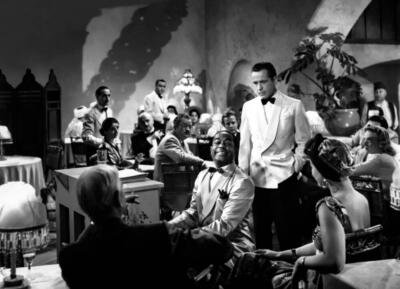
The look bedded in as an alternative to the classic 6×4 double-breasted cut in the 1930s and ’40s, with garments like Bogart’s cream dinner jacket in 1942’s Casablanca etching the look into the popular consciousness (above).
It fell out of style after the world wars, however, only to resurface as a symbol of 1980s power dressing and then 1990s loucheness (below). Whether Wall Street, Miami Vice, or Armani, those decades are awash with examples that now litter menswear mood boards.
As with a lot of menswear, there aren’t many options when you want to turn the expressiveness up a notch and low-slung DBs are an obvious way to go.


With so much cultural history behind it, there are actually a few different ways you can go with a low DB cut today.
For one thing, it’s a silhouette that lends itself to a big, drapey, fashion-forward look, which is how brands like Gucci, Zegna and notably Saint Laurent (even if you’re not a fashion lover, the Fall-Winter ’24 collection is worth a look) have brought it back to life.
While the low DB’s dramatic look plays a part here, fashion’s tendency to ‘supersize it’ is telling. After all, oversizing circumnavigates the need for a precise fit. (Below, two Saint Laurent FW24 looks and one Gucci FW23.)


In a classic-style context, however, several brands are worth highlighting – they’re finding subtler and arguably smarter ways to breathe new life into the low DB.
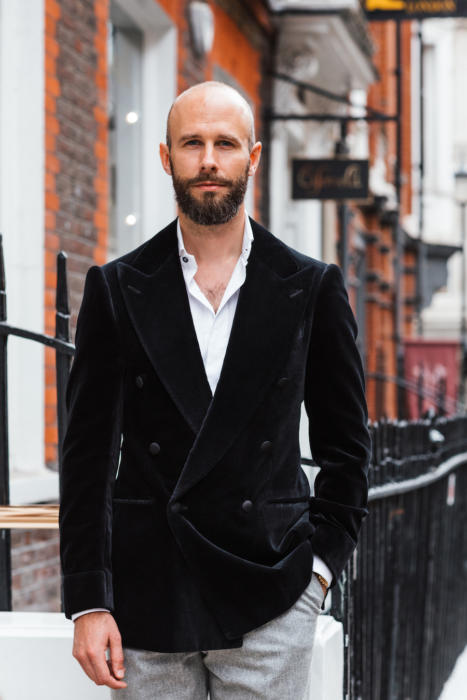
The jacket I’m wearing at the top of this article is probably a good place to start. Edward Sexton cut this for me in 2019, and low-buttoning double-breasteds are firmly part of the Sexton DNA – the three images below are a good illustration. They show Edward himself, a current RTW jacket and a seventies wedding style.
The Sexton low DB is less about an hourglass waist and more about emphasising both shoulder and hip, with a dramatic lapel line connecting the two. Tellingly, even though Sexton began cutting low DBs in the 70s, it was always in reference to an Art Deco feel. Again that Casablanca jacket, as well as old Laurence Fellows fashion plates, were key places for inspiration.


“Our low-button double-breasted is slightly wider in the shoulder, with only very gentle waist suppression and a narrower hip,” explains Dominic Sebag-Montefiore, the house’s creative director and Sexton’s long-time business partner.
“And always without vents – if you keep vents in a low double-breasted jacket, the skirt splays out and it loses its shape.”
Perhaps unsurprisingly, the Sexton low DB brings with it a hint of drama – even in the form of a trad blazer like mine. Dominic recommends the look for “elegant evening or cocktail jackets, cut in silk blends for something a little bit sexy.”


Other tailors take a slightly different approach. Cifonelli is of course famous for its low double-breasteds (see Simon’s black velvet jacket, first image above), but Cifo’s cut sits very close to the body with minimal expression in the chest.
Steven Hitchcock cuts a handsome low DB jacket but it’s very much expressive of his softer, drape-led look (third image above). The generosity of Steven’s cut ensures a roomy chest and confident lapels, both of which are flattering.
Davide Taub at Gieves & Hawkes, on the other hand, tries to ‘casualise’ the low DB silhouette. His take has a cleaner chest, a neater waistline, and foregoes roped shoulders for just a hint of sleevehead roll (examples below). The cloth choice is important too. “I tend to nudge customers towards casual materials like heavy linen, jumbo corduroy or especially soft, drapey flannel,” he says.
Taub likes garments that feel functional for modern living, so his low DBs also have inverted bellows pockets (which are sewn inside the jacket’s skirt, rather than onto the jacket’s exterior), and lapels that button at the nape, among other useful tweaks.


The Anthology also offers a low DB jacket as a bespoke option. “Setting the proportions of a low DB is tricky, it has to be very carefully thought through,” says Buzz Tang.
“We retain the lower gorge and relatively straight lapel that are key aspects of our house style. The fastening button then has to hit your hip line, and the pockets sit exactly in-line with it. It’s a cut that was historically quite flashy, so we like executing it in a softer cloth; something that’s pared-back like brushed cotton, heavy linen or baby camelhair.”
As with Dominic, Buzz emphasises that the key is not to think in terms of the normal, waisted silhouette of a jacket, but rather just the relationship between the shoulder and hip. Examples below.


For Davide, these proportions are what allow a low DB to be worn by different body shapes.
“When you’re cutting a low DB, you’re very conscious of where the fastening button is. If the button’s much higher than the pockets, it looks like it’s slipping upwards. If it’s too low, the jacket will look like its falling off the customer.
“That said, it can work for everyone: tall and skinny, short and round. A higher button is less flattering to a shorter figure, which this helps with, while the longer lapel line will suit a taller figure.”


My advice, based on personal experience, is try it if you want to – and don’t overthink how you’ll wear it. Sure, it’s a look that lends itself to eveningwear, but in a dark, plain flannel, a low DB ought to be no harder to wear than a conventional double-breasted suit.
It also gives you scope to be subtly expressive, should you wish. Flannel chalkstripes lend themselves to those broader lapels, and mottled jacketings can look chic.
The one thing I’d be less inclined to choose, personally, is a bold check. I’d argue that the lapel line does you the favour of drawing the eye upwards, so breaking it with a horizontal grid undermines the design.
Beyond cloth choice, there are really only two critical decisions to make. The first is pocket flaps, or none? Personally I’m anti-flaps, because they can distract from a clean line over the hips. But, I’ve seen plenty with flaps and it does work. If you’re torn, you can always fall back on ordering flaps and tucking them in.

The other decision is more interesting: do you choose a one-by-two button stance, or one-by-three?
The former is marginally cleaner, and less dressy, but the latter can help to draw the eye up through the line of the chest, which is often quite flattering. Most of Stephen Hitchcock’s low DBs, for example, are finished as one-by-threes.
If in doubt, a one-by-two is perhaps a safer place to start. But it’s really a question of which style speaks to you.


Should you need more inspiration, there are lots of places to turn. Armani’s recent passing has helped to repopularise the look, given it was so synonymous with the brand’s golden era.
It was also telling that when I visited SuitSupply’s website just a few weeks after he’d passed, the ‘new arrivals’ section was awash with good-looking low double-breasted designs, all with an ‘Armani-ish’ quality (above). Incidentally, SuitSupply is a great option for cheaper low-double breasted suits.
Whatever you choose, enjoy the sense of romance that comes with the look. That’s what this jacket is all about: making a statement in a way that shows you know your stuff, without having to shout about it.