
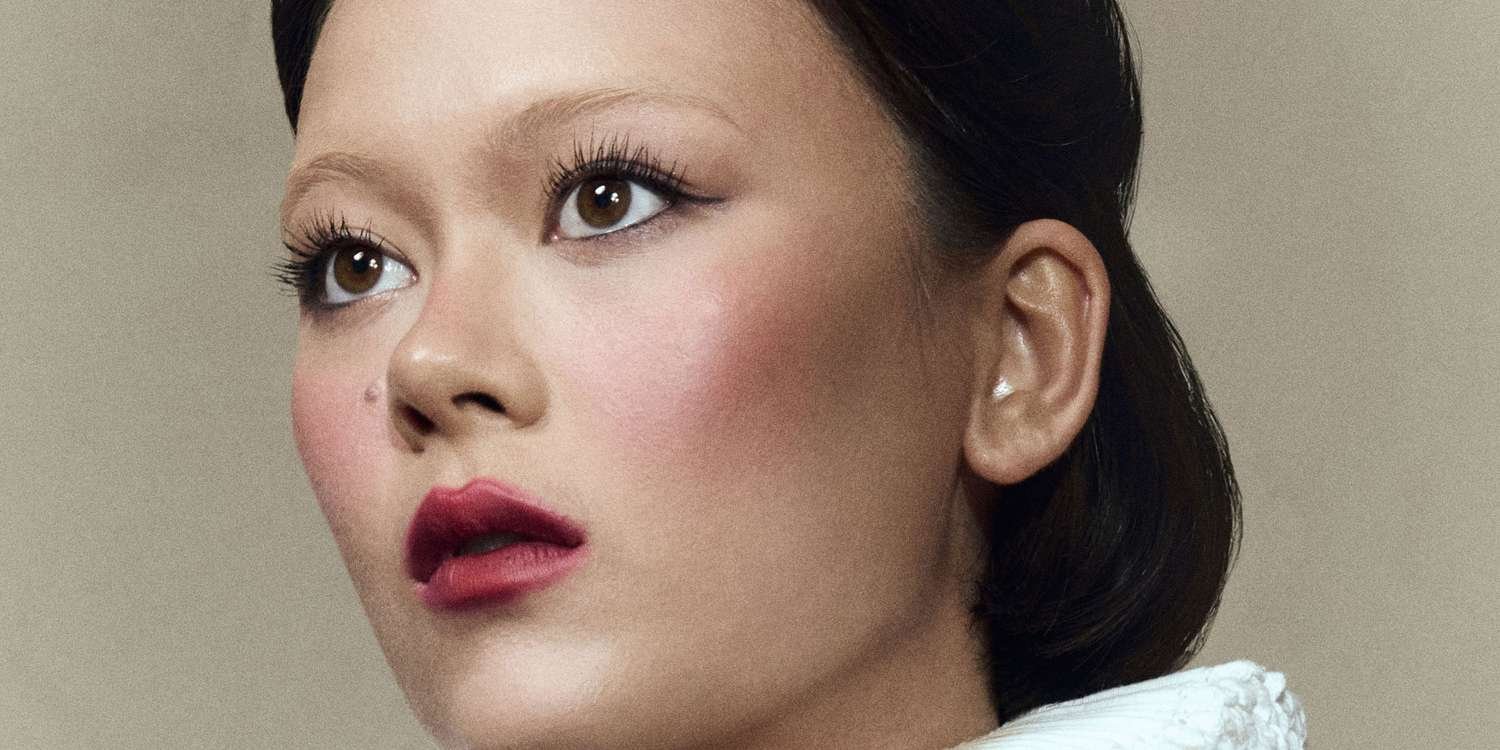
There’s a ratty cat stuffed animal that I still have from childhood. I don’t remember where I got it. It was most likely a Savers find or from the basement bin of toys at my paternal grandma’s house. At 8 years old, I named this stuffed animal Alicia Markova. I had just watched a documentary on The Ballets Russes, my mama’s weekly library DVD find for me, and I was just as enamored with the sound of Alicia’s name as I was with her dancing. Ah-LEE-see-ah Mar-COVE-ah. A four–three. A good syllabic balance. I’m a three–two. Loo-KEE-tah MAK-swel.
Luke Lovell. Renaissance Renaissance top and skirt, Orchard Corsets corset, Stylist’s own tiara and Lukita’s own shoes.
My mama put me in ballet classes starting at the age of 3. My childhood was nomadic, but my mom always found a ballet studio for me. Bali at 5, tumbling out of class happily barefoot, mossy lava rocks, and the scooter ride home smelled like WD-40. Massachusetts at 8, watching other dancers slip on their perfect pink Uggs while I struggled to zip up my confusingly oversize parka that had “room to grow into.” Utah at 10, mama picking me up in grandma’s old Cadillac DeVille equipped with nori snacks and boiled eggs ready to be devoured.
Luke Lovell. Renaissance Renaissance top and skirt, Orchard Corsets corset, Stylist’s own tiara and Lukita’s own shoes.
“Saint George, Utah” is often the response I’ll hear myself say when a stranger asks me where I’m from. Much of my time in that town was spent in a ballet studio with my teacher, Bené Arnold. Bené was in her late 70s. She was one of those electric humans whose energy was not bound by physical age or by the attitude of the conservative town. We had the same affinities for elongating movements so they bled into one, for defining the line the arm makes from the shoulder to the tip of the middle finger, and for the jumps that achieved the illusion of weightlessness, ballon.

Ballet, the sport of perfectionism. Crisp costumes, fluid choreography, sharp makeup, posture, and breath. The sweet drip of a good day only entering your body if you turned at least thrice or hit your arabesque like a held breath. I was hard on myself, took it seriously, and compared myself often to the girls in the 2011 documentary, First Position. Ballet, a system of controllable variables. The addicting, energetic pulse when you feel good at something. I liked feeling like I was good at something. There wasn’t room for error, but I wasn’t erring often. I was dutifully obeying the ballet rulebook, I really wanted to be “the best.” Before I had met Bené, my perception of “the best” was tethered to technical proficiency.
Bené introduced an element of artistry to my relationship with ballet. When to respect its rigidity of principle and when I could take the liberty of making movements mine. “Stay in plié until the last second of your rond de jambe,” “change the music’s accent to the ‘up’ instead of ‘down’ on your sauté,” “hold, hold, hold the last breath of that pirouette.” Through variations, I started to play with emotion in my movements in The Sleeping Beauty’s Bluebird, joyous and bright; Giselle’s Myrtha, ghostly and somber; and Paquita, sharp and eye-catching. I was storytelling. I loved it.
Luke Lovell. Renaissance Renaissance dress and J.R. Malpere headpiece.
Recently, I found my journal from around that time, and much of my scribbled handwriting is a declaration of love for performing, and specifically performing in a company. I loved watching a stage crew puppeteer their ropes and pulleys, stretching with older dancers before a show, and hearing the orchestra tune their instruments. I wrote that I loved rehearsing smaller dance numbers for months that culminated in one greater performance. Breathing with an ensemble of artists maintains my roots. I feel nourished when I see a visual deck for a film, when observing a camera crew set up a shot, and when I hear what music has been paired with a finished scene. Being a breath in a greater lung. It’s comforting.
Luke Lovell. Renaissance Renaissance dress and J.R. Malpere headpiece.

Early October 2013, Southern Utah University.
I’m standing at the head of a classroom facing 15 or so high schoolers and one adult. The adjudicator. I just learned what “adjudicator” meant. They’re all about to watch me perform a monologue from Henry VI: Part III. Queen Margaret. A grieving mother holding the body of her son in her arms, crying in anguish to the men who killed him: “O traitors! Murderers!” I’m 11. I feel magnificently small in my thrifted cargo pants and sneakers, my style utilitarian, always. All the older kids in the room are costumed in crunchy red velvet Elizabethan collars, holding skulls, sceptres, or swords. The adjudicator asks me what I’ll be performing, and I hear myself answer. There’s a density to the air around my ears, a fog. I realize I’m shaking. I hadn’t felt this when I rehearsed the monologue with Miss Colleen, a mom from my homeschooling group. Miss Colleen is why I’m here in the first place.
After noticing my literary intrigue about Shakespeare a few weeks ago, she’d asked if I’d want to “act” and perform a monologue at the Utah Shakespeare Festival. It sounded fun to me. The only Shakespeare I’ve ever seen was Emma Watson performing a monologue from A Midsummer Night’s Dream (Puck’s “I am that merry wanderer of the night”) in the 2007 film Ballet Shoes. I love that movie so much. When Miss Colleen asked me what I wanted to perform, I told her I wanted to do Puck. She told me I needed something juicier. So here I am, performing Queen Margaret in cargo pants.
Luke Lovell. Western Costume Co. jacket, collar and crown, Renaissance Renaissance skirt, Calzedonia hosiery and Jude shoes.
The shaking is most apparent in my hands. I bind them together behind my back and let my fingers pick at themselves. The adjudicator finishes writing something, he looks up and says, shortly, “Go ahead.” Miss Colleen told me to take my time before I began speaking. To visualize where I am, who I’m speaking to, and what I want. My hands unclasp, I look down to my imaginary son, and as I say, “Oh Ned, sweet Ned,” the fog around my ears becomes a sort of protection. I know the words, I’m performing them well. Well enough to win my category. I’ve never won first place for anything before.

The fog, a timely friend, has often found me when I perform. On set, if I’m prepared and I’ve run my lines, the fog acts as a medicine to my anxieties. I find its density correlated with the weight of a scene; it becomes more opaque the heavier the material. It’s only penetrable if I’m unsure of a line or lost on the meaning of a scene. Also, when my scene partner is funny. Sometimes, then, the sweet fog wanes. When we shot Season 1 of Shrinking, I remember Jason [Segel] telling me he feels the most comfortable between “action”and “cut.” When the fog is pouring out my ears, embracing me, that’s also how I feel.
I have this recurring nightmare where I’m in the wings of a stage, rosining my pointe shoes. I realize that I’ve completely forgotten my choreography. I step on stage and look out into a cavity of darkness that quickly animates itself into a full house audience. The music starts, I begin dancing, and it’s all improvised movement, painfully aimless. Every so often, I glance to the audience, and it’ll be emptier and emptier until there is only a void. There’s another dream that takes place on a set, and often it’s in Jimmy and Alice’s kitchen [from the set of Shrinking] on the Warner Bros. lot. In the dream, I hear action called and everything I’ve ever known about acting abandons my mind. I can’t remember my line. Jason will say his line, I’ll ad-lib, and to my surprise, whatever I improvise works. I hear laughs from behind the monitor. They call cut, say we’re going for another take, and the dialogue runs back to me.
Luke Lovell. Western Costume Co. jacket and collar.
Being an actor has affirmed my need to embrace unknowns, to listen, and to stay curious. Magical, essentially spiritual, moments happen on set when something unscripted happens. There’s a brief pit in your stomach, the fog is loudly absent, but somehow, you can catch ephemeral energy in your hand. It’s hard for me to let go. I’m a thinker, an overthinker much of the time. My therapist tells me I’m burdened with awareness. She says it’s an artist’s trait.

As a kid, ballet was my first practice. Practice in the name of a sure, nearly prophetic outcome. Now, my goal is less tangible. I think it’s more of a practice in process. I’m trying to throw shit against the wall to see if it’ll stick more often. I’m trying to ruminate less on the unknowns and just make. A couple of years ago, I overheard someone say there’s no one more insufferable than an artist not putting their art into the world. I don’t want to be that artist.
Luke Lovell. Renaissance Renaissance top, skirt, and shoes, Intimissimi bra, Western Costume Co. hat, Miss Claire Sullivan arm cuffs.
Pi·er·rot /ˈ
pēəˌrō/
noun – French
clown character in traditional pantomime, with a sad painted face, a loose costume, and a pointed hat. The archetype of artistic alienation, unrequited love, and the masked self.

When I first started acting, I was more drawn to dramatic characters, ones that felt vulnerable, ones that let you watch them think. Worlds of comedy seem to have found me, specifically with Generation and Shrinking. I’ve tried to play my characters, Delilah [Generation] and Alice [Shrinking], from places of vulnerability and honesty. I don’t know how to approach a scene “being funny.” I just try to understand the present circumstances through my character’s eyes and be guided by their intuition. I don’t know which is more vulnerable, tragedy or comedy. I think the mask of comedy is the same as the mask of tragedy. I don’t know if it’s better to wear the mask or to strive to take it off. Shrinking is categorized as a dramedy. It’s a balancing act of an entire spectrum of emotion and being. Playing Alice has been my front-row seat to countless examples of that tightrope walk.
Season 1, witnessing Harrison [Ford] captivate not only the cast and crew but also the camera. He has a sustained and powerful relationship with the camera. Season 2, sitting across from Jason in the set kitchen, and we’re shooting a scene for the finale. He’s apologizing to me for failing as a father. He says the lines, take after take, and somehow, it’s different every time. He’s brilliant at catching the ephemeral moments, listening to them, and letting them infuse his performance. Season 3, hiding on the kitchen staircase, watching Gaby [played by Jessica Williams] plead with Louis [played by Brett Goldstein] to move on. She’s brave, funny, and undeniably great. When I think of my times on the set of Shrinking, there’s an ever-calcifying gratitude in my body that I feel will continue growing with time.
Luke Lovell. Renaissance Renaissance top.
After Generation, my post-wrap ritual has been bleaching my eyebrows. It’s something small that makes me feel in control of my appearance, especially after spending weeks or months playing a character. After camera wraps and I’ve said goodbye, I’ll get in my car and stop at the beauty store to pick up bleach and developer. The next morning, I’ll wake up with raw skin around my brows and an itch to find the next thing. Often, I want the next thing to be a personal photo project, to get cast in an indie film, or to write. Usually, the next thing is press. Along with most of my actor comrades, I find press an attempt to wear an ill-fitting mask. It doesn’t feel like a mask fit to you, or to your character, but maybe one that’s an amalgam of both? I’m unsure whether people have wanted to see me as me or as my character. Speaking through this mask, how do you concisely define the energy of an entire shoot? How to be smart, likeable, and interesting, and do it all rapid-fire and purportedly off the top of your head (the latter is hard. I’m an overthinker, remember?). In the past, my answers have felt either laconic or uncomfortably earnest. An insecure, detrimental thought of the past has been that maybe being “myself” is not what’s best to promote a project.
Luke Lovell. Western Costume Co. Pierrot suit, J.R. Malpere hat and collar, Falke tights and Repetto shoes.
After we wrapped Season 2 of Shrinking, I left for London for the summer. My intention was to study at the Royal Academy of Dramatic Art, grieve a breakup, and find a sense of self again. Earlier that year, I had applied to RADA’s Shakespeare acting program in a reaching attempt to reconnect with my childhood affinity. I wanted to connect with a true sense of play without perception anxiety. In London, I was alone for the first time in a long time. There were many hours spent unsure of how they should be spent. I walked a lot and wrote a lot and read a lot of Shakespeare. It was a simple and nourishing time for my spirit. Coming home felt like a gentle revelation. I was more secure in my opinions and tastes. I could finally answer questions about myself without bothering to assuage the inquirer. I know this has to do with getting older, but revisiting the interests of my younger self was a catalyst.

My favorite word when I was 12 was “obsequious” for no other reason than the way it sounded. It rang perfectly in my head. I named my goldfish Obsidian because I wanted to hear some of those aural patterns more often. I vaguely knew what the word meant, but paid it no attention.
Ob·se·qui·ous /əbˈ
sēkwēəs/
adjective
Obedient or attentive to an excessive degree.
I don’t want to be obsequious. I don’t need to say a lot, but what I will say will be with intention. I’ll take my time. I’m accepting the process more. I’m more comfortable saying “I don’t know.” I’m sure the clown in me will roll her eyes at the ballerina, and the actor will stand by, in observation. They’re all curious entities chasing the next thing, maybe a photo project, maybe an indie film, or maybe to write. I’m more comfortable with wearing a mask, even an ill-fitting one, and with taking it off. I’m sure I’m wearing one now, writing this piece. Whatever mask, my fidelity to curiosity won’t change.
Luke Lovell. J.R. Malpere collar.