
Like many other cultures, the ancient Romans loved their board games. Some of history’s most well-documented examples of tabletop pastimes date back to the empire. Ludus Latrunculorum, aka latrones, was a strategy face-off between two players on a grid board similar to chess or checkers. Another favorite, Ludus Duodecim Scriptorum, saw players compete on a backgammon-like setup that also involved dice.
A complete catalog of Roman games may never be known, but an international research team is confident they have a new addition to the list. As detailed in a recently published study in the journal Antiquity, their explanation also finally solves a mystery that’s puzzled archaeologists for over 40 years.
The saga began in 1984 while researchers excavated the ancient settlement of Coriovallum. Located in the Netherlands not far from the present-day German border, the town was founded during the reign of Augustus (27 BCE–14 CE) and is one of the region’s only outposts that is specifically named in primary sources. Coriovallum was also strategically placed at the nexus of two principle roadways for the Roman Empire. This guaranteed a sustained level of economic prosperity for centuries, as evidenced in its impressive architecture and ornate burial plots.
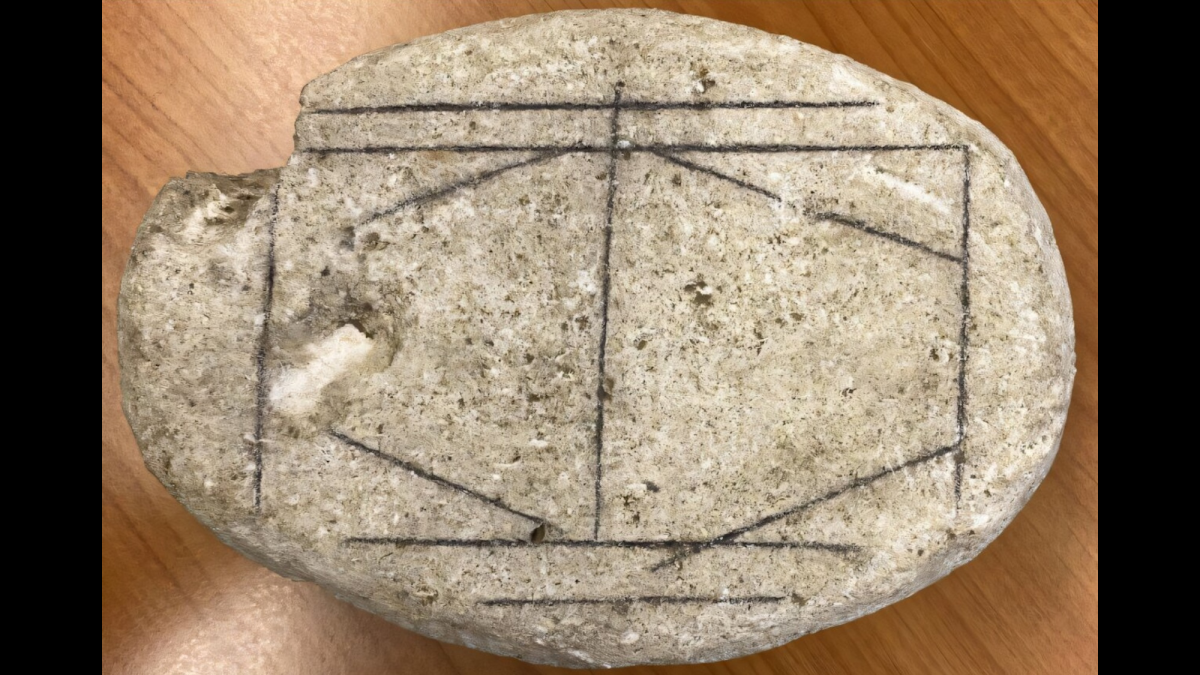
During their excavation work, archaeologists discovered an oval stone measuring roughly 8.3 by 5.7 inches in diameter and etched with various intersecting lines. Further examinations revealed the material to be a type of white Jurassic limestone sourced from ancient quarries in Norroy in northeastern France.
“Norroy limestone was a popular choice for large architectural elements in the Roman northern provinces because of its white color, smooth surface, and relative softness, making it an easily sculpted substitute for marble,” explained the study’s authors.
Experts debated the stone’s purpose for years. It was too small to be intended as a building component, and its shape wasn’t suited for roadwork. Although its lines conceivably could represent some form of architectural sketch, the theory was unlikely due to a lack of similar examples from the time period. But while some researchers consistently contended the stone was a board game’s playing surface, it didn’t resemble any known examples from the era.
Recent analysis now appears to support the longstanding board game theory. 3D imaging revealed some of the diagonal and horizontal lines are deeper than others—indicative that people routinely moved tiny pieces along these routes more often than others.
“We can see wear along the lines on the stone, exactly where you would slide a piece,” Leiden University archaeologist and ancient game specialist Walter Crist said in a statement.
But if it was a board game, then what were the rules? The question may seem impossible to answer without access to a playing guide, but Crist’s team doesn’t think this is necessarily the case. After enlisting help from machine learning programmers at Maastricht University in the Netherlands, researchers designed an artificial intelligence system trained on rules from around 100 ancient games documented from the same region as the stone’s origin. The resultant AI program (dubbed Ludii as a play on ludi, Latin for “games”) calculated a number of optional playing styles for the mystery pastime researchers named Ludus Coriovalli.
“[Ludii] produced dozens of possible rule sets. It then played the game against itself and identified a few variants that are enjoyable for humans to play,” said Maastricht University AI designer Dennis Soemers.
From there, researchers doublechecked the potential rule sets against the documented wear on the stone to confirm the most likely move patterns in the game. In the end, Crist, Soemers, and their colleagues theorize Ludus Coriovalli was a “deceptively simple but thrilling strategy game” with the objective to pursue and trap your opponent’s pieces in as few moves as possible.
Although the study’s conclusions offer arguably the most plausible explanation behind the limestone artifact, researchers stopped short of declaring themselves the winners. Without additional primary source references, the exact rules of Ludus Coriovalli may never be fully known.
“If you present Ludii with a line pattern like the one on the stone, it will always find game rules. Therefore, we cannot be sure that the Romans played it in precisely that way,” Soemers cautioned.
Like any great board game, it’s always important to consider all the options and avoid getting too cocky.

2025 PopSci Best of What’s New