
Table of Contents
Key Takeaways
- Recent research uncovers that Native American hunter-gatherers used two-sided dice over 12,000 years ago, predating Old World examples by more than 6,000 years.
- The identification of these ancient dice involved a four-part morphological test, distinguishing them from tools or decorative objects.
- Dice games may have fostered social interactions by creating contexts for exchange among disconnected groups, emphasizing fairness.
- The continuity of dice usage across various cultural periods reflects both adaptability and a deep-rooted tradition in North America.
- Understanding the role of women in this gaming tradition and the absence of dice from eastern North America remains an open question.
Hold a small piece of bone in your palm. One face is scored with parallel lines; the other is plain. You close your fingers around it, shake once, and let it fall. Something happens that you neither control nor fully understand, and yet the game proceeds, scores are kept, goods change hands. You have just done what Robert Madden, a PhD student at Colorado State University, has now documented people doing on the western Great Plains as long as 12,000 years ago, in the closing centuries of the last Ice Age. Twelve thousand years. That is not a small revision to the history of chance.
The study, published this week in American Antiquity, argues that Native American hunter-gatherers were manufacturing and using two-sided dice thousands of years before the oldest known examples from Bronze Age societies in Mesopotamia, the Indus valley, and the western Caucasus. As Madden puts it, “Historians have traditionally treated dice and probability as Old World innovations.” The archaeological record, it now appears, says otherwise.
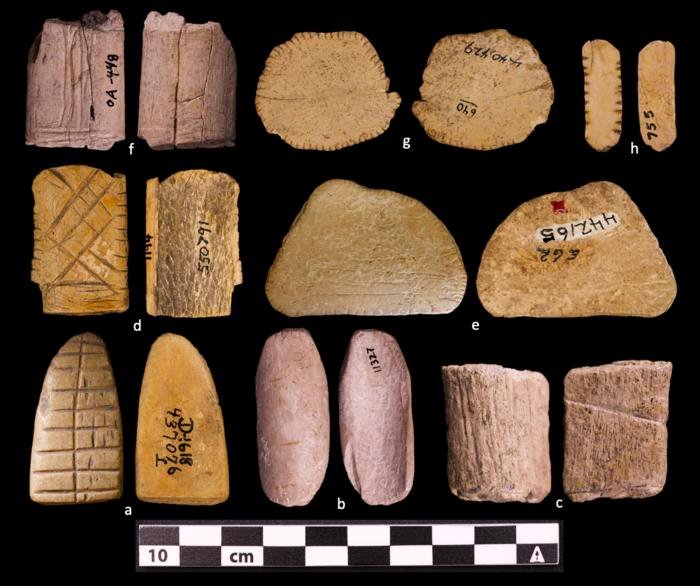
The problem with prehistoric gaming pieces has always been identification. For more than a century, excavations across North America turned up small, carefully worked objects labelled, with varying confidence, as “gaming pieces.” But without a principled way to distinguish an actual die from a decorative object or a tool by-product, no one could say much with certainty. Madden’s contribution is to solve that identification problem first, before attempting to answer the antiquity question. Working from Stewart Culin’s 1907 compendium Games of the North American Indians, a 809-page survey of 293 sets of historic Native American dice from 130 tribal groups, he derived a four-part morphological test: two-sided, non-perforated, made of bone or wood, with sides distinguished by applied markings or colour, appearing in cross-section as flat, plano-convex, concave-convex, or convex-convex, and small enough that two or more could be held in the hand and cast.
The study addresses this directly by deriving a strict four-part test from a database of 293 sets of documented historic Native American dice, rather than relying on resemblance or intuition. Objects that pass all four criteria, being two-sided, non-perforated, made of bone or wood, with distinguishable faces and the right size and shape to be held and thrown, fit seamlessly into the known tradition of dice use that runs unbroken from the past 2,000 years to the present day.
The oldest known dice from the eastern hemisphere date to around 3,500 BC, appearing in Bronze Age contexts in Mesopotamia, the Indus valley, and the western Caucasus. The Folsom dice from Wyoming, Colorado, and New Mexico predate these by more than 6,000 years. Even later North American examples, some 7,000 to 8,000 years old, still predate the Old World’s earliest examples.
Not in the formal mathematical sense, no. What the study argues is more interesting: that by generating, observing, and recording random outcomes in structured, repeatable games, Folsom-period people were creating the exact conditions in which probabilistic regularities can be perceived and relied upon, even without algebra. Formal probability theory, developed in Europe in the 1600s, grew from studying dice games. The Pleistocene Plains version was doing something structurally similar, thousands of years earlier.
Scholars who study Native American gambling argue that dice games functioned as social technology, creating a rule-governed, fair context for exchange and interaction between groups who had no preexisting relationship. The fairness of a dice game, grounded in equal probability, allowed strangers to trade goods and information on neutral ground. That adaptive function may help explain why the practice persisted across every major cultural period and subsistence strategy in North American prehistory.
Applied to the published archaeological record across three years of searching, that test yielded 659 diagnostic and probable dice from 57 sites in 12 states, spanning roughly 13,000 years of North American prehistory. The oldest cluster comes from Folsom-period sites in Wyoming, Colorado, and New Mexico.
The Folsom cultural complex dates to between 12,845 and 12,255 years before the present. These were mobile hunter-gatherers on the Great Plains, best known for the finely worked projectile points they left embedded in bison bones. What the Agate Basin site in eastern Wyoming, the Lindenmeier site in northern Colorado, and the Blackwater Draw site in New Mexico also contain, it turns out, is dice. Twenty of them, across the three locations: flat bone discs, concave-convex split-bone pieces, and plano-convex rib sections, many of them marked with edge incisions or faint traces of red pigment on one side. Madden visited the Smithsonian Institution, the University of Wyoming Archaeological Repository, and the Denver Museum of Nature and Science to examine these objects directly. They are not casual or ambiguous finds.
The comparison with the Old World is stark. The earliest known dice from the eastern hemisphere appear around 3,500 BC, or roughly 5,450 years before the present, in Bronze Age contexts in Mesopotamia and the Indus civilisation. The Folsom dice predate them by more than six thousand years. Even later North American examples, including seven-thousand-to-eight-thousand-year-old dice from the Sudden Shelter and Cowboy Cave sites in Utah, still predate the earliest known Old World examples by a considerable margin.
Historians of mathematics have long identified the invention of dice as an important early step in humanity’s evolving understanding of randomness, the intellectual precursor that eventually, via Cardano, Galileo, Fermat, and Pascal in the sixteenth and seventeenth centuries, produced formal probability theory. The connection is not metaphorical. Dice games produce a simplified, repeatable stream of random events that can be observed and scored over time, creating exactly the kind of structured experience from which regularities like the law of large numbers can be perceived, even without algebraic notation to express them. Madden argues that ancient Native American dice players were, in a practical sense, doing precisely that: generating, observing, and relying on probabilistic patterns in ways that demanded some working understanding of how chance actually behaves.
Whether that understanding was explicit or intuitive is impossible to know. The ethnographic record hints at something more than casual superstition: Zuni tradition describes dice games as reflecting celestial forces governing human fate, with outcomes decided not by divine will but by chance itself. These are not accounts of people who thought randomness was nothing.
The social function of gambling may be equally significant. Scholars of later prehistoric periods have argued that dice games in North America functioned as a mechanism for integrating otherwise disconnected groups, creating a rule-governed context for exchange and interaction that could operate outside existing social relationships. Dice-playing required a shared understanding of fairness, which meant an implicit acknowledgement of equal probability on both sides of a throw. That the archaeological record shows dice at both the Agate Basin and Lindenmeier sites, both of which have been proposed as possible Folsom communal aggregation locations based on their size and assemblage diversity, is potentially meaningful.
The persistence of the tradition is perhaps equally striking. Dice appear at sites associated with every major period of North American prehistory, from Paleoindian through Archaic and Late Prehistoric, and they turn up among groups with radically different subsistence strategies, from mobile bison hunters to sedentary Pueblo agriculturalists. That continuity, Madden suggests, reflects genuine adaptive fitness, not mere conservatism. Today, more than 250 tribes operate more than 500 gaming locations in the United States, generating over $40 billion in annual revenue. The arc from a small scored bone thrown on the Pleistocene Plains to a modern casino floor is unbroken.
One curiosity the study raises without resolving: no prehistoric dice were identified from eastern North America, despite the well-documented presence of dice games among eastern tribes in the colonial period. Whether that absence reflects a genuinely western-only origin that spread east only under the disruptions of colonialism, or merely a gap in the published record, is currently unclear. It is, Madden notes, a question worth investigating. As is the gender dimension: an analysis of the ethnographic record by an earlier scholar found that more than 80 percent of documented Native American dice games were played exclusively by women. The possibility that women were the primary early movers in both the social and intellectual dimensions of this 12,000-year tradition is not, on the evidence available, something that can be ruled out.
Quick Note Before You Read On.
ScienceBlog.com has no paywalls, no sponsored content, and no agenda beyond getting the science right. Every story here is written to inform, not to impress an advertiser or push a point of view.
Good science journalism takes time — reading the papers, checking the claims, finding researchers who can put findings in context. We do that work because we think it matters.
If you find this site useful, consider supporting it with a donation. Even a few dollars a month helps keep the coverage independent and free for everyone.
Related