
Table of Contents
Most people already know the broad strokes of healthy eating. More vegetables, fewer biscuits, drink water. The gap was never knowledge. It’s the stretch between knowing and doing on a Tuesday night when you’re tired and there’s half a cabbage in the fridge.
Nutrition gets buried under noisy headlines. One week eggs are a problem, the next they’re a superfood. Meanwhile the research on diet and long-term health has stayed remarkably steady for decades: plenty of plants, enough protein, not too much salt and added sugar, and a pattern you can actually keep going for years rather than eleven days.
What follows is deliberately practical. What goes on the plate, which numbers are worth remembering, and how to build meals that don’t need a recipe or a spreadsheet.
The plate, in plain terms
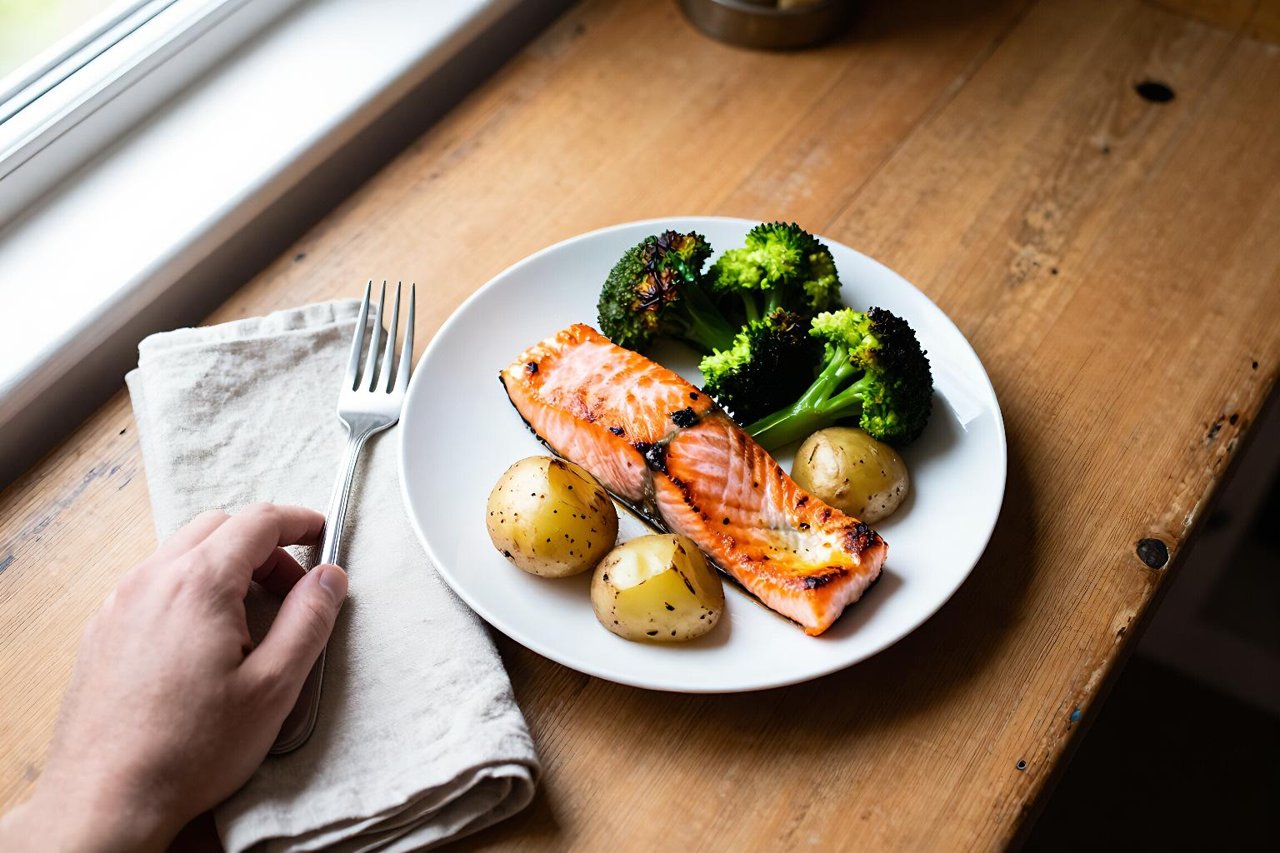
Forget macros for a moment. Dietitians tend to describe a balanced meal the same way: half vegetables or salad, a quarter protein, a quarter starchy carbohydrate, plus a thumb of fat. It’s a rough template, and that’s exactly why it works. You can apply it to a curry, a sandwich, a roast dinner or a bowl of leftovers without weighing a single thing.

Your own hand is a decent portion guide. A palm-sized piece of fish, chicken, tofu or tempeh lands at roughly 30g of protein. A clenched fist of dry rice or pasta is about 50g. A thumb of olive oil is a tablespoon, which is around 120 calories — more than most people expect when they’re “just drizzling”.
Three meals that fit the template without any effort:
- Greek yoghurt with frozen berries, 40g of oats and a spoon of peanut butter
- A roasted chicken thigh, potatoes in their skins and half a head of broccoli
- Red lentil soup with wholemeal bread and a handful of spinach stirred in at the end
None of those take longer than twenty minutes. That matters more than any nutrition label.
Three numbers worth remembering
You don’t need an app subscription. A small handful of figures covers most of what nutrition advice is trying to tell you.
Fibre: aim for 30g a day
The average adult manages about 18g. Fibre feeds gut bacteria, slows digestion, keeps blood sugar steadier after meals and is one of the more reliable dietary predictors of long-term health. It also makes food more filling, which quietly solves a lot of overeating.In practice: 40g of oats is 4g, half a tin of chickpeas is 6g, an apple is about 2.5g, two slices of wholemeal bread is 4g, a portion of broccoli adds another 2.5g. That’s roughly 19g before you’ve eaten dinner, and it took almost no planning.
Protein: somewhere between 1.0 and 1.6g per kilo
Sedentary adults need around 0.8–1.0g per kilo of body weight. If you lift weights, 1.6g per kilo is close to the ceiling of what’s useful. For a 75kg person that’s a range of about 60g to 120g a day. Two eggs give you 12g, a 100g chicken breast gives 31g, 200g of Greek yoghurt gives around 20g.
Older adults should sit toward the higher end. Muscle loss after 50 is real, and protein becomes more important, not less, especially alongside resistance training.
Salt and free sugars: 6g and 30g
Very little of the salt you eat comes from the shaker. It’s in bread, bacon, stock cubes, soy sauce, cheese and pretty much anything in a packet. Sugar guidelines target “free sugars” — the added stuff plus honey and fruit juice — at 30g a day for adults. A single can of cola is 35g. A flavoured yoghurt can hold 15g without tasting especially sweet.
Ultra-processed food, without the hysteria
In 2019, researchers at the US National Institutes of Health ran a four-week inpatient trial with 20 adults. Half ate an ultra-processed diet, half ate an unprocessed one, matched for calories, sugar, fat, fibre and sodium. On the ultra-processed weeks, people ate roughly 500 extra calories a day and gained weight without noticing they were doing it. Same nutrients on paper, very different result in the body.
That said, “processed” is a wide net. Frozen peas, tinned tomatoes, wholemeal bread, tofu and yoghurt are all processed, and all are good for you. The category worth limiting is the one engineered to be soft, sweet, salty and fast to eat — the products where the ingredient list contains things you’d never find in a kitchen cupboard.
It helps to think in terms of what a food does rather than which category it sits in. Fresh food you cook yourself tends to regulate appetite on its own. This is one of the reasons the everyday habits that genuinely move the needle look so unglamorous.
Reading a label in ten seconds
Ignore the front of the pack. The back tells you more, and you can scan it fast with the per-100g thresholds used on traffic-light labelling:
- High — more than 22.5g sugar, 17.5g fat or 1.5g salt per 100g
- Low — 5g sugar or less, 3g fat or less, 0.3g salt or less per 100g
- Compare products per 100g, never per serving. Serving sizes are chosen by marketing departments, not by nutritionists.
Two products can look identical on the shelf and differ by 15g of sugar per 100g. Checking takes seconds and is the single highest-value habit in a supermarket.
Why meal plans collapse and what holds up instead
The problem with a rigid seven-day plan is that it assumes a normal week. Weeks are not normal. Someone gets ill, a deadline lands, the football training runs late. A plan that can’t absorb a bad Wednesday gets abandoned by Thursday.
What survives is looser: a handful of default meals you can cook from memory, a freezer with something decent in it, and a rough idea of what you’re eating for the next three days. Batch-cooking a big pot of chilli or lentils on a Sunday does more for your diet than any app. Building something that survives a genuinely bad week is a skill worth learning properly, and it’s covered well in how to build a sustainable healthy lifestyle that survives a bad week.
If time is the specific blocker rather than motivation, the tactics are different again — smaller shops, fewer decisions, food that doesn’t need a recipe. There’s a good breakdown of that in maintaining healthy habits when life gets busy without adding hours to your day, which focuses on squeezing changes into the gaps rather than rebuilding your schedule.
Where supplements actually earn their place
Most supplements do very little for most people eating a varied diet. A few are genuinely worth it:
- Vitamin D, 10µg daily through autumn and winter, because sunlight in northern latitudes isn’t strong enough to make it
- Vitamin B12 for anyone vegan or mostly plant-based, since it occurs naturally almost exclusively in animal foods
- Folic acid, 400µg before and during early pregnancy
- Iron only if a blood test shows you need it — supplementing blind can cause problems
Beyond that, the evidence gets thin fast, and the marketing gets loud. If you’re specifically curious about what’s worth buying, the best vitamins for men and what’s a waste of money separates the useful from the expensive urine quite neatly.
Start with one meal, not a new identity
The fastest way to improve your nutrition is to change breakfast and leave everything else alone for a fortnight. Breakfast is the meal with the fewest variables and the most repetition, so a swap sticks quickly. Trade the cereal bar for eggs on toast, or the sugary yoghurt for plain yoghurt with fruit and nuts. You’ll add 10–15g of protein and 5g of fibre before 9am, and you’ll be less hungry at 11.
Weeks two and three, add a vegetable to lunch. Not a salad — whatever you already eat. Frozen peas into the pasta, spinach into the sandwich, a tomato chopped on the side. By week four you’ll have made three changes that survive contact with real life, which beats a total overhaul every time.
Small, boring and repeatable is the whole trick. That’s the pattern behind most of the changes in healthy lifestyle tips that stick, and it’s the reason a slow approach beats a dramatic one. Pick one thing this week. Get it working. Then pick the next.


