
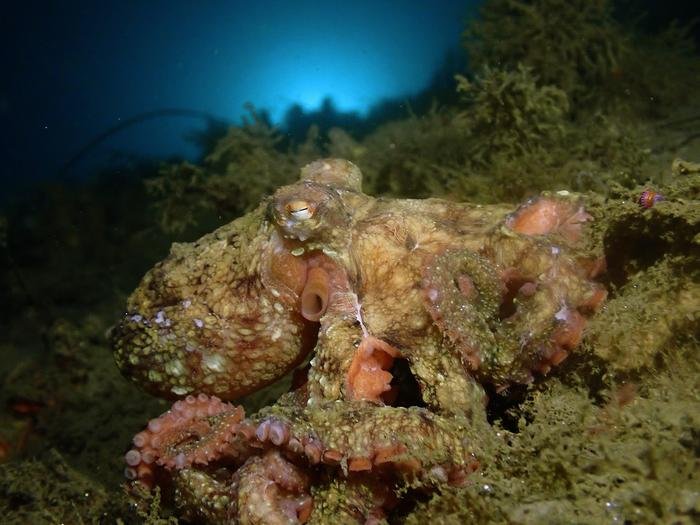
It begins with a shimmer, a near-magical flicker across an octopus skin that vanishes into the sand. That same color-shifting pigment, xanthommatin, has now been recreated in record quantities by a team at UC San Diego, marking a leap toward sustainable, nature-inspired materials.
Published in Nature Biotechnology, the new study details how researchers at Scripps Institution of Oceanography engineered bacteria to mass-produce the elusive pigment that gives octopuses, squids, and cuttlefish their camouflage powers. By linking the survival of the microbes to pigment production, the team created a feedback loop that turned bacterial metabolism into a tiny biological factory.
Turning Bacteria Into Artists
Traditionally, xanthommatin has been almost impossible to make in useful amounts. The pigment, also responsible for the fiery hues in butterfly wings and dragonfly bodies, occurs naturally but has resisted industrial-scale synthesis. Harvesting it from animals is impractical, and chemical routes are slow, expensive, and low-yield.
The UC San Diego team found a workaround. They genetically engineered a bacterium so that its growth depended on making the pigment itself. Each molecule of xanthommatin produced also generated formic acid, which the microbe needed to survive. That simple but ingenious connection created a self-reinforcing cycle.
“We made it such that activity through this pathway, of making the compound of interest, is absolutely essential for life. If the organism doesn’t make xanthommatin, it won’t grow,” said Leah Bushin, the study’s lead author, now a Stanford faculty member who conducted the work as a postdoctoral researcher at Scripps Oceanography.
To push the system even further, the team used robotic automation and adaptive laboratory evolution to optimize the microbes, ultimately boosting pigment yields up to 1,000 times higher than previous methods. The bacteria churned out one to three grams of pigment per liter, compared with just milligrams in older approaches.
When the experiment finally worked, Bushin described the thrill of discovery. She had left the cultures overnight and returned the next morning to find deep color saturating the medium—a visual confirmation that the system had succeeded. “It was one of my best days in the lab,” she recalled.
From Camouflage To Consumer Products
Senior author Bradley Moore, a marine chemist with joint appointments at Scripps and the UC San Diego Skaggs School of Pharmacy, said the breakthrough could open doors across materials science and biomanufacturing. Potential uses include bio-based dyes, UV protectants, adaptive coatings, and even military or cosmetic applications.
“This natural pigment is what gives an octopus or a squid its ability to camouflage, a fantastic superpower, and our achievement to advance production of this material is just the tip of the iceberg,” said Moore.
The research, funded by the National Institutes of Health, the Office of Naval Research, the Swiss National Science Foundation, and the Novo Nordisk Foundation, also signals a broader shift toward sustainable chemistry. By coupling microbial survival to molecule creation, scientists can bypass fossil-derived feedstocks and instead harness nature’s own biochemical logic.
According to co-author Adam Feist, whose lab specializes in computational bioengineering, the approach represents a glimpse into a new era of biomanufacturing, one where computers, robots, and microbes collaborate to produce complex molecules from simple sugars. The method could be adapted to other high-value natural products, from pigments to pharmaceuticals.
For now, the ocean’s secret color code has been cracked in a Petri dish. What once shimmered only beneath the waves may soon color the materials that shape our future.
Nature Biotechnology: 10.1038/s41587-025-02674-3
If our reporting has informed or inspired you, please consider making a donation. Every contribution, no matter the size, empowers us to continue delivering accurate, engaging, and trustworthy science and medical news. Independent journalism requires time, effort, and resources—your support ensures we can keep uncovering the stories that matter most to you.
Join us in making knowledge accessible and impactful. Thank you for standing with us!