
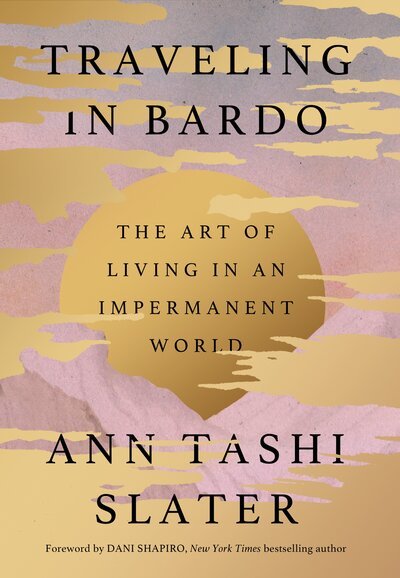
Ann Tashi Slater’s Traveling in Bardo: The Art of Living in an Impermanent World is the kind of book that quietly rearranges your thinking, sometimes with a gentle nudge, sometimes with something closer to a punch in the gut. Slater, who was raised between the cultures of Tibet, India, Japan, and the U.S., writes like someone who’s made a home in the in-between space of transitions and uncertainty, someone for whom impermanence isn’t a philosophical abstraction, but a lived reality.
The “bardo” in the title refers to the Tibetan Buddhist concept of the liminal spaces between death and rebirth, but Slater’s bardo is broader than that. For her, life itself is a series of bardos – thresholds, transitions, the moments when the ground drops out from beneath you and you have to figure out how to keep going even when everything you thought was solid turns out to be smoke. This expanded understanding of bardo transforms an ancient Tibetan teaching into a lens through which we can examine every major transition in our lives, career changes, relationships ending and beginning, relocations, losses, and even the smaller daily shifts that accumulate into fundamental transformations.
Slater’s chapters move fluidly between her own family’s migrations, the loss of her mother, travels in Asia and the West, and the larger historical tragedies that haunt her lineage. She’s as interested in the small stuff (packing a suitcase, the taste of a particular fruit, getting lost in a foreign city) as she is in the big questions of mortality and meaning. This attention to the granular details of everyday life grounds her more expansive meditations, reminding us that impermanence isn’t just about death or dramatic upheaval, but about the way a childhood home smells different when you return as an adult, or how a friendship can shift imperceptibly until one day you realize you’re strangers.
There’s a kind of radical honesty to her writing. She doesn’t flinch from grief or uncertainty, but she’s not interested in easy answers or spiritual platitudes either. Slater resists the temptation to package Buddhism into digestible self-help mantras. Instead, she invites readers into the uncomfortable, necessary work of sitting with what can’t be fixed or explained away. Her explorations of her Tibetan grandmother’s death rituals, for instance, don’t sentimentalize tradition or exoticize Eastern spirituality; they reveal the profound practical wisdom embedded in ceremonies designed to help both the living and the dead navigate transition.
One of the book’s greatest strengths is the way Slater weaves together the personal and the universal. Her voice is intimate, like a friend telling you a story over tea, but she’s also after something larger: how to live when nothing lasts, how to love when you know you’ll lose, how to keep moving forward when history and memory are so heavy. She writes about her own dislocations (growing up with one foot in Tibetan culture and another in American life, inheriting stories of a homeland she can never truly know) with a vulnerability that makes room for readers to see their own experiences of displacement and belonging reflected back at them.
She’s unafraid to let her essays drift, to linger on a sensory detail, or follow a stray thought, and yet the book as a whole has a coherence that comes from Slater’s deep commitment to her subject. The structure mirrors her thesis: just as life doesn’t move in straight lines, neither does this book. Each chapter circles back to central themes while opening new perspectives, creating a reading experience that feels less like a linear argument and more like a deepening meditation.
What makes Traveling in Bardo particularly timely is how it speaks to our contemporary moment of perpetual disruption. In an era of climate anxiety, political instability, and rapid technological change, Slater’s wisdom about living with uncertainty feels urgently relevant. She doesn’t promise that embracing impermanence will make life easier, but she compellingly suggests, that it might make us more fully human, more capable of tenderness in the face of loss, more alive to beauty precisely because we know it won’t last.
Final Thoughts
If you’re looking for a book that will give you five easy steps to inner peace, this isn’t it. If you want a book that will sit with you in the mess of being human – complicated, tender, unresolved – then Traveling in Bardo is a rare and beautiful companion. Slater writes with the kind of wisdom that can only come from living with your eyes open, and her book is a reminder that impermanence, for all its pain, is also what makes life precious.
It’s not a book you finish and set aside. It’s the kind you carry with you, a little lighter on your feet, a little more awake to the world’s beauty and its losses. Slater has given us a guide for uncertain times, not a map with clear directions, but something better: the companionship of someone who knows the territory and isn’t afraid to walk beside us through it.