
Table of Contents
Most weight loss meal plans fail for a boring reason. They were built for someone with a different job, a different budget, and a different relationship with food than yours. The menu isn’t the problem. The fit is.
So this isn’t a menu. It’s the process for building one: seven steps, real numbers, and example days you can assemble on a Sunday evening and be eating by Monday morning. Expect to spend about 40 minutes on it the first time, then five minutes a week after that.
Step 1: Find your starting calorie number
Everything else hangs off one figure, so get a rough answer rather than a perfect one. Take your body weight in pounds and multiply by 14. For most people who move a little during the day, that lands close to maintenance.
Example: a 42-year-old woman, 82 kg (180 lb), 167 cm, desk job, walks 30 minutes most days. 180 x 14 = 2,520 kcal maintenance. Cut 20% and she lands at about 2,000 kcal a day.

That number is a starting bid, not a verdict. You won’t know if it’s right until you’ve run it for two weeks and looked at the trend rather than any single weigh-in. If you’d rather build the whole structure around your schedule, budget and training first, the approach in how to build the best weight loss program for your life in seven steps pairs neatly with this one.
Step 2: Set your protein target before anything else
Protein is the one number worth protecting. It helps hold onto muscle while you lose fat, and it’s the reason a 2,000 kcal day can feel satisfying instead of bleak.
Aim for 1.6 g per kilogram of body weight. Our 82 kg example works out at about 130 g a day. If you’re new to training, 1.2 to 1.6 g/kg is plenty; if you lift hard three or four times a week, sit closer to 1.8.
That is a lot of chicken. A palm-sized portion of most meats gives you 25 to 35 g, a 150 g pot of Greek yogurt around 15 g, and a scoop of powder another 20 to 25 g. Choosing a powder worth buying is its own decision, and the six-step walkthrough on choosing the best protein powder with real numbers is a sensible place to settle it.
Step 3: Use a four-part template for every meal
With your daily protein target in hand, build every meal from the same four parts:
- Protein: 25 to 40 g
- Produce: one to two cups of vegetables or fruit
- Starch: 30 to 50 g of carbs, roughly a cupped hand of cooked rice, pasta or potato
- Fat: 8 to 15 g, about a thumb of oil, a quarter avocado, or a small handful of nuts
Follow that and a meal lands between 350 and 550 kcal without you counting a thing. Two fists of salad and a palm of chicken don’t need a spreadsheet.
Step 4: Fit the template to your daily number
Now split the day into four slots. For a 2,000 kcal target:
- Breakfast: 450 kcal, 35 g protein
- Lunch: 550 kcal, 35 g protein
- Afternoon snack: 250 kcal, 20 g protein
- Dinner: 750 kcal, 45 g protein
That totals 2,000 kcal and 135 g of protein, which is the whole trick. Notice how much room dinner gets. A tight breakfast and lunch make a generous evening meal possible, and that’s usually the meal people refuse to give up.
What three days actually look like
Breakfast stays the same every day, deliberately: oats or two eggs, 150 g Greek yogurt, a handful of frozen berries. 450 kcal, 35 g protein, three minutes.
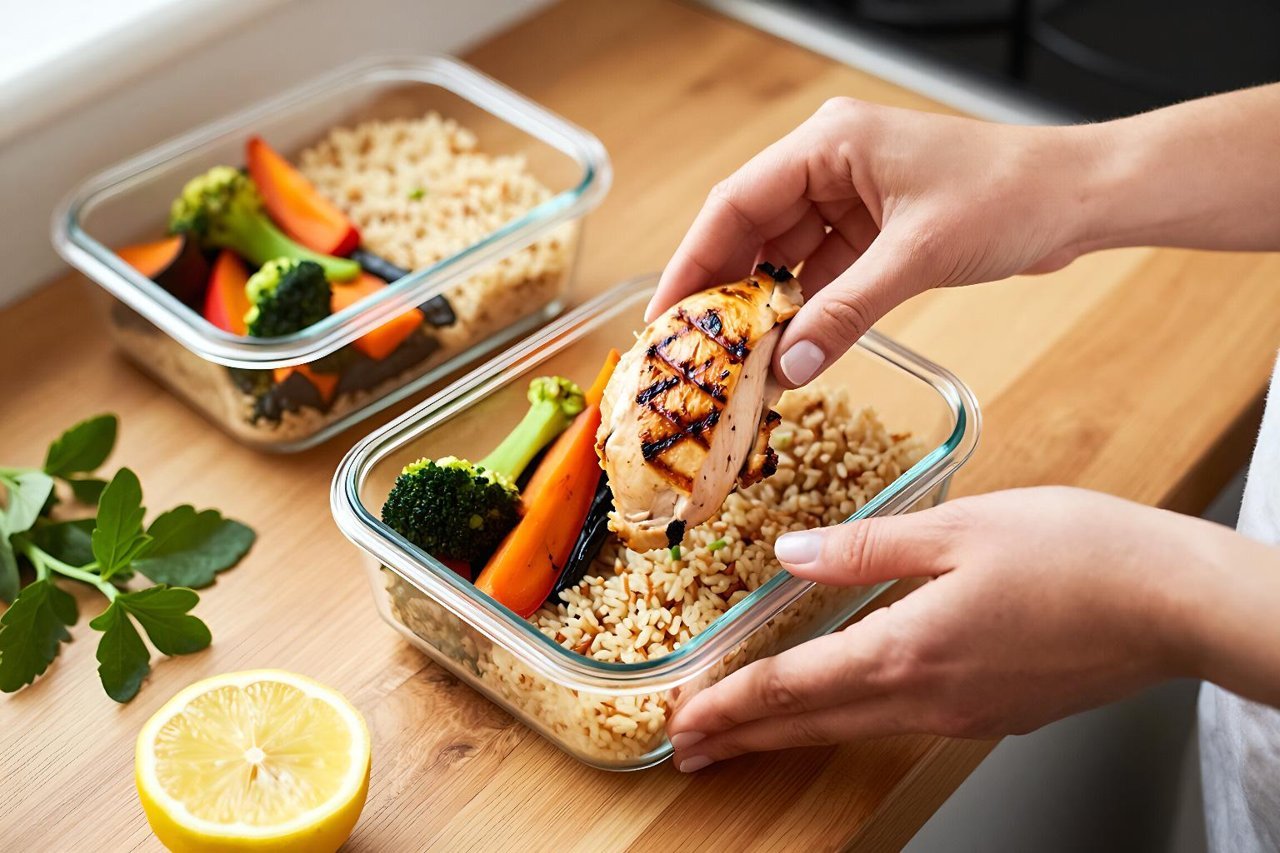
- Day 1: lunch is 150 g chicken, a cup of rice, roasted peppers and olive oil. Dinner is a salmon fillet, potatoes and green beans.
- Day 2: same chicken bowl, different sauce. Dinner is lean beef mince in tomato sauce with wholewheat pasta and a big salad.
- Day 3: lunch is tuna, chickpeas, cucumber and feta. Dinner is chicken thighs, sweet potato and broccoli.
Nine meals, three breakfasts, one shopping list. Nothing exotic, nothing you need a special trip for.
Step 5: Plan three days, not seven
Seven-day plans get abandoned on Wednesday. Three-day rotations survive because the list is short, nothing rots at the back of the fridge, and you’re only making four decisions instead of twenty-one.
Build three breakfasts, three lunches and three dinners, then rotate them. Keep two emergency meals in the freezer for the nights you’d otherwise order in. If you want the wider logic behind why this looser structure beats a strict menu, the flexible, realistic meal plan framework explains it well.
Step 6: Shop and prep in 90 minutes
One trip, one session. The list is about 20 items and the prep is the same six jobs every week:
- Roast or marinate 1.5 kg of chicken thighs
- Cook a big pot of rice, quinoa or potatoes
- Roast two trays of vegetables with oil and salt
- Boil eight eggs
- Wash and dry the salad leaves
- Portion yogurt, nuts and berries into tubs
Ninety minutes on Sunday buys you a week of ten-minute dinners. One warning: if your fibre intake jumps from 12 g to 30 g in a single week, expect a few days of bloating. Add the vegetables gradually, and if your digestion is sensitive, the guide to choosing the best probiotics for your gut is worth a read before you blame the plan.
Step 7: Set your adjustment rule before you start
Write this down now, while you’re calm and objective. The version of you who’s been stuck at the same weight for three weeks makes bad decisions.
Weigh yourself three or four mornings a week and average the numbers. Then follow the rule:
- Average unchanged for two weeks: drop 100 to 150 kcal, taken from carbs or fat. Never cut protein.
- Losing more than 1% of body weight per week: add 100 to 150 kcal back. At 82 kg that’s losing more than 0.8 kg a week, which is faster than you need.
- Losing 0.5 to 1% per week: change nothing. That’s roughly 0.4 to 0.8 kg, and it’s exactly the pace that holds up over months.
When the week goes sideways
A restaurant dinner on Thursday, birthday cake on Saturday, a work trip the following week. None of it breaks the plan. Only abandoning your anchors does.
Two rules cover most of it. Hit your protein target before anything else, because a day at 130 g protein and 2,600 kcal does far less damage than a day at 60 g and 2,600 kcal. And use the two-day rule: one off day is noise, two in a row is a trend.
At restaurants, order protein and vegetables first, ask for sauces on the side, and eat something with protein an hour before you leave the house. Arriving ravenous is what wrecks the evening, not the menu itself.
Three numbers, and nothing else
Once this is running, you only need to hold onto three things: your daily calorie target, your protein target, and your weekly average weight. The specific meals, sauces and restaurant choices are all negotiable, which is exactly why this holds up longer than a printed plan.
Give it six weeks before you judge it. That’s three full adjustment cycles, enough data to see a trend, and long enough that the prep stops feeling like effort and starts feeling like a habit you’d miss.


