
Table of Contents
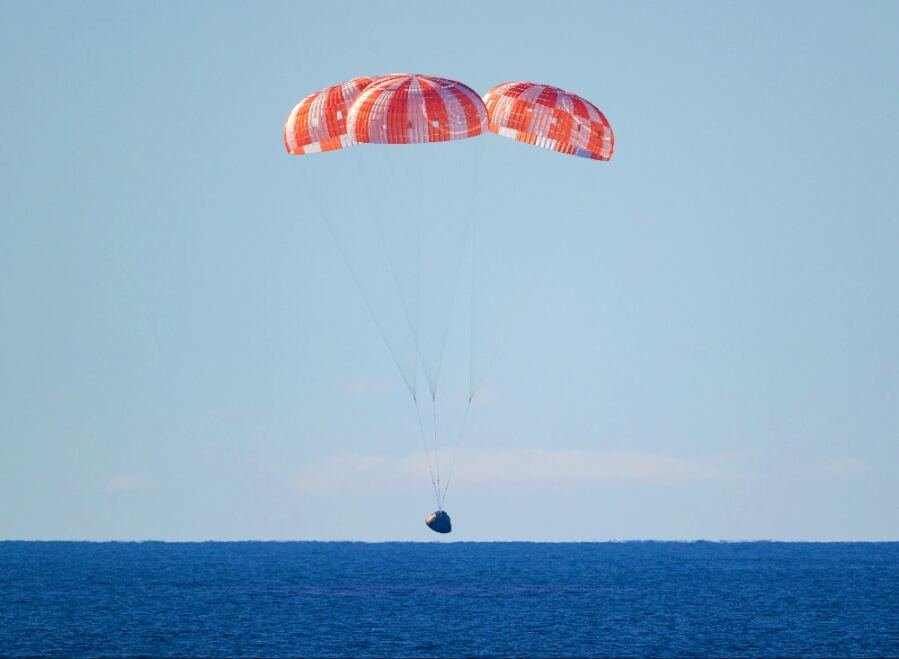
At 5:07 p.m. Pacific time on Friday, a scorched capsule hit the water off San Diego and bobbed there, four humans sealed inside, having just crossed 694,481 miles of space in ten days. The spacecraft was Orion, its crew-given name was Integrity, and its passengers were the first people to see the Moon up close since the last Apollo astronauts came home in December 1972. Fifty-three years. That is how long it had been since anyone made the trip.
Key Takeaways
- NASA’s Artemis II mission successfully returned the first crew to the Moon since Apollo 1972, traveling 694,481 miles in ten days.
- The mission conducted extensive scientific experiments, including monitoring astronaut health and capturing over 7,000 lunar images.
- Orion’s heat shield and life support systems proved effective during re-entry, demonstrating the spacecraft’s capabilities.
- NASA plans to prepare for Artemis III, targeting a lunar landing in 2028, while Artemis II surpassed Apollo 13’s distance record.
- The crew collected valuable data on lunar terrain and environmental conditions for future missions, including tests with organ-on-a-chip technology.
NASA’s Artemis II mission sent commander Reid Wiseman, pilot Victor Glover, mission specialist Christina Koch, and Canadian Space Agency astronaut Jeremy Hansen on a looping trajectory around the Moon and back. At their farthest point they were 252,756 miles from Earth, which quietly surpassed the distance record Apollo 13’s crew set in 1970 during their famously improvised survival run.
The mission was, at its core, a test flight. Nobody landed. Nobody walked on regolith. But the ten days the crew spent inside Orion were perhaps more scientifically dense than any crewed lunar mission before them, packed with biomedical experiments, piloting trials, and a geological observation campaign that generated more than 7,000 images of the lunar surface. The crew wore wristband monitors tracking their sleep and stress in deep space (a study called ARCHeR), blotted saliva onto specialized paper booklets to track immune changes, and carried organ-on-a-chip devices, roughly the size of a USB thumb drive, loaded with miniature stand-ins of their own bone marrow. That last experiment, AVATAR, was the first time such technology had flown beyond the Van Allen belts.
Why does bone marrow matter out there? Because it is where your immune cells are manufactured, and it is exquisitely sensitive to radiation. The chips could eventually help NASA personalize medical kits for individual astronauts, tailored to how each person’s biology responds to the deep-space environment.
On April 6, during the lunar flyby, Orion swooped to within 4,067 miles of the surface. The crew photographed impact craters, ancient lava flows, surface fractures, and color variations across terrain that no human eyes had scrutinized at this range in over five decades. They documented the terminator (the boundary between lunar day and night) where low-angle sunlight casts long shadows, conditions similar to those awaiting astronauts at the Moon’s South Pole, where a landing is penciled in for 2028. They spotted meteoroid impact flashes on the night side. They even proposed names for two craters.
“This moment belongs to the thousands of people across fourteen countries who built, tested, and trusted this vehicle,” said NASA Associate Administrator Amit Kshatriya after splashdown. “Their work protected four human lives traveling at 25,000 miles per hour and brought them safely back to Earth.”
A team of geologists with expertise in volcanism, tectonism, impact cratering, and lunar ice sat in the Science Evaluation Room at Johnson Space Center in Houston, feeding real-time guidance to the crew during the flyby. It was, in a way, a dry run for the kind of ground-to-crew science operations that will become routine if Artemis delivers on its promise. Human eyes, NASA reckons, catch subtleties in color and texture that orbital cameras miss, and the crew arrived trained for the task, having practiced geology fieldwork in Iceland and other Moon-like spots on Earth. Koch, for instance, had studied geologic features alongside Artemis geology lead Cindy Evans in landscapes that could pass for the lunar highlands if you squinted hard enough.
The crew also took manual control of the spacecraft during several piloting demonstrations, collecting handling data that will feed into rendezvous and docking procedures for Artemis III and beyond. Sort of like a test drive, except at interplanetary speeds and with no second vehicle to actually dock with. Not yet, anyway.
Four CubeSats from international partners hitched a ride too, deployed into high Earth orbit on the first day. Argentina’s ATENEA will measure radiation doses across various shielding methods. South Korea’s K-Rad Cube uses a dosimeter made of tissue-mimicking material to assess biological effects at different altitudes through the Van Allen belts. Saudi Arabia and Germany contributed their own radiation and space-weather instruments. None of these were central to the Artemis II mission, strictly speaking, but they add to a growing body of data about the environment humans will need to survive if we are serious about going back and staying.
And “staying” is the word NASA keeps using. Administrator Jared Isaacman said after splashdown that focus now turns to assembling Artemis III and preparing to, in his words, “never give up the Moon again.” That next mission, currently slated for next year, will test integrated operations with commercially built Moon landers in low Earth orbit rather than at the Moon itself. The actual lunar surface landing, with astronauts walking on the South Pole, is targeted for 2028.
Whether those timelines hold is, to put it mildly, an open question. Artemis has weathered years of delays, budget fights, and hardware problems already. But what Artemis II demonstrated, perhaps more than anything, is that the spacecraft works. Orion’s heat shield survived re-entry at roughly 25,000 miles per hour. Its life support kept four people breathing in deep space. Its guidance brought them to a pinpoint splashdown in the Pacific, where Navy divers fished them out and helicoptered them to the USS John P. Murtha for medical checks.
The crew is expected back at Johnson Space Center today. Their saliva samples, blood draws, and bone marrow chips will be heading to laboratories. And somewhere on the Moon’s far side, two craters might soon have new names.
Source: NASA Release 26-030, April 10, 2026
No. Artemis II was a crewed flyby, not a landing. The four astronauts orbited the Moon and returned to Earth without touching the surface. The first Artemis lunar landing, with astronauts walking on the Moon’s South Pole, is currently targeted for 2028 as part of the Artemis III or subsequent mission.
At their farthest point from Earth, the Artemis II crew reached 252,756 miles, surpassing the 248,655-mile mark set by Apollo 13 in 1970. Apollo 13’s record was an unplanned consequence of its emergency trajectory after an oxygen tank explosion. Artemis II’s distance, by contrast, was built into the mission’s design from the start.
The AVATAR experiment used tiny devices, about the size of a USB thumb drive, containing miniature replicas of each crew member’s bone marrow grown from their own blood donations. The chips measured how individual astronauts’ tissue responded to deep-space radiation and microgravity, marking the first time organ-on-a-chip technology had flown beyond the Van Allen radiation belts. The data could eventually help NASA customize medical kits for each astronaut on future missions.
The terminator is the boundary between the sunlit and dark sides of the Moon, where low-angle sunlight casts long shadows across the surface. Those lighting conditions closely resemble what astronauts will encounter at the Moon’s South Pole, the planned landing zone for a future Artemis mission. Documenting terrain under these conditions gives mission planners critical data about what crews will actually see and navigate when they arrive on foot.
Quick Note Before You Read On.
ScienceBlog.com has no paywalls, no sponsored content, and no agenda beyond getting the science right. Every story here is written to inform, not to impress an advertiser or push a point of view.
Good science journalism takes time — reading the papers, checking the claims, finding researchers who can put findings in context. We do that work because we think it matters.
If you find this site useful, consider supporting it with a donation. Even a few dollars a month helps keep the coverage independent and free for everyone.
Related