
Table of Contents
Ask a dealer principal what keeps them awake and the answer is rarely the showroom. It’s the service drive. New-car margin has always been thin and cyclical; the money that covers the rent comes from the parts counter, the finance office and the used lot. That is the axis the future of car dealerships is actually turning on, and it explains almost everything happening on a forecourt right now: fixed pricing, smaller retail space, larger workshops, and fewer, bigger owners.
Wall Street has already priced in part of this. Carvana retailed more than 400,000 vehicles in 2024, a volume that would have sounded absurd a decade ago for a company with no stores. In the US, roughly 40 million used vehicles change hands each year against about 16 million new ones. The trade isn’t disappearing. It’s being rebuilt around different economics.
The showroom is shrinking, the workshop is growing
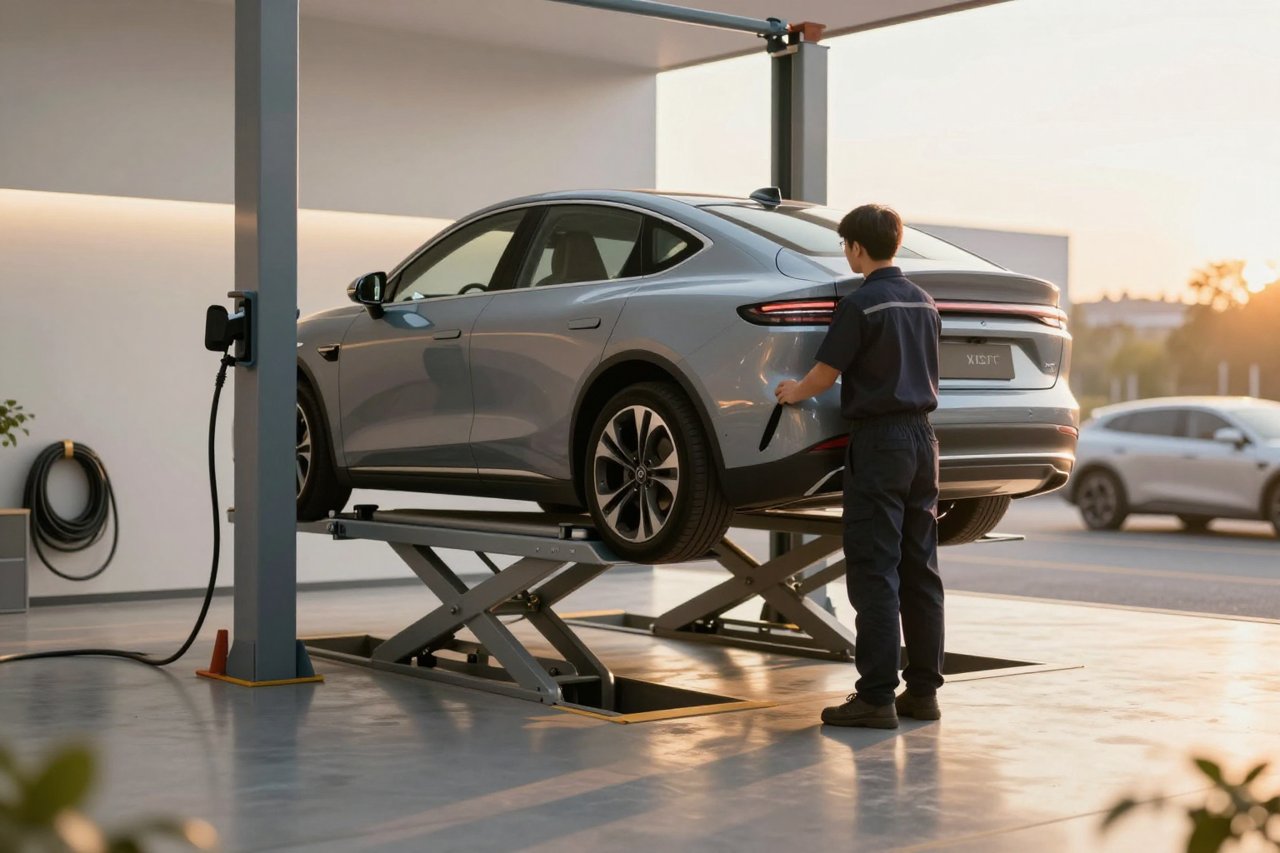
Manufacturer facility programmes have pushed glass palaces for thirty years. That era is ending, quietly. Dealer groups are buying smaller footprints on cheaper land, often on the edge of town rather than on the ring road, and spending the saved capital on lifts, diagnostic kit and high-voltage bays.
The reason is uncomfortable for anyone whose business plan assumes a lifetime of oil changes. An EV has roughly a third fewer moving parts than a combustion car. Brake pads last longer thanks to regenerative braking. There is no oil, no spark plugs, no exhaust. Industry estimates put routine maintenance revenue per EV at 30 to 40 per cent below an equivalent petrol car over five years. The same shift that makes EVs cheap to run hollows out the most reliable profit line in the dealership.

Dealers who have done the maths are chasing the work that survives: tyres, alignment, air conditioning, software faults, battery health checks, and collision repair. Some are adding charger installations and home-charging consultations, which sounds odd until you see the invoices.
Fixed prices are winning and haggling is losing
Negotiation used to be the dealer’s edge. The customer walked in blind; the salesperson knew the invoice, the holdback and the bonus target. That information asymmetry is gone. Buyers arrive with three competing quotes on their phone and a reasonable idea of what the car cost the store.
The result is a slow march towards transparent, published pricing. Honda moved to upfront pricing on its electric models in the US. Ford set non-negotiable prices for its EV line. In Europe, several manufacturers including Mercedes-Benz and Stellantis have shifted to agency-style retail, where the brand sets the price and the dealer is paid a fixed fee per car. The dealer stops being a reseller and becomes a service provider.
What that does to the sales floor
Commission-only sales roles get harder to justify when there is nothing to negotiate. Stores that have moved to fixed pricing typically cut headcount on the floor and reinvest in product specialists who can explain charging, towing limits and software features. The best of them are paid a salary plus a satisfaction bonus rather than a per-unit spiff. It is a different job, and it attracts a different person.
Direct sales, agency models and the fight over the customer
Tesla spent a decade proving that a manufacturer can sell cars without franchised dealers, and state franchise laws spent a decade pushing back. The map is patchy: direct sales are blocked or restricted in more than a dozen US states, which is why Tesla buyers in some markets still complete paperwork in neighbouring states.
The newer flashpoint is Scout Motors, which plans to sell and service its vehicles directly, including through own-brand workshops. Dealer associations have responded with lawsuits and lobbying, and the argument is genuinely about who owns the customer relationship after the sale. Whoever holds that relationship controls the trade-in, the finance product, the accessory sale and the next purchase three years later.
For franchised dealers, the practical question is less about ideology and more about leverage. If the manufacturer owns pricing, owns the online configurator and owns the data, the franchise becomes a delivery and repair contract with a fixed margin. That can still be a decent business. It is not the business most dealers signed up for.
Consolidation keeps accelerating
Public groups have been buying. Lithia’s acquisition of Pendragon’s UK motor business, completed in 2024, added dozens of stores and a finance software arm in one move. AutoNation, Penske and Group 1 continue to pick off family-owned rooftops where the next generation doesn’t want the risk.
The scale argument is straightforward: cheaper floorplan financing, better used-car software, shared reconditioning centres, and the ability to absorb manufacturer facility demands that would sink a single-site operator. The counter-argument is that big groups are also the first to close stores when a brand underperforms, which is part of why the wave of car industry layoffs has hit retail harder than headlines suggest.
Software turns the finance office into a subscription desk
Hands-free driving systems are the clearest example. GM’s Super Cruise and Ford’s BlueCruise are sold as subscriptions, and the dealer is often the place where the trial gets activated, the account gets set up and the customer gets talked through what the system will and won’t do. That is a retail skill, not a technical one, and it’s billable.
Over-the-air updates are changing service too. Recalls that once required a workshop visit now arrive as a download overnight. That’s good for owners and bad for dealers who booked eight hours of labour per fix. The stores adapting fastest treat software as a product line: they train a dedicated specialist, they schedule activation appointments alongside delivery, and they follow up when a subscription lapses.
What the dealership that survives actually looks like
- Smaller, cheaper real estate. Two-acre sites with a strong service drive beat eight-acre glass boxes on expensive frontage.
- Published pricing. One price, visible online, with a documented trade-in offer that holds for seven days.
- A serious used operation. New-car margin is volatile; used cars and reconditioning keep the lights on through the troughs.
- High-voltage capability. Trained technicians, isolated bays, proper tooling and insurance. Battery work is becoming the new engine rebuild.
- Fixed operations as the core. Service retention, not showroom traffic, is the number that decides whether a store is worth buying.
- Digital-first paperwork. Remote signatures, online finance applications, and a delivery appointment that takes 40 minutes instead of four hours.
Where the jobs actually move
Retail headcount is falling at the front of the store and rising at the back. Master technicians, EV-certified mechanics, parts interpreters, software specialists and used-car buyers are in demand. Sales roles are shrinking and consolidating into fewer, better-paid positions. If you want a realistic picture of how the pay compares across those roles, this breakdown of automotive salaries is a useful starting point, particularly on the gap between flat-rate technicians and six-figure F&I managers.
There’s a catch worth naming. Technical training takes years, and dealerships have spent the last two decades complaining about a technician shortage while cutting the trainee programmes that would have solved it. Groups now running their own apprenticeships and paying for tooling are doing so because they’ve worked out that a good technician generates more gross profit than three average salespeople. For anyone weighing a move into the trade, this guide to where automotive hiring is genuinely happening is more accurate than the general noise about the industry shrinking.
The dividing line is capital and location, not technology
Most predictions about the future of car dealerships obsess over whether people will buy cars online. They mostly won’t complete the whole purchase online, but that was never the real threat. The threat is that the profitable parts of the business get carved up: the manufacturer takes the price, the finance company takes the loan margin, the fast-fit chains take the tyres, and the dealer is left with a lease on a building and a shrinking service book.
The dealers resisting that outcome share two things. They own their property or carry low debt against it, and they sit in catchments where the nearest alternative for a warranty repair, a battery diagnostic or a same-day brake job is 45 minutes away. Convenience is the one advantage that survives every pricing model, every direct-sales argument and every software update.
That’s the uncomfortable truth for anyone planning to buy a dealership in the next five years. The showroom can be a coffee bar with two cars in it. The workshop needs to be excellent, staffed by people you trained, and open on Saturday. Everything else is decoration.


