
Table of Contents
A relay runner could move a message from Cusco to Quito, roughly 2,000 kilometres of mountain road, in about a week. He would sprint two or three kilometres, hand over a knotted cord, and the next man would take it through the night. No horses. No wheels. No alphabet. That single arrangement tells you most of what made the Inca Empire strange, and why it is still worth studying five centuries after it collapsed.
Tawantinsuyu, as its people called it, was the largest state ever built in the pre-Columbian Americas. At its height it held somewhere between 10 and 12 million people across an estimated 2 million square kilometres. It lasted barely a century. Here is the Inca Empire explained through the things that actually held it together: labour, roads, stored food and a system of knotted strings.
From a Small Highland Kingdom to a Continental Power
For around two hundred years, the Inca were a modest Quechua-speaking kingdom in the Cusco valley. Nothing about them looked destined for empire. Then, in roughly 1438, the Chanca people attacked, the reigning ruler fled, and his son stayed to fight. He won, took the throne as Pachacuti, and started reorganising everything he could reach.
Pachacuti rebuilt Cusco in stone, resettled conquered populations, and pushed outward. His son Túpac Yupanqui and grandson Huayna Capac kept going. By the 1520s the empire stretched about 4,000 kilometres north to south, from the Maule River in central Chile to Pasto in southern Colombia. It was divided into four quarters, which is what Tawantinsuyu means: “the four parts together.”

How Tawantinsuyu Was Actually Governed
There were no coins, no markets in the European sense, and no merchant class. The state ran on obligation. Every household owed labour to the Sapa Inca, the emperor, who was treated as semi-divine and usually married to his own sister to keep the royal bloodline pure.
- The mita: a rotating labour tax. Peasants worked set periods on state farms, roads, mines or building projects instead of paying tribute in goods.
- The ayllu: an extended family group that collectively owned land and looked after its own members, from babies to the elderly.
- The curacas: local lords who kept their authority as long as they cooperated. Conform and you stayed rich. Rebel and your community was broken up.
- The mitmaq: loyal populations moved into newly conquered territory, and troublemakers moved somewhere far from home.
- A decimal chain of command: officials were responsible for 10 households, then 100, then 1,000, then 10,000. Problems were supposed to reach the emperor’s ear quickly.
The state also stockpiled. Thousands of stone storehouses, called qollqa, held freeze-dried potatoes, maize, quinoa and cloth against bad harvests. This was a welfare system as much as an economy, and it made rebellion risky: the empire could feed people through a drought that would starve an independent village.
The Roads That Held the Andes Together
The Qhapaq Ñan, the great road network, ran some 40,000 kilometres. Two highways ran north to south, one along the coast and one through the highlands, stitched together by cross-routes and stairways cut into cliff faces. Rope bridges spanned gorges, and the technique never died: at Q’eswachaka, near Cusco, villagers still weave and rebuild a grass suspension bridge by hand every year.
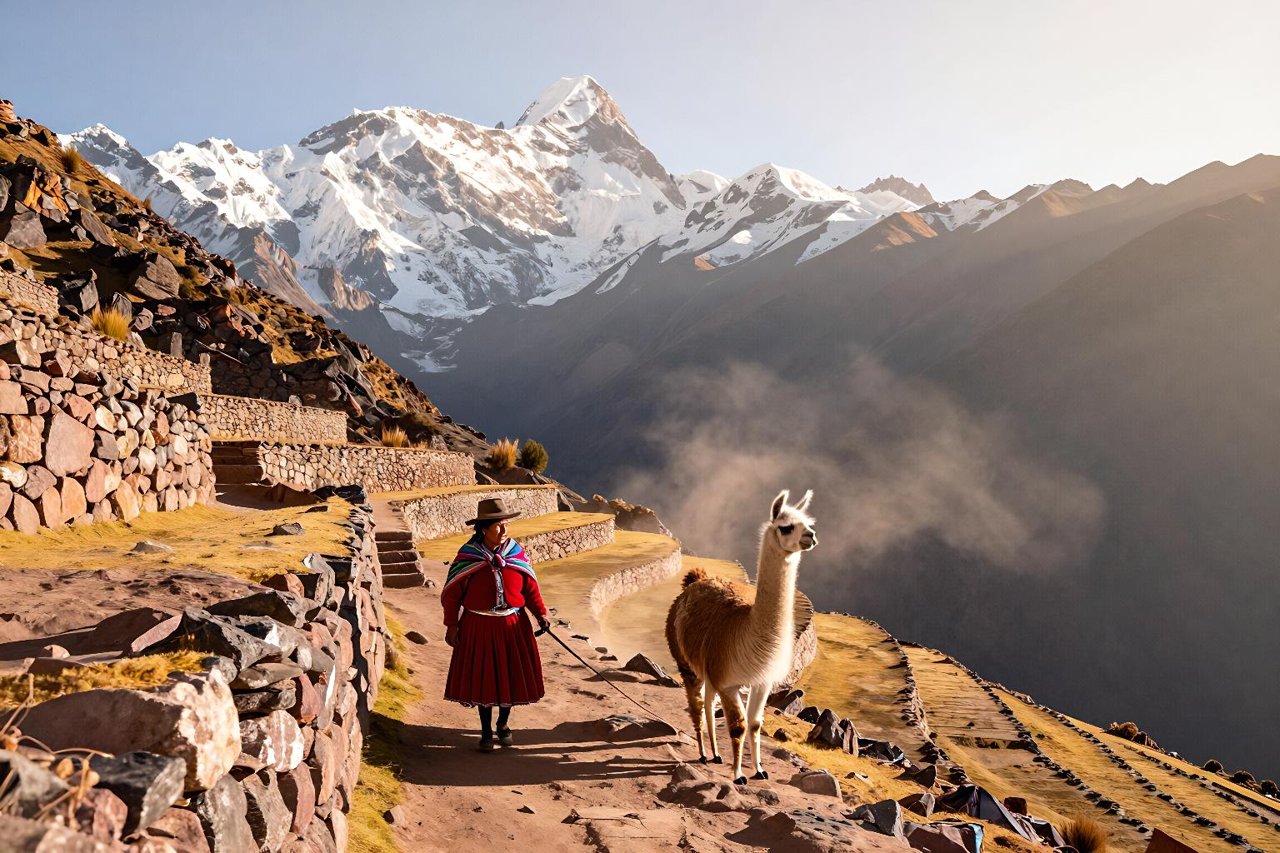
Roughly 2,000 waystations, or tambos, sat along the routes, offering shelter and supplies to officials and armies. Llamas carried loads of around 25 to 30 kilograms, because there were no pack horses, oxen or carts. Fresh fish from the Pacific could reach the highland capital in a day or two on the backs of runners, which is a fairly astonishing logistics story for a society with no written ledger to check it against.
Farming at 4,000 Metres
The Andes is a brutal place to grow food: thin air, hard frost, steep slopes, unpredictable rain. The Inca answered with engineering. Terraces called andenes turned mountainsides into staircases of soil, held up by stone retaining walls with drainage layers underneath. At Moray, near Cusco, a set of sunken concentric terraces drops 30 metres and creates temperature differences between levels, probably used for testing crops.
They cultivated thousands of potato varieties, along with oca, olluco and quinoa. Maize grew in the warmer valleys, and coca was grown on the eastern slopes. Potatoes too bitter to eat fresh were trodden into pulp, frozen overnight and dried in the sun to make chuño, which keeps for years and weighs almost nothing. Irrigation canals still function in places like Ollantaytambo. Llamas and alpacas provided wool and meat, while the wild vicuña’s fleece was so fine that clothing made from it was reserved for royalty.
Sun Gods, Mountains and Sacred Stones
The state religion centred on Inti, the sun, and the Coricancha temple in Cusco was reportedly sheathed in gold. The June solstice festival, Inti Raymi, marked the turning of the year and has been revived in Cusco as a major public event.
Religion was not confined to temples. Mountains, springs, caves and unusual stones were huacas, living sacred places, and pilgrimage routes threaded them together across the landscape. Rulers used ritual to legitimise conquest, a pattern with deep Andean roots: centuries earlier, hallucinogenic rituals helped solidify social castes in pre-Incan Peru, binding political rank to access to the supernatural. The Inca scaled that idea up, occasionally in grim form: the capacocha ceremony left sacrificed children on summits above 6,000 metres, preserved by cold and dry air.
An Empire Without Writing
This is the part that unsettles modern assumptions. The Inca had no script, no alphabet, no cuneiform tablets. Instead, officials called quipucamayocs used quipu: cords of cotton or camelid wool, hung from a main rope, with knots tied at different positions and heights. Position indicated place value in a base-ten system, so a quipu could record a census, a tribute quota, a harvest, or a storehouse inventory.
Some researchers argue the cords also encoded narratives, and colonial documents suggest quipu were used to recite histories and laws. Spanish officials destroyed huge numbers of them, so the code has been partly lost. It is worth remembering that writing itself was invented elsewhere for exactly this administrative purpose, as the first cities and written records of ancient Mesopotamia show. The Inca simply found a different technology for the same job.
The Civil War and the Spanish Arrival
Huayna Capac died around 1527, almost certainly of smallpox or a similar epidemic that swept down from Central America before any Spaniard reached the Andes. The disease killed his heir too, and the succession collapsed into a five-year civil war between two of his sons, Huáscar in Cusco and Atahualpa in Quito. Tens of thousands died in battles the Spanish never fought.
Francisco Pizarro arrived in 1532 with 168 men, 62 of them on horseback. At Cajamarca on 16 November, Atahualpa walked into a plaza with a few thousand attendants and was seized in under half an hour. The ransom he offered, a room filled with gold and two with silver, was paid and he was executed anyway in 1533. Manco Inca led a serious revolt from 1536, besieging Cusco, and a rump Inca state survived at Vilcabamba until 1572.
Steel, horses and disease mattered enormously, and so did tens of thousands of indigenous allies who resented Inca rule. But the decisive vulnerability was political. The empire was built around one sacred figure. When that figure was captured, the system froze in place, unable to organise a resistance it had never needed to design. A decentralised set of squabbling chiefdoms could never have built Machu Picchu. Centralised power also made it easier to decapitate.
What the Inca Left Behind
Quechua is spoken today by an estimated eight to ten million people, and Quechua words have migrated into Spanish and English alike: coca, llama, jerky, puma, quinoa. Andean communities still practise ayni, reciprocal labour, and rebuild those grass bridges each June. Terraces and canals dug six centuries ago remain in use. The Qhapaq Ñan was declared a UNESCO World Heritage site in 2014.
Machu Picchu, built around 1450 for Pachacuti and abandoned within a century, was never found by the Spanish, which is why so much of it survived. Hiram Bingham reached the site in 1911 and took thousands of artefacts back to Yale; most were returned in 2011. Meanwhile, archaeology keeps denting the old picture: in 2023 a dense network of pre-Hispanic settlements was mapped in the Bolivian Amazon, and Lidar surveys have exposed whole engineered landscapes in the shadow of the Andes. The Inca Empire explained in textbooks rarely looks quite as tidy as the landscape the Inca actually built.


