
Table of Contents
The Renaissance explained in one sentence is a rebirth of classical learning that reshaped art, science, politics and the way Europeans saw themselves. It ran roughly from the 14th to the early 17th century, beginning in the wealthy city-states of northern Italy and spreading through trade routes, printed books, war and travel. It was not a single event with a starting gun. More like a slow change in mood, one that asked a dangerous question: if the ancient world had achieved so much, what could living people achieve now?
What Was the Renaissance?
The word means rebirth, and it referred to the recovery of Greek and Roman texts, buildings and ideas. Historians often point to Florence in the 1400s as the period’s engine room, though writers such as Petrarch were already hunting for lost Roman manuscripts in the 1300s. The term itself became popular much later, when 19th-century historians such as Jules Michelet and Jacob Burckhardt turned the period into a story about individualism and modernity.
That story is useful, but it needs a warning label. The Renaissance did not switch on like a light. Medieval Europe had universities, trade, sophisticated theology and beautiful art. What changed was the scale of cultural production, the intensity of interest in antiquity and the speed at which ideas could travel. A goldsmith in 1400 might never see a Roman statue. By 1550, a curious student could study printed diagrams of one.
Why Italy, and Why Florence?
Italy had money, ruins and rivalry. Its city-states, including Florence, Venice, Milan and Rome, competed for prestige. Wealthy families and civic guilds paid for buildings, paintings and manuscripts as a way of showing power and piety at the same time. The Medici bank gave Florence an extraordinary pool of capital. Cosimo de’ Medici spent much of it on libraries, churches and artists, and his descendants kept the habit.

Florence was also compact enough for ideas to collide. Brunelleschi’s dome for the cathedral, completed in 1436, solved an engineering problem that had defeated builders for decades. Donatello carved bronze figures with a new sense of weight and psychology. Botticelli painted mythological scenes for private patrons. A young Michelangelo could study antique sculpture and fresh frescoes within walking distance of each other. Competition helped. So did the city’s cloth trade, its banks and its endless political arguments.
Humanism Put People Back in the Frame
Humanism was not atheism. Most Renaissance humanists were devout Christians. They argued that studying classical literature, history and rhetoric made people better citizens and better servants of God. Petrarch’s obsession with Cicero and Virgil fed a wider educational programme: grammar, poetry, history, moral philosophy. Erasmus applied that sharp textual training to the Bible and the Church, which made him admired by some and deeply inconvenient to others.
This shift did not erase faith or mystery. It made human agency a serious subject. Pico della Mirandola wrote about human dignity and the freedom to shape oneself. Machiavelli looked at politics without pretending that princes were saints. Questions about the soul, perception and human agency were not settled then, and they still provoke debate; modern arguments about a consciousness field at the foundation of reality are a distant cousin of those older arguments about mind and matter.
Art That Changed How We See
Linear perspective is the Renaissance’s most visible technical break. Brunelleschi’s experiments with geometry helped painters create a convincing illusion of depth. Masaccio’s Holy Trinity in Santa Maria Novella, painted around 1427, used a vanishing point so precisely that viewers felt they were looking into a chapel rather than at a wall. Once that trick was understood, it spread through workshops like a trade secret.
Anatomy came next. Leonardo da Vinci dissected corpses to understand muscles and tendons. Michelangelo treated the human body as a structure to be understood from the inside out. Raphael combined grace with clear composition. Oil paint allowed slow blending, glazing and rich shadows; chiaroscuro pushed light and dark into dramatic contrast; Leonardo’s sfumato softened edges until forms seemed to breathe. These were not isolated genius moves. They were workshop methods, taught, copied and improved.
The workshop was the engine
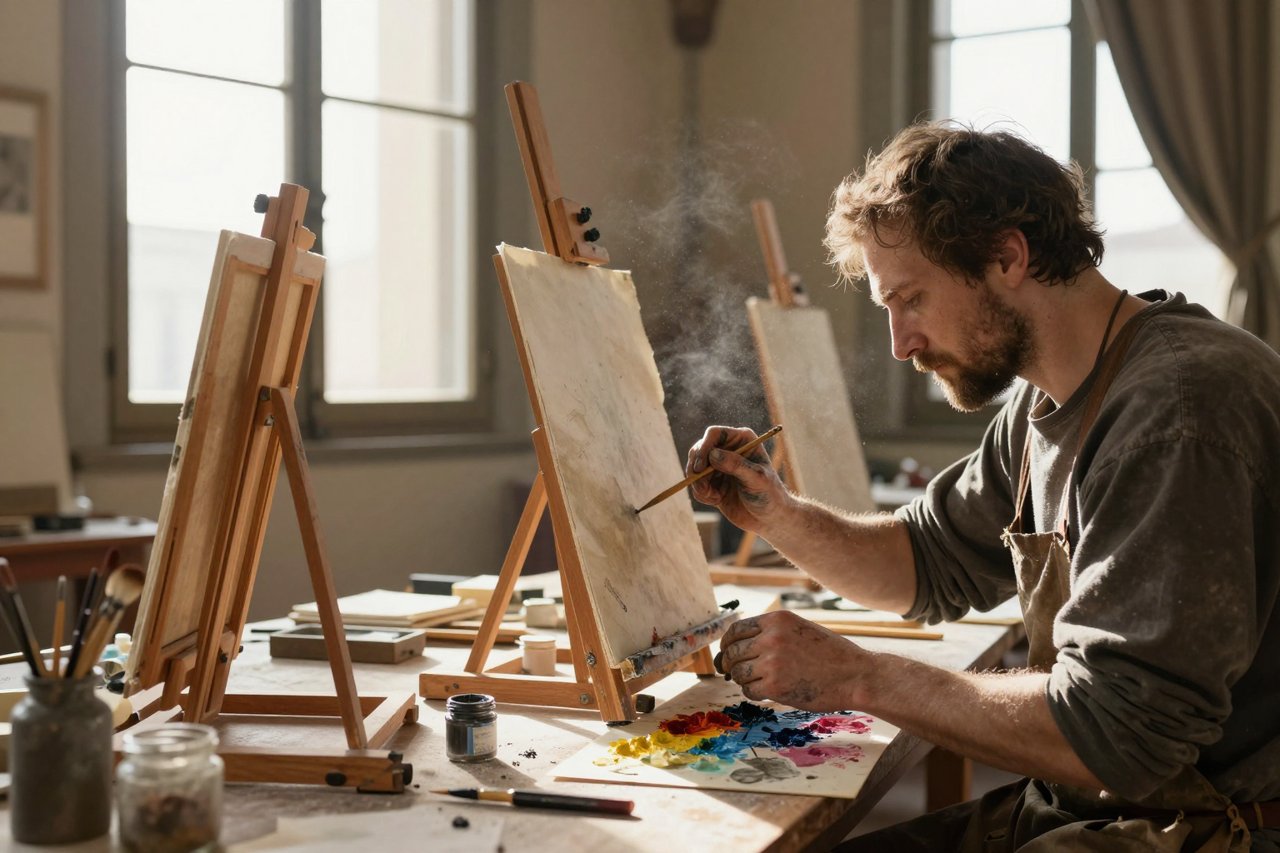
Most artists trained as apprentices, grinding pigments, preparing panels and copying their master’s work. Guild rules governed materials and contracts. A major fresco or altarpiece was a team job. The lone genius image came later. The reality was closer to a small business with demanding clients, tight deadlines and fierce local reputation at stake.
That technical ambition never really disappeared. Modern animation still uses perspective, staging and light to make flat images feel alive, even when the tools are digital rather than egg tempera and plaster.
Printing, Reformation and a Faster Conversation
Johannes Gutenberg’s movable type changed the pace of everything. His Bible appeared around 1455. By 1500, printing presses operated in more than 250 European towns, and millions of books had been printed. Pamphlets made arguments portable. Vernacular translations put scripture and controversy into the hands of readers who had never studied Latin.
Martin Luther’s challenge to the Church in 1517 turned print into a political weapon. The Reformation split Europe, triggered wars and forced both sides to define their beliefs more sharply. The Renaissance and the Reformation overlapped, sometimes uneasily. Northern artists such as Jan van Eyck and Albrecht Dürer brought their own meticulous realism and printmaking genius to the same wider conversation.
Science, Anatomy and the Habit of Questioning
Copernicus published On the Revolutions of the Heavenly Spheres in 1543, the same year Vesalius published his anatomical masterpiece De humani corporis fabrica. Both books relied on careful observation and challenged received authority. Galileo’s telescope observations in 1609 made the argument harder to ignore. This was not a clean march from religion to science. Church patronage funded much research, and censorship could be brutal. Giordano Bruno was burned at the stake in 1600. The period produced bold inquiry and deep resistance in the same breath.
Everyday Life, Fashion and Beauty
Renaissance life was not all frescoes and philosophy. Cities smelled, epidemics returned, and sumptuary laws told people what they could wear according to rank. Clothing carried status in sleeves, ruffs, velvet and expensive dyes. Women faced tight social constraints even when they commanded courts or patronised artists. Beauty ideals favoured pale skin, high foreheads and blond hair, partly because they signalled leisure and wealth.
The visual language of the period still gets recycled. Runway collections continue to borrow Renaissance silhouettes and turn them into modern resort wear. The pursuit of a flawless finish has not disappeared either; it has simply moved into cosmetics, including setting sprays that keep sweat and shine in check.
Common Misconceptions About the Renaissance
- It was a clean break from the Middle Ages. Medieval scholars, builders and artists did much of the groundwork. The Renaissance accelerated existing trends as much as it invented new ones.
- It was only Italian. The Italian city-states were central, but the Northern Renaissance produced Van Eyck, Dürer, Holbein and Erasmus, and its own distinctive achievements.
- It was purely secular. Popes, cardinals and religious confraternities were among the biggest patrons. Biblical subjects dominated public art.
- Artists were solitary rebels. Most worked inside guilds, workshops and patronage networks. Collaboration was normal, not a compromise.
What the Renaissance Still Asks of Us
The Renaissance remains useful because it shows how quickly a society can change when new information meets old money, ambitious artists and people willing to disagree. It also exposes the cost of that change: censorship, war, inequality and the exclusion of most women from public intellectual life. The period is not a museum room of perfect geniuses. It is a messy argument about what counts as knowledge, who gets to make it and what we do with it. That argument is still running.


