
Table of Contents
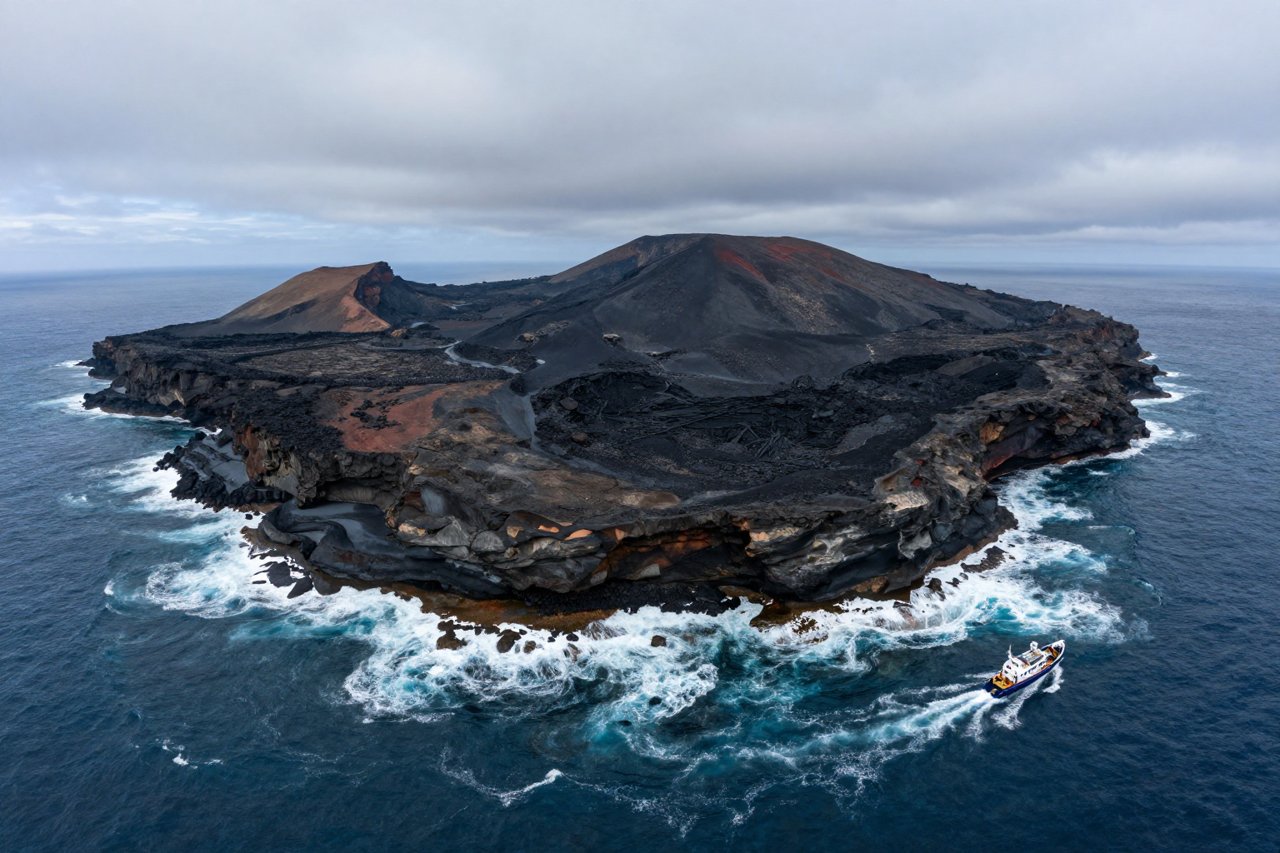
The sea off Iceland’s south coast began to boil on 14 November 1963. A trawler crew fishing nearby smelled sulphur, watched black ash climb nine kilometres into the sky, and saw an island that had not existed the day before force its way out of the Atlantic. Four years later it was 2.7 square kilometres of fresh rock. Erosion has since chewed it back to about 1.4.
That is one kind of island secret: geology happening in real time, on a patch of land almost nobody is allowed to step on. The others are stranger. A Japanese mining town that emptied in a single year. A Scottish island that stayed poisonous for nearly half a century. A bug the size of a cigar that came back from extinction on a rock spire in the Tasman Sea.
Here are the top 7 islands with fascinating secrets, plus what it genuinely takes to get near them.
1. Surtsey, Iceland: an island with a birth certificate
Surtsey is one of the few places on Earth whose age is known to the day. The fissure opened on 14 November 1963 and kept erupting until June 1967, stacking up 2.7 square kilometres of tephra and lava and a peak of 174 metres. By the end of any year you can look up exactly how much of it the sea has taken back.

A controlled laboratory
Access is restricted to a small number of researchers with permits from Iceland’s environment agency. This is not modesty. Surtsey is a live experiment in how life colonises bare rock, and every seed that lands is a data point. Sea rocket and sea sandwort appeared within a few years. Nesting gulls arrived much later, and their droppings did what volcanic ash cannot: they fertilised the ground. Today there are around 70 species of vascular plant, plus mosses, lichens and more than a hundred recorded bird species.
UNESCO listed the island in 2008. When scientists dig a soil sample there, they are reading the first paragraphs of a book that started 60 years ago.
2. Hashima, Japan: the island abandoned overnight
Hashima sits 15 kilometres off Nagasaki and looks, from a boat, like a warship. It earned the nickname Gunkanjima, Battleship Island, because of its silhouette. Between 1890 and 1974 it was also a working coal town, and at its peak in 1959 it packed 5,259 people onto 6.3 hectares. That made it one of the densest settlements anywhere on the planet.
Under the sea floor ran the seams: tunnels that reached a kilometre out beneath the water. Above it were concrete apartment blocks nine storeys high, a school, a cinema, a temple, a pachinko parlour. Children were born, played and buried there.
What the tour doesn’t show
- Mitsubishi closed the mine in January 1974, with only a few months of notice to the families.
- Koreans and Chinese civilians were conscripted to work here during the 1930s and 1940s, a controversy that surfaced sharply when Japan nominated the site for UNESCO listing in 2015.
- Visitors since 2009 walk a fixed boardwalk on part of the island. The rest of the towers are slowly falling into the interiors, and nobody is allowed in.
3. Gruinard, Scotland: 48 years of anthrax
Gruinard is a grey, lumpy little island in a quiet Highland bay. In 1942 government scientists chose it as the test site for anthrax bombs, and eighty sheep were tethered down for the experiment. The spores took. They stayed for four decades, and nine years of spraying with 280 tonnes of formaldehyde diluted in seawater finally cleared the ground in 1990.
The secret broke in 1981, when a group calling itself Operation Dark Harvest left soil from the island at a research lab and demanded the place be cleaned up. The British biological warfare programme had planned a much larger attack in 1944, which was never ordered. The operation was meant to drop anthrax linseed cakes over German farmland. Gruinard is how the plan worked out on a small scale: just a small, empty pasture that nobody could touch.
4. Ball’s Pyramid, Australia: a 562-metre rock and one bush
Ball’s Pyramid is a 562-metre sea stack rising straight out of the Pacific, 23 kilometres from Lord Howe Island. Climbing it was banned for decades; fishing around it is tightly controlled. The reason is one of the strangest survival stories in conservation.
The insect that refused to stay extinct
Lord Howe Island’s own stick insect, dubbed the tree lobster, was wiped out by rats that swam ashore from a wrecked ship in 1918. It was declared extinct in the 1930s. Then, in 2001, climbers on Ball’s Pyramid looked up at a single shrub and found 24 living ones clinging to it. That bug was the entire world population.
Four of them were brought down, and a pair, nicknamed Adam and Eve, went to Melbourne Zoo in 2003. The colony bred into the thousands. Return trips to Lord Howe are planned once rat eradication is complete, so keep an eye on the island. A creature presumed dead for 80 years is waiting to move back into its home.
5. Socotra, Yemen: an island drifting its own way
Socotra has been separated from mainland Arabia for 18 million years, and it shows. About 37% of its plant species live nowhere else on Earth, and the same is true of over 90% of its reptiles. The dragon’s blood trees do most of the work: fat trunks, flat canopy, and scarlet resin used in varnish and medicine for centuries.
They are also in trouble. Two intense cyclones in 2015, Chapala and Megh, tore through the cloud forests in the same week, and the seedlings struggle to establish on land now grazed by goats. Between the civil war in Yemen and a narrow, intermittent flight link from Cairo and the Gulf, visiting is not a simple booking. Anyone who does reach the island travels with a licensed local operator and a research permit.
6. Poveglia, Italy: the island Venice won’t sell
Poveglia sits in the Venetian lagoon, 18 acres of brick and weeds. A fortified octagon was built here in the fourteenth century. From 1793 the island served as a quarantine station for ships suspected of carrying plague, and the stories of what happened behind those walls have been repeated so often that even the exaggerations now have footnotes.
An asylum opened on the site in 1922 and closed in 1968. Since then Poveglia has been closed to the public and visible only from passing boats. Italy’s state property agency tried to auction a 99-year lease in 2014 and found no credible bidders, which is a polite way of saying nobody wanted it. The island stays silent, within sight of the tourist ferries.
7. Tristan da Cunha: the most isolated community on Earth
Tristan da Cunha is 2,434 kilometres from the island of St Helena and about 2,800 from Cape Town. The capital is Edinburgh of the Seven Seas, home to roughly 240 people descended from a handful of nineteenth-century settlers: eight surnames cover almost everyone, including Glass, Repetto and Swain. There is no airport and no airstrip. The only way in is a six or seven-day crossing by fishing vessel or research ship, and there is no running schedule.
When the volcano woke up
In 1961, when the settlement was barely 15 years into its new post-war life, the volcano behind the village cracked open. All residents were evacuated to England, landing in Southampton in the middle of a cold autumn. Most hated it. The majority voted to go home in 1963 after the island was declared safe.
Life since has been quietly odd: an unusually high rate of asthma that researchers still argue about, a lobster industry that carries the economy, and a postal code, TDCU 1ZZ, affixed to all of it.
What it actually takes to reach a secret island
Most of these places are not vacations. They are logistics. If you are curious enough to try, do it the legitimate way.
- Take the licensed tour where one exists. Nagasaki runs daily boat trips to Hashima, weather permitting, and landing is limited to a short walkway.
- Stay on the water. Surtsey, Poveglia and Tristan are all viewable from a boat without ever breaking a rule.
- Go through science. Surtsey has no tourist access, but its research permits and published papers are open to anyone with a serious question.
- Respect biosecurity above all. Socotra and Lord Howe both enforce strict rules on seeds, soil and food, because one introduced rat or weed is all that a 18-million-year isolation took to unravel.
These islands keep their secrets because someone decided the secrecy was worth more than the ticket revenue. That is the part worth noticing, more than any ghost story. A rock in the North Atlantic is letting scientists watch life start from zero. A stack in the Tasman Sea is waiting to welcome an insect home. Some doors stay closed because what is behind them is still working.


