
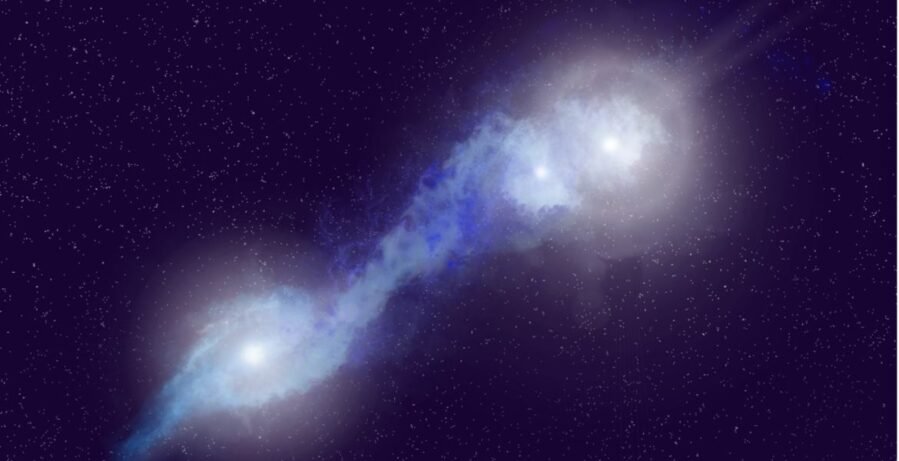
About 1.2 billion light-years away, three supermassive black holes are throwing a cosmic banquet. Astronomers have confirmed the first known triple system where all three galaxies host actively feeding black holes that blaze brightly in radio wavelengths, a discovery that captures an exceptionally rare moment in galactic evolution.
The system, cataloged as J1218/1219+1035, consists of three galaxies caught mid-collision with their central black holes separated by roughly 22,000 and 97,000 light-years. What makes this trio remarkable isn’t just their proximity but their synchronized activity. All three black holes are simultaneously devouring material and launching jets that light up radio telescopes, making this the first confirmed “triple radio AGN” system. Only two other triple active galactic nuclei have been verified anywhere in the nearby universe.
These colliding galaxies offer a direct window into how the universe’s largest structures grow. Galaxies like the Milky Way reach their size by repeatedly smashing into and absorbing smaller neighbors over billions of years. Theory predicted that such mergers should occasionally create temporary trios where multiple black holes activate at once, but actually catching three in the act has proven extraordinarily difficult.
Finding the Hidden Trio
The discovery began with an infrared anomaly. NASA’s Wide-field Infrared Survey Explorer flagged J1218/1219+1035 as suspicious, suggesting at least two obscured active galactic nuclei hiding in what appeared to be a pair of interacting galaxies. Follow-up optical observations confirmed one active black hole and found ambiguous signals in the others that could indicate either black hole activity, star formation, or shockwaves from the collision.
Only when researchers from the U.S. Naval Research Laboratory turned the Very Large Array’s radio dishes toward the system did the full picture emerge. Ultra-sharp imaging at frequencies of 3, 10, and 15 gigahertz revealed compact radio cores perfectly aligned with all three optical galaxies. The radio signatures matched the characteristic synchrotron emission from active galactic nuclei, including steep spectral slopes suggesting unresolved jet activity in at least one source.
“Triple active galaxies like this are incredibly rare, and catching one in the middle of a merger gives us a front-row seat to how massive galaxies and their black holes grow together,” Dr. Emma Schwartzman of the U.S. Naval Research Laboratory explains. “By observing that all three black holes in this system are radio-bright and actively launching jets, we’ve moved triple radio AGN from theory into reality and opened a new window into the life cycle of supermassive black holes.”
The Very Long Baseline Array provided additional constraints, setting brightness-temperature limits that ruled out star formation as the primary radio source. The tidal features stretching between the galaxies trace their gravitational dance, confirming this is a dynamically bound group destined to eventually merge into a single massive galaxy.
What Happens When Three Black Holes Meet
Galaxy collisions funnel gas toward galactic centers, feeding the resident supermassive black holes and triggering the intense radiation that defines active galactic nuclei. Catching three systems doing this simultaneously provides a unique laboratory for testing models of how these encounters ignite black hole growth. The team used the VLA in its highest-resolution configuration to isolate each galaxy’s radio core, while planned near-infrared and X-ray observations will map the tidal structures and probe each black hole’s high-energy output in greater detail.
With only three confirmed triple AGN systems now known, each discovery substantially expands astronomers’ understanding of how frequently multiple black holes interact before their host galaxies finish merging. The finding demonstrates that combining mid-infrared surveys with sensitive radio imaging can uncover complex systems that remain hidden or ambiguous at other wavelengths. Future surveys with facilities like the VLA and VLBA should reveal whether triple systems represent a common but overlooked phase of galaxy evolution or genuinely rare cosmic coincidences.
Eventually, the three black holes in J1218/1219+1035 will spiral toward each other as their galaxies complete their merger, potentially producing gravitational waves detectable by future space-based observatories. For now, they offer astronomers something equally valuable: a snapshot of hierarchical galaxy growth caught in the act, with all three participants actively shaping the final product.
If our reporting has informed or inspired you, please consider making a donation. Every contribution, no matter the size, empowers us to continue delivering accurate, engaging, and trustworthy science and medical news. Independent journalism requires time, effort, and resources—your support ensures we can keep uncovering the stories that matter most to you.
Join us in making knowledge accessible and impactful. Thank you for standing with us!